
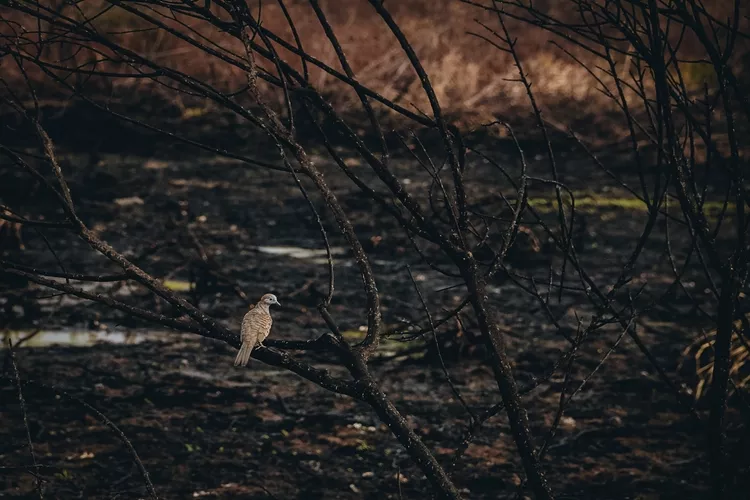
As wildfires become more frequent, their smoke is reducing bird diversity beyond the areas directly burned, according to a study conducted in North America
By
Severe wildfires are an increasingly global threat to life, driven by the dry conditions that climate change produces. Since 2025, more land has burned (81,355 hectares) than in the entire previous five years combined (57,244 hectares).
In Canada, wildfire season has been particularly active this year. More than 800 wildfires were burning across the country by mid-July, with large clusters in Ontario near the Minnesota border, according to the Canadian Interagency Forest Fire Centre (CIFFC).
Now, a new study has revealed how the smoke from wildfires in North America is a factor endangering bird populations and diversity. Led by environmental economist Sarah Meier at ETH Zurich, along with Eric Strobl from the University of Bern, the study examined the effects of wildfire smoke on bird populations in the US.
The researchers considered data from the North American Breeding Bird Survey, a long-term monitoring programme of bird populations that has been running since 1966. Trained volunteers document all the birds they see or hear, counting them along fixed routes; each route is around 40 kilometres long, with some stops along the way. Meier and Strobl analysed data from around 2,800 such routes in the US over a 15-year period, from 2008 to 2022, and combined it with high-resolution data on particulate matter pollution from wildfires.
Researchers also examined how evenly the birds were distributed among species and how these species differed from one another in evolutionary terms.

The study concluded that if smoke levels rose from an average year to one with more smoke, the number of species dipped by around three per cent. For example, if an average survey route had 55 species, this equates to roughly one to two fewer species on that route.
‘The effect isn’t huge, but it is measurable. And we never know which species will disappear and which of these are particularly important for an ecosystem. Therefore, even a small decline can, in the worst-case scenario, cause an ecosystem to become unbalanced.’
Wildfires directly destroy habitat, making it uninhabitable for birds to breed.
How did researchers discover this?
To determine whether smoke was really to blame for the decline of bird diversity, researchers considered other factors that could be at play, such as weather, land use and differences in how the bird counts were conducted, comparing each area over many years.
Meier and Strobl’s team examined two particularly obvious explanations before concluding that wildfire smoke was to blame. Firstly, the lower bird diversity could be a direct consequence of destroyed habitats. However, even on survey routes where no areas had burned within a five-kilometre radius, the effects of the smoke persisted. Secondly, birds might simply have moved to neighbouring areas to avoid the smoke. Even after the researchers had accounted for local shifts in their analysis, reduced avian diversity remained evident.
The study does not reveal exactly what happens to the birds. Other research suggests that smoke can weaken birds, possibly causing weight loss and respiratory damage. Their behaviour may also change during the breeding season.
How does avian decline affect the economy and ecosystems?
For Meier, the findings highlight a consequence of forest fires difficult to account for in traditional damage assessments. Bird biodiversity in North America is vital for maintaining healthy ecosystems, supporting agriculture through pest control and pollination, and serving as a critical indicator of environmental health.
Trends show that it is not just rare species endangered now – formerly common, abundant species in North America are slowly disappearing. Take the Red-winged Blackbird, for instance. At an estimated population of more than 170 million red-wings today, it is certainly a common bird. But just 50 years ago there were more than 260 million, meaning a third of the entire population has been lost in half a century.
Enjoying this article? Check out our related reads…
A decline in avian diversity undoubtedly has far-reaching impacts for animal and plant species, as well as sectors such as agriculture and forestry. This is because the greater the decline of common birds, the higher investments in pesticides will have to be. The natural defence they provide for crops against pests will gradually be lost.
Though the study intentionally does not quantify the extent of the economic damage caused by a decline in avian diversity, it is such damage an inevitable consequence of avian loss.
Meier wanted to focus, at least initially, on demonstrating individual impacts as reliably as possible. She said, ‘Theree other consequences of forest fires that we have barely taken into account to date, even though they have an impact on society.’
‘In the case of burned-out buildings, we can relatively easily quantify the cost of the damage. With biodiversity, things are far more complex.’


