A fast-moving measles outbreak has killed hundreds of children in Bangladesh and pushed hospitals beyond capacity
By Piyas Biswas in Dhaka
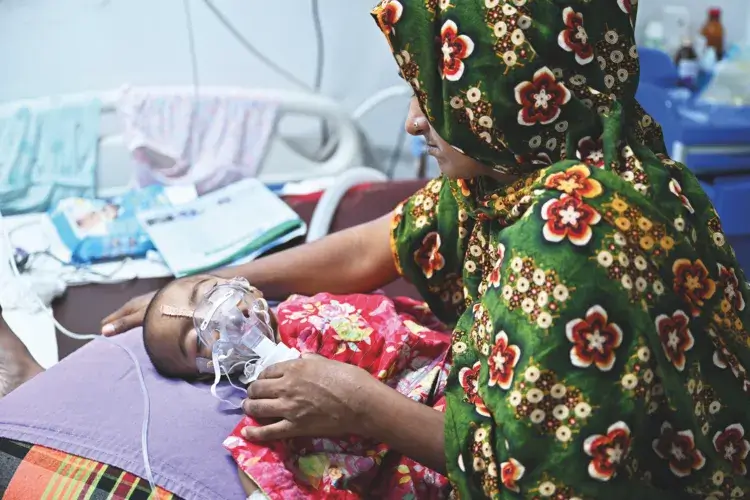
Seven-month-old twins Khadija and Fatema were among thousands of Bangladeshi children who fell ill as measles swept across the country earlier this year.
The sisters first developed fever, cough and cold symptoms in early April. Their family sought treatment at a hospital in Narayanganj, an industrial city on the outskirts of Dhaka. As their condition worsened, their parents rushed them to the capital, where they were moved between hospitals in search of specialised care. Both twins developed severe complications as a result of a measles infection. Their mother, Saima Begum, says the family struggled to find available beds and intensive care facilities as hospitals became overwhelmed by the growing outbreak. On 23 April, Fatema died while receiving treatment in a paediatric intensive care unit. ‘I never imagined Fatema would die,’ her mother recalls. ‘She was smiling and playing with toys in the hospital.’
Related reads…
The surviving twin, Khadija, continues to suffer from recurring fever, cough and rashes. To pay for treatment, the family sold jewellery and borrowed money, joining thousands of households pushed into financial hardship by a disease that modern medicine has long known how to prevent.
Their story reflects a national crisis that has turned Bangladesh’s hospitals into the frontline of one of the country’s worst measles outbreaks in years. According to Bangladesh’s Directorate General of Health Services (DGHS), 84,266 suspected measles cases were recorded nationwide between 15 March and 12 June 2026. Of these, 10,185 were laboratory-confirmed, while 68,934 patients were admitted to hospitals. Health authorities reported 551 suspected measles deaths and 92 deaths among confirmed measles cases, bringing the combined toll linked to the outbreak to 643 children.
Professor Zahid Raihan, additional director general of the DGHS, says transmission remains stubbornly persistent. ‘Currently, the number of identified cases remains at the same level, around 1,100 to 1,300 per day,’ he says. ‘Sometimes it drops below 1,000, but we are not yet seeing a significant decline.’
For epidemiologists, the outbreak is a stark reminder of how quickly measles can return when vaccination coverage falls. Measles is among the most contagious infectious diseases known. The virus spreads through the air via respiratory droplets and can remain active in the air or on contaminated surfaces after an infected person has left a room. In communities with insufficient immunity, a single case can rapidly trigger widespread transmission.
Although highly effective vaccines have existed for decades, measles continues to kill tens of thousands of people globally each year. In 2024, the World Health Organization (WHO) estimated that 95,000 people died from measles, most of them unvaccinated or under-vaccinated children under the age of five.
Bangladesh was once regarded as a model for childhood immunisation in South Asia, with its Expanded Programme on Immunisation (EPI) widely recognised for dramatically improving vaccine coverage and reducing child mortality over several decades. Through the EPI, vaccination coverage increased dramatically over the past four decades, helping to reduce childhood mortality and bringing the country closer to measles elimination.
Health experts say the current outbreak emerged after routine immunisation systems experienced significant disruptions in recent years. According to health officials, measles vaccination campaigns planned for 2024 weren’t implemented, while procurement difficulties and vaccine shortages affected routine immunisation during 2025. The interruption created gaps in immunity among children who missed scheduled vaccinations.
Professor Raihan notes that supplementary vaccination campaigns play a critical role in reaching children who fall outside routine services.
‘If around 12 per cent of children remain outside vaccination coverage, herd immunity cannot be maintained,’ he explains. ‘When herd immunity is lost, measles outbreaks become possible.’
The WHO has similarly linked the outbreak to declining population immunity, vaccine supplies and the absence of nationwide supplementary measles campaigns in recent years. For a disease that requires vaccination coverage of about 95 per cent to prevent sustained transmission, even relatively small declines can have major consequences.
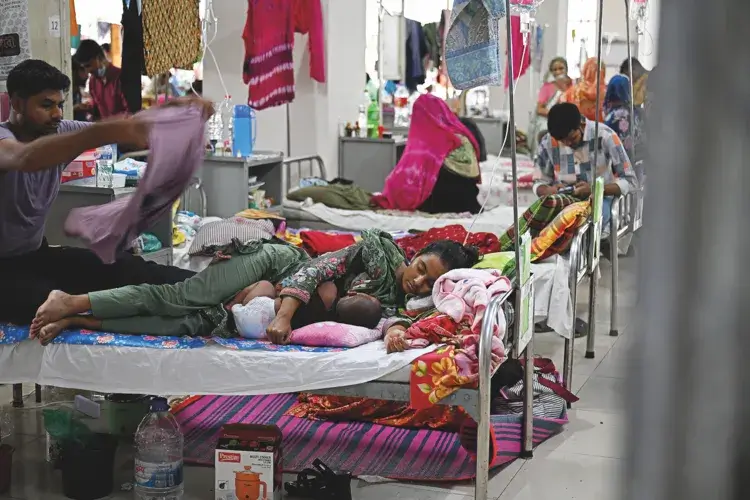
The impact of the outbreak is most visible inside Bangladesh’s hospitals. At the Infectious Diseases Hospital in Dhaka, doctors and nurses face a constant influx of children suffering from measles and its complications.
‘My hospital has only 100 beds, and almost every day we are getting more than 100 patients,’ says FA Asma Khan, superintendent of the hospital.
Not every patient has measles, she explains, but many arrive with infections or complications linked to the disease.
Across the capital, healthcare workers describe overcrowded wards, shortages of beds and growing demand for oxygen support and intensive care. Families often travel hundreds of kilometres seeking treatment. Some are turned away by multiple hospitals before finding available space.
In Narayanganj, Mohammad Nure-Alam spends his days beside his six-year-old daughter Taski, who developed severe respiratory complications after contracting measles. ‘I’ve been in the hospital for four days,’ he says. ‘My younger daughter is still recovering at home while my elder daughter struggles to breathe.’
Many children arrive with pneumonia, dehydration and severe respiratory distress – conditions that can become life-threatening, particularly among malnourished children. The virus weakens the immune system, increasing vulnerability to secondary infections. Children may develop pneumonia, encephalitis, blindness or long-term disability. In severe cases, the disease can be fatal. The risks are particularly high among children who are malnourished.

Bangladesh has made substantial progress in reducing childhood malnutrition, yet undernutrition remains a major challenge. Health workers report that many of the children requiring hospitalisation during the outbreak were already vulnerable before becoming infected. This combination of measles and malnutrition has contributed to the severity of the crisis.
In response to the outbreak, Bangladesh launched an emergency measles-rubella vaccination campaign with support from international partners, including WHO, UNICEF and Gavi. The campaign began on 5 April in high-risk areas before expanding nationally later that month. Millions of children have since been vaccinated, while hospitals have expanded isolation facilities and increased the distribution of vitamin A supplements, which can reduce the risk of severe complications.
Public health experts believe that these measures will eventually slow transmission. Professor Raihan says that once the campaign is fully completed, authorities expect the country to be ‘partially protected from this risk’.
Yet they also warn that emergency campaigns alone can’t replace strong routine immunisation systems. Unless Bangladesh restores a reliable vaccine supply, strengthens surveillance measures and reaches children that have been missed by routine services, the country could remain vulnerable to future outbreaks of a disease that it had once brought under control.