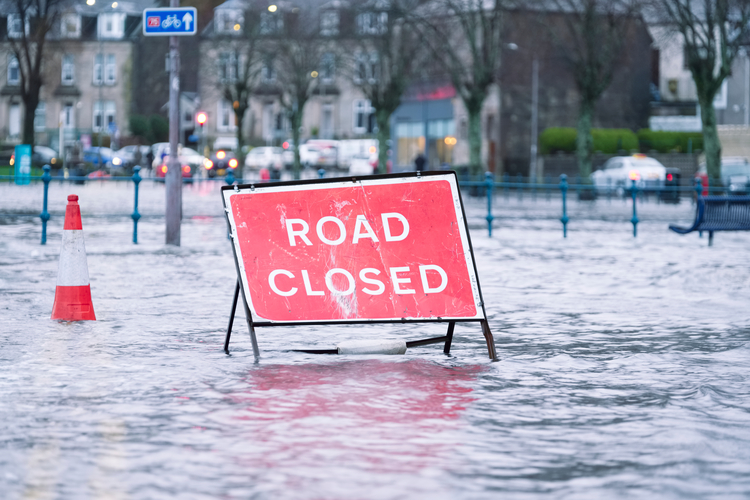
‘Reasonable worst-case scenario’ modelled by scientists would see sea level rise of more than 15 metres across the UK by 2300
By
Around 1.4 million more people in the UK are set to be affected by coastal flooding by the turn of the next century – even if current global carbon emission pledges are met – according to a study led by the Met Office and the University of Bristol. This figure rises to 1.7 million by 2300.
The study – published in Nature Communications – marks the first time scientists have quantified the scale of the UK population under threat from coastal flooding under future sea-level rise projections.
Enjoying this article? Check out our related reads…
‘The findings highlight the importance of global action on emissions – as set out in the Paris Climate Agreement – to de-risk future sea level rise and the need to adapt to unavoidable sea-level rise in the coming decades,’ said lead author Professor Matt Palmer.
The research showed sea levels are set to rise between 0.4 and 0.6 metres across UK coastlines by 2100, resulting in a 13 per cent increase in areas classified as at risk of coastal flooding. By 2300, these levels will rise to between 1.2 and 1.8 metres, with areas prone to coastal flood risk growing by more than half (56 per cent).

Particular areas of the UK will be hit by coastal sea rise more than others. ‘As you would expect, the low-lying areas will be hit hardest by sea-level rise,’ said study co-author Dr James Savage. ‘The Wash and the Humber Estuary stand out as ‘hot spots’ for future coastal flood risk across all scenarios.’
Scientists also considered a ‘reasonable worst-case scenario’ for sea level rise, which would see more than 15 metres of sea level rise across the UK by 2300. Such increases would pose extensive flood risks to the M25 motorway and the financial district of London, with large areas of west and north London under one metre of water during a severe coastal flood event. In this worst-case scenario, an additional 13 million people could be exposed to a 1-in-200-year undefended flood event.
‘The worst-case sea-level rise outcomes would pose massive challenges for the UK in the coming centuries and the need for large-scale movement of populations and settlements away from the coast,’ said study co-author Professor Jeffrey Neal.
‘But there is also huge potential to avoid these outcomes by pursuing concerted global efforts to reduce greenhouse gas emissions, in line with the Paris Agreement goals.’
Earlier this month, researchers at Climate Central created an interactive map to show how parts of UK villages and towns could be submerged underwater due to rising sea levels.
In the map, much of North Somerset could flood by 2050. North Somerset Council has said it is developing a long-term investment plan to identify where future upgrades to its flood management systems should occur.
Ultimately, though, tackling sea level rise comes from curbing pollution on our planet.