
• Skip to main content
  • Skip to secondary menu
  • Skip to primary sidebar
  • Skip to footer
Geographical

Geographical

Official magazine of the Royal Geographical Society (with IBG)

  • Home
  • Briefing
  • Science & Environment
  • Climate
    • Climatewatch
  • Wildlife
  • Culture
  • Geopolitics
    • Geopolitical hotspots
  • Study Geography
    • University directory
    • Masters courses
    • Course guides
      • Climate change
      • Environmental science
      • Human geography
      • Physical geography
    • University pages
      • Aberystwyth University
      • Brunel University
      • Cardiff University
      • University of Chester
      • Edge Hill University
      • The University of Edinburgh
      • Newcastle University
      • Nottingham Trent University
      • Oxford Brookes University
      • The University of Plymouth
      • Queen Mary University of London
    • Geography careers
      • Charity/non-profit
      • Education & research
      • Environment
      • Finance & consulting
      • Government and Local Government
    • Applications and advice
  • Quizzes
  • Magazine
    • Issue previews
    • Subscribe
    • Manage My Subscription
    • Special Editions
    • Podcasts
    • Geographical Archive
    • Book reviews
    • Crosswords
    • Advertise with us
  • Subscribe
    • Direct Debit Changes

Arctic lichen are bleaching due to climate change, study finds

19 May 2026
3 minutes

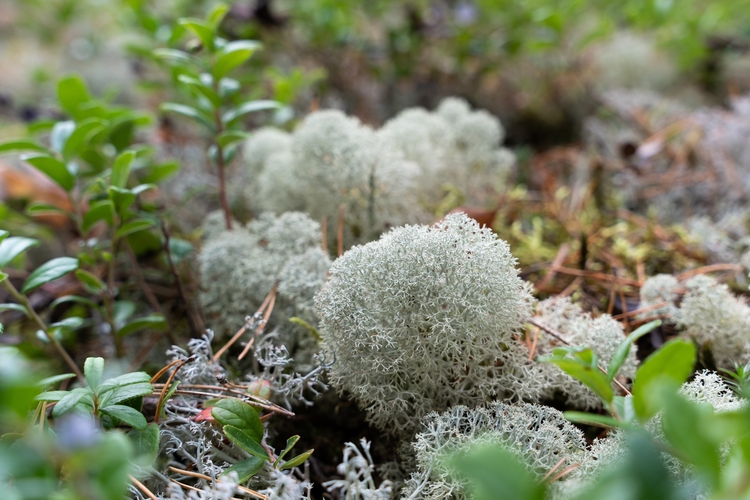
Arctic lichen
Arctic lichen plays a vital role in the world’s carbon dioxide storage. Image: Shutterstock

A study has found that warming global temperatures are causing irreversible bleaching in certain Arctic lichen species, posing a threat to carbon storage and the Arctic food chain


By Khadeejah Masud

A new study, conducted by researchers from the University of Edinburgh and the British Antarctic Survey, has revealed that climate change is bleaching a lichen species that grows exclusively in circumpolar Arctic and subarctic regions.

The planet’s average surface temperature has risen about one degree since the late 19th century – and though it may seem an inconsiderable amount to the average person, this has caused a significant change in our biosphere. 

Lichens are symbiotic organisms, a fusion between fungi and algae. The lichen at risk of permanent bleaching is known as Cetrariella delisei — responsible for its vital role in the world’s carbon dioxide storage, despite being so small and sparse. 


Enjoying this article? Check out our related reads…

  • ‘Catastrophic’ mass bleaching event hit Great Barrier Reef in 2024, study finds
  • The rightful return of beavers to Britain
  • Climate extremes triggered rare coral disease and mass mortality on the Great Barrier Reef
  • Geo explainer: The threats to coral reefs
  • Great Barrier Reef’s coral cover has sharply declined, new study finds

Rising temperatures are linked to destructive ecological impacts, posing a silent threat to fragile ecosystems. The tundra encompasses approximately 10-20 per cent of Earth’s land surface, and it is responsible for storing 1.4 to 1.6 trillion metric tons of carbon in its permafrost soils – roughly double the amount of carbon currently in the Earth’s atmosphere. 

The study was conducted in the Arctic archipelago of Svalbard, one of the fastest-warming regions on Earth, where temperatures are rising up to seven times faster than the global average. 

OTC experiment with microclimate loggers. From “Lichen bleaching as a response to long-term experimental warming in the High Arctic” by Šubrt, J (2026).
The experiment used microclimate loggers, pictured above. Image: Šubrt, J, University of Edinburgh

Researchers investigated how lichens responded to sustained temperature increases over nine years, using plexiglass enclosures to simulate warmer conditions. They monitored whether the lichens underwent bleaching, finding a visible loss of the algal symbiont and colour change linked to declining health and reduced photosynthetic activity.

A breakdown of symbiotic relationships through climate-driven bleaching is also well known in corals, where rising ocean temperatures cause corals to lose the algae they depend on to survive. As recently as 2025, the Great Barrier Reef experienced its sixth mass bleaching since 2016. Coral bleaching occurs for the same reason as lichen bleaching; it is a stress response that expels algae, which provides the vibrant colour that give the coral 90 per cent of its energy. This significantly reduces the quality of marine biodiversity. 

The findings suggest that this response may be driven by gradual, long-term increases in temperature, rather than short-term extreme weather events — even though certain coral bleaching cases have been linked to extreme events such as La Niña. 

The future resilience of Arctic tundra ecosystems is precarious, as the Arctic is warming faster than the global average. Even small temperature increases can accumulate and push species beyond their limits.

Lichens are also a vital part of the Arctic food chain – large mammals such as reindeer and oxen, as well as small insects like mites, are reliant on this food source. Lichen loss not only affects soil stability but also the very nutrient cycling itself, including the availability of forage for herbivores to consume 

Lead author from the School of Geosciences at the University of Edinburgh, Jiříl Šubrt, said: ‘Our findings underline the importance of long-term ecological monitoring.’ His ultimate takeaway was that ‘lichens can take some time to respond to changes in temperature. The visible damaging changes illustrate that organisms that are thought to be resilient might be endangered.’ 
Themes Briefing Arctic

Protected by Copyscape

Primary Sidebar

SPRING SALE

GEOGRAPHICAL WEEKLY LOGO FREE - Sign up to get context, clarity and perspective in a noisy world, every Friday

Popular Now

Algerian Sahara

A journey back to the Algerian Sahara

Wildfires aerial

2025 wildfires were the costliest and most damaging on record, new research…

The growing number of losers in the Iran War and the few…

The growing number of losers in the Iran War and the few…

QUIZ: Flags of the World – Asia

QUIZ: Flags of the World – Asia

QUIZ: Country Shapes – Easy

QUIZ: Country Shapes – Easy

Footer

  • Facebook
  • Instagram
  • LinkedIn
  • Reddit
  • TikTok
  • Twitter
  • YouTube

Geographical print magazine cover

Published in the UK since 1935, Geographical is the official magazine of the Royal Geographical Society (with IBG).

Informative, authoritative and educational, this site’s content covers a wide range of subject areas, including geography, culture, wildlife and exploration, illustrated with superb photography.

Click Here for SUBSCRIPTION details

Want to access Geographical on your tablet or smartphone? Press the Apple, Android or PC/Mac image below to download the app for your device

Footer Apple Footer Android Footer Mac-PC

More from Geographical

  • Subscriptions
  • Get our Newsletter
  • About Us
  • Contact Us
  • Advertise with us
  • Privacy policy
  • Terms & Conditions

Copyright © 2026 · Site by Syon Media