Doug Specht examines how a border crisis in Ceuta quickly became a political spectacle before anyone checked the facts

Over two days at the end of July, news outlets across Europe reported that tens of thousands of people had swam around the harbour breakwater at Tarajal or scaled the fence into Ceuta, a Spanish enclave stranded on the North African coast. It was the largest crossing there since May 2021. Spain sent in troops. Dozens of people died in the water, though no government ever agreed on exactly how many. Within days, though, the great majority had gone back to Morocco.
Italy suspended Schengen. Twenty-two governments demanded emergency talks. Politicians on both sides of the Atlantic called it an invasion. What’s left, weeks later, is a case study in how fast a manufactured crisis can outrun the facts, and how little anyone cared once the facts caught up.
The numbers were never the point
Spanish authorities said close to 49,000 crossed in 24 hours. Moroccan officials said 40,000, total. International outlets split the difference and printed ‘60,000’ as though consensus were the same thing as accuracy. The death toll climbed from 18 to 67 in Spain’s own revised counting, while Morocco stopped at 11 and admitted its figure only covered bodies recovered on its side of the water.
Enjoying this article? Check out our related reads…
These seemingly confused numbers are themselves the story. Every actor here had a reason to inflate, deflate, or simply repeat whatever number served them, and almost none of the coverage said so out loud. A number stated with confidence and no source is not information. It’s a political tool dressed as a fact.
The same dishonesty runs through how the people themselves were described. Day one, they were ‘young men’, a phrase built to signal threat. Within a week, they were ‘unaccompanied minors’, a phrase built to extract sympathy. These were, to a significant degree, the same teenagers.
Spain’s own figures show over 860 minors still in Ceuta’s care a week on, and minors on this route are overwhelmingly teenage boys. The switch from menace to victim wasn’t a correction. It was a redeployment of the same bodies for a different argument, and both versions were doing political work rather than describing anyone accurately.
The frenzy ran on a border nobody could locate
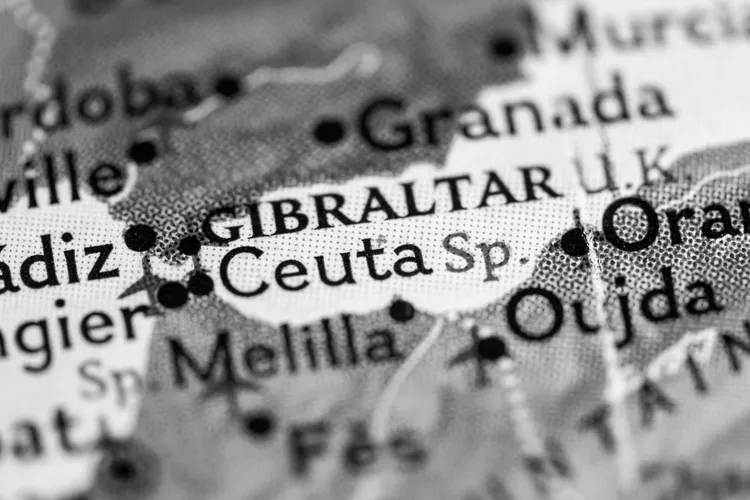
Here is what actually enabled the panic: almost nobody arguing about Ceuta could place it on a map. Ceuta is Spanish, it’s in the EU, and it is outside Schengen and outside the customs union, sitting on the North African coast with no legal route to the Spanish mainland for anyone crossing irregularly.
Whatever happened at the Tarajal breakwater never touched Schengen territory. Meloni suspended an agreement that the event, by definition, could not have violated. That wasn’t a mistake born of urgency. It was a decision made because the geography was inconvenient to the story she wanted to tell, and few were going to correct her.
A Facebook video calling this ‘migrants breaking into Spain through the southern border’ was shared over 111,000 times. It got the country wrong. That a claim this basic could travel that far says less about misinformation as a technical problem and more about how little the audience for this story was ever expected to know, or check.
Manufactured, then weaponised
Trace the actual mechanics and the ‘spontaneous crisis’ framing collapses fast. The trigger was a narrow Spanish court ruling on maritime pushbacks, real and specific, which online rumour flattened into ‘the border is open’. One report claims that rumour was pushed deliberately, across platforms, to 11 million impressions, with logistics content on wetsuits and unpatrolled beaches attached. Treat that report as what it is: intelligence-adjacent, and useful to governments that want to describe migrants as instruments rather than agents. But the amplification that followed it is not in dispute.
Meloni suspended Schengen. Trump blamed Spain’s ‘weak law, bad management’. Vox called it an invasion, in language lifted almost verbatim from Spanish coverage of the 2021 crossing, where researchers already documented the same avalanche and flood metaphors doing the same work. This is not a media class discovering a new crisis. It’s a media and political apparatus rerunning a script it wrote five years ago, because the script works.
Underneath that ran outright fabrication: claims that the arrivals were prisoners released for the king’s coronation, conspiracy theories blaming Israel. Nobody had to believe these for them to do damage. They only had to circulate faster than any correction. Meanwhile Frontex, the cross–European border agency, said it was too early to know anything. That statement was accurate, unglamorous, and almost entirely ignored, because uncertainty doesn’t get you a Schengen suspension or a cable news segment.
What the spectacle was built to hide
Strip away the invasion rhetoric and what’s underneath is neglect, and it long predates July. Ceuta’s shelters for unaccompanied minors, official capacity 29, were running at nearly 3,000 per cent of that figure. The main reception centre, built for 512, was similarly overwhelmed, with children still unaccounted for on the streets weeks after the story died. The same centre was overwhelmed at nearly double capacity back in 2025.
This is not a system that broke under sudden pressure. It is a system that has been broken for years, propped up by exactly the kind of political attention that evaporates the moment the crisis stops being useful.
The timing should embarrass everyone involved. A new EU Migration and Asylum Pact, built around categories like ‘mass influx’, had entered force just seven weeks before this crossing, and rights groups had already warned those categories would be used to gut asylum protections whenever a government needed an emergency to point to.
And there is a precedent for how seriously these episodes get investigated once the cameras leave: in 2014, 14 people drowned in a near-identical crossing after Civil Guard officers fired rubber bullets at swimmers, and the inquiry, run by the same command that carried out the operation, went nowhere. Nobody should expect this year’s dead to fare better.
Up close, Ceuta looked like the collapse of Europe’s border. From a few weeks out, it looks like something far less dramatic and far more damning: a contested, badly counted local emergency that European governments found useful to exaggerate, and to inflame xenophobia. Meanwhile, the support systems for those at risk remain chronically underfunded and always over capacity.