
Ghost tours, witchcraft and themed attractions turn marginalised histories into spectacle – creating a cityscape haunted as much by commerce as by the dead

By
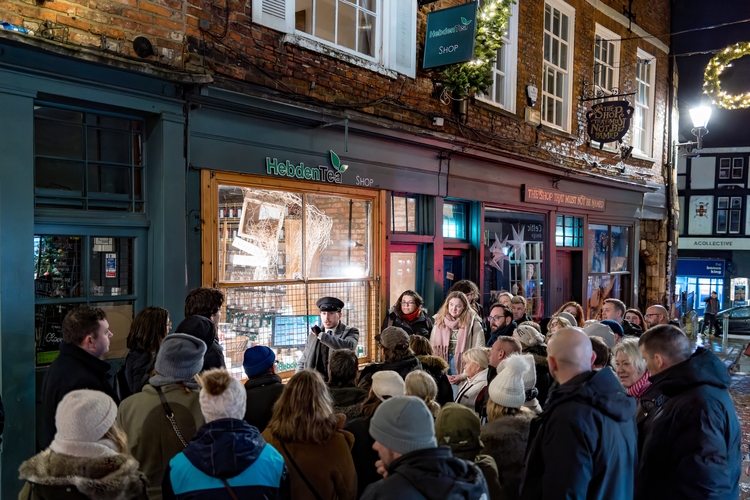
In twilight, with a chill in the air, on cobbled streets where cars can’t pass, something is awry in medieval York. At the heart of the compact northern city, the imposing Gothic cathedral, York Minster, stands monumental. In the lee of the stonework, along Minster Yard, people congregate every evening. Groups large and small join the gaggle of nightly ghost tours that relish the city’s dark history. Tour guides robed in Victoriana or steampunk attire gather their audiences, then summon their own faculties to lead an exploration of fantasy and legend.
Enjoying this article? Check out our related reads…
York is widely regarded as the most haunted city in Europe. It was declared such by the International Ghost Research Foundation due to its bloodstained history and a rumoured 500 hauntings within the ancient city walls.
Is this all real? Mostly, it depends on whether you believe in the occult. Research last year by the National Folklore Survey found that 36 per cent of people think that ghosts or spirits exist. The tour groups will include sceptics and true believers alike. Despite the bemused eye rolls of the cynics, for a significant proportion, the hauntings of York are an authentic part of the city’s geography: as real as the twin towers of the Anglican Minster.
Two of the most infamous ghost tales cast light on social tragedies. One is the first stop for many tours. Next to the Minster is a house with a small window. After dark, passers-by occasionally glimpse a young girl with a sunken face looking out, searching for someone on Chapter House Street. The story goes that when the bubonic plague arrived in York, she was one of the first to show symptoms. After seeing the swollen buboes on her neck, the girl’s parents abandoned her and fled. As the key turned in the lock and they trapped her in the house, they shouted empty promises that they would be right back.
The second is the tragedy of Marmaduke Buckle, now a wandering spectre found in the Snickleway Inn and La Piazza Restaurant on Goodramgate, where he lived between 1697 and 1715. Marmaduke hailed from a wealthy family, but that offered him little protection against the social stigma he faced due to severe physical disability. He spent his days persecuted and hidden away at home, until he hanged himself from a beam. Just before that, he carved his initials and the dates 1697–1715, which are still visible in the wood. Today, his legacy continues as he haunts the inn, slamming doors, making lights flicker and causing a commotion in the kitchens.

As well as York’s legions of ghost stories, the city is associated with witchcraft. Historically, those cast as witches were society’s most ostracised, including widows, spinsters, unmarried mothers, lesbians and non-binary people. Today, the witch identity is aspirational in York: many gift shops are packed with gimmicky mini plastic cauldrons, fun-flavoured potions and non-functioning flying broomsticks. There is a trail of black cats to find. Felines adorn the buildings like a band of witches’ familiars – supernatural spirits in animal form that served as their assistants, spies or messengers.
Folklore and tales of the occult preserve stories, albeit in hyper-real versions, of marginalised people. These three examples from York – the abandoned child victim of disease, an outcast with disabilities and people accused of witchcraft – are the types of social history that are largely absent from conventional accounts of the past. Perhaps some collective empathy for the stories of the subaltern lures thousands of visitors to York. Or maybe it’s just a fun day out.
The city has many fantastical features, including a cat café for real-life felines, an axe-throwing bar, wizard-themed crazy golf and the more sober and historically grounded Jorvik Viking Centre, where time-capsule carriages take patrons on an archaeological tour of York’s ancient streets. Among the most sensational attractions is the York Dungeon – a live, interactive venue where visitors experience full-sensory exposure to torture, séances and witch trials.
Some tourist-packaged experiences stray far from the cultural history of York. There is a proliferation of Harry Potter-themed merchandise found on the Shambles, York’s most medieval-looking street. Diagon Alley from J K Rowling’s book series has a resemblance to the Shambles, although there is no direct link between that lore and the real streetscape.
The overall effect of all this cultural geography is the creation of what we can call a ‘phantasmagorical landscape’. The old centre of York is somewhere that’s fantastic, surreal and constantly changing. When tourists visit, they curate their own histories as they move through a space of illusions. At times, it doesn’t feel like an authentic city but almost a theme park, hyper-real like Disneyland and haunted by cynical commercialism as well as the spirits of its deceased citizens.