Seven out of eight ‘safe and just’ boundaries have been exceeded, new research reveals
By Victoria Heath
New research sheds light onto the multitude of ways that humans have breached the limits of Earth, with stark warnings to businesses, cities and governments to implement change before irreversible damage is caused.
Over forty researchers from an international science commission compiled eight key ‘safe and just’ boundaries for the planet. These included climate, biodiversity, freshwater and various pollution types, such as air, soil and water.
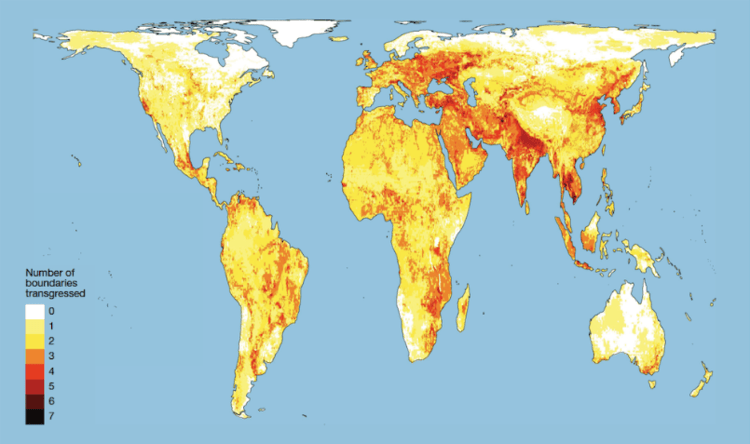
To create the boundaries, the scientists used methods such as modelling, literature reviews and expert judgement. The study concluded that seven out of eight of these boundaries were transgressed.
What are ‘safe and just’ boundaries, and why are they important?
‘Safe’ refers to boundaries that ensure stable and resilient conditions on Earth, while ‘just’ is defined as boundaries which support the reduction of human exposure to significant harm. Significant harm can include loss of food, water or nutritional security, chronic disease, loss of lives, livelihoods or incomes, injury or malnutrition.
Multiple environmental assessments have concluded that justice is a necessity for humanity to exist within planetary limits.
‘We cannot have a biophysically safe planet without justice,’ says co-author Joyeeta Gupta, Co-Chair of the Earth Commission, Professor of Environment and Development in the Global South at the University of Amsterdam and Professor of Law and Policy in Water Resources and Environment at IHE Delft Institute for Water Education. ‘This includes setting just targets to prevent significant harm and guarantee access to resources to people and for as well as just transformations to achieve those targets,’
Set of eight Earth-system boundaries for consideration: climate, functional integrity of the biosphere, natural-ecosystem area, surface-water flows, groundwater levels, nutrient cycles for nitrogen and phosphorus, and atmospheric aerosol levels. Red lines indicate the ‘safe’ limits, indicating levels beyond which we risk detrimental consequences. Blue lines signify the ‘just’ limits, representing a more sustainable approach that considers both ecological and societal needs. The green shading denotes the areas where the safe and just boundaries align, highlighting regions where we can find a balance between human activities and the Earth’s natural systems. The icon of the Earth serves as a visual representation of the planet’s current state, reminding us of the importance of our actions in safeguarding its health. Image: Rockstrom et al
The effects of crossing these boundaries
Published by Nature, the findings of the study highlight the impact that humans have caused to the stability of the planet.
‘Within the five analysed domains, several boundaries, on a global and local scale, are already transgressed, says Professor Johan Rockström, Earth Commission Co-Chair, lead author and Director of the Potsdam Institute for Climate Impact Research. ‘For example, human activities are altering water flows, excessive amounts of nutrients are released into waterways from fertiliser use, and limited natural areas are left. This poses existential threats for a stable planet, to ecosystems and their vital contributions to people.’
The study also shows that the planet has passed the climate boundary, set at 1°C above pre-industrial temperature levels. Already, the current level of climate change is causing harm to tens of millions of people across the globe.
‘Unless a timely transformation occurs, it is most likely that irreversible tipping points and widespread impacts on human well-being will be unavoidable. Avoiding that scenario is crucial if we want to secure a safe and just future for current and future generations,’ Rockström says.
Building upon existing evidence
As a basis to create the boundaries within the study, scientists compiled previous research from both universities and UN science groups, including the Intergovernmental Science-Policy Platform on Biodiversity and Ecosystem Services and the Intergovernmental Panel on Climate Change.
The study is the first of its kind to assess and quantify ‘safe and just’ Earth system boundaries on both a local and global level. It advances existing scientific evidence that defines the biophysical conditions required to maintain a stable planet to support life on Earth, and how significant harm to humans and other species can be avoided.
Moving beyond global climate change targets
While global target setting focuses predominantly on climate change, science suggests that other biophysical systems and processes must be addressed to determine the planet’s livability accurately.
‘The Earth system is an interconnected set of biophysical processes that operate across regions and scales,’ says Wendy Broadgate, Earth Commission Executive Director and Future Earth, Global Hub Director, Sweden. ‘Interference in one part of the world can have enormous impacts in other regions. Using Earth Systems Boundaries as an entry point for holistic and transformative action will support impactful and just progression towards a safe and just world.’
Implementing the study into life
The report suggests that new science-based targets will be set for businesses, cities and governments, underpinned by the Earth Systems Boundaries. These targets will address the multiple crises of health damage from air pollution, ecosystem damage from fertiliser overuse as well as lack of access elsewhere, biodiversity decline, and water shortages.
‘With this global scientific assessment, we provide all stakeholders with scientific boundaries that can enable a prosperous and equitable world development on a stable planet, a better future for people and planet,’ concludes Rockström.
With scrutiny at an all-time high, the report concludes that the success of businesses, cities and governments will be determined by an ability to consider and improve their impact on both the planet and people.
‘A safe and just transformation to a manageable planet requires urgent, collective action by multiple actors, especially in government and business to act within Earth system boundaries to keep our life support system of the planet intact. Stewardship of the global commons has never been more urgent or important,’ concludes Wendy Broadgate, Earth Commission Executive Director, and Global Hub Director (Sweden), Future Earth.