
The warnings were clear, but the response fell short. Now intensifying wildfires threaten to push the climate crisis beyond repair

By
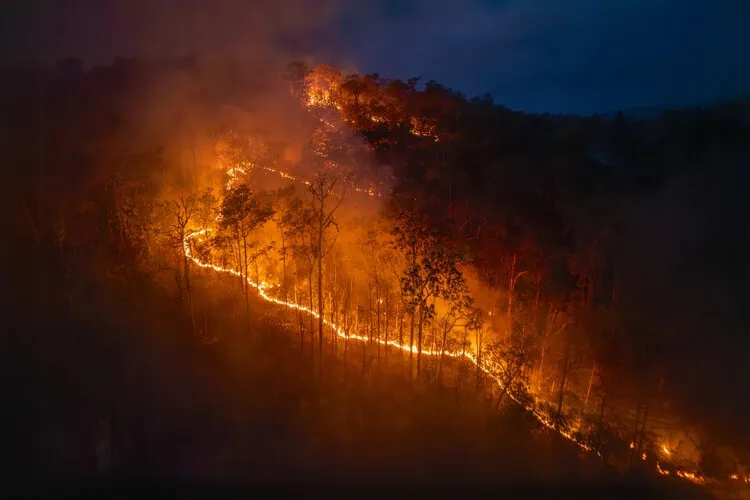
Few things can be scarier than wildfires. Almost nothing, though, can be more frightening than a thunderstorm born from extraordinary heat. A pyrocumulonimbus cloud is a column of hot air, smoke and ash that behaves like the updraft of an ordinary thunderstorm but is far more concentrated and turbulent. If the updraft is strong enough, the cloud reaches high into the troposphere, sometimes extending into the stratosphere, ten or more kilometres up. Such violent convection generates lightning, which can spark further fires. It can also produce fierce, erratic surface winds that whip the parent fire into greater fury, occasionally spinning up fire tornadoes. A pyrocumulonimbus can be triggered by a huge volcanic eruption, a nuclear explosion — Hiroshima’s ‘mushroom cloud’ was one — or a wildfire of unimaginable strength. It’s what happened, for the first time in recorded memory, in July in France.
Enjoying this article? Check out our related reads…
As we write, the huge blazes engulfing large swathes of France and Spain show few signs of abating. Local authorities say that fully extinguishing them could take weeks, if not months. Hundreds of thousands of hectares have been incinerated; more than 350,000 people have been displaced; smoke plumes are stretching across the continent. By the time you read this, the situation across Europe could have worsened. In recent years, records have been shattered in North America. Now they’ve been shattered in Europe, too.
While fires are a natural part of many ecosystems, it’s beyond dispute that human-induced warming — now 1.5°C above pre-industrial levels — has fundamentally altered the fate of forests. Four consecutive heatwaves in Europe have created the conditions for the perfect firestorm: besides France and Spain, countries including Turkey, Greece, Italy and the UK are burning. While the continent is warming faster than the global average, wildfires are a menace on a global scale. In Canada, a record 7.8 million hectares of forest were incinerated in 2023, and an untold area is burning right now. In Australia, the frequency of forest megafires has markedly increased since 2000, and the strengthening El Niño phase in the Pacific doesn’t bode well for the coming austral summer. In the tropics, from the Amazon to the Congo Basin, wildfires are perpetually burning somewhere.
That said, the total area burned between 2003 and 2019 actually decreased, but this has more to do with land use than global warming. The decline comes from savannas and croplands, especially in Africa, where agricultural expansion has reduced the traditional burning of grasslands. This isn’t the case with forests — our biggest carbon sink after the oceans. And here lies the real trouble.
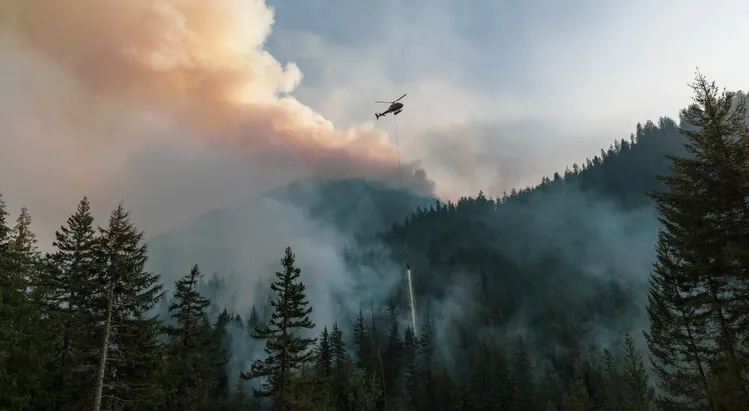
When forests go up in smoke, they release back into the atmosphere, in a matter of days, the carbon dioxide they had been capturing for decades or centuries through photosynthesis. This injects massive quantities of greenhouse gases into the air, triggering a long list of feedback loops. Suffice it to say that this will further accelerate warming and fuel more fires.
Forests traditionally absorb roughly 25 per cent of human carbon emissions. When recurrent, high-intensity fires destroy these ecosystems faster than they can regenerate, carbon sinks become net carbon sources. In other words, fires are likely to accelerate our trajectory towards 2°C of warming. Without emissions cuts, this horrific threshold is estimated to be crossed around the median year of 2043. But it could happen earlier. The science is clear: at 2°C, we will face an explosion in heat-related deaths; intensified droughts; the disappearance of coral reefs, with sinister consequences; and widespread forest dieback, as lush vegetation gives way to dry, fire-prone shrublands. Not only can things become much worse with another half a degree of warming — in many cases — but the changes may also become irreversible.
Are you scared enough now? Well, many governments aren’t.
According to the We Don’t Have Time advocacy platform, over the past 12 months, a score of countries — including some in the scorching European Union — have reversed a total of 45 climate policies. ‘Before, climate policy was far too weak and far too slow, but at least the overall direction was forward. Now, the consequences are impossible to ignore,’ wrote Ingmar Rentzhog, the platform’s founder.
I’ve always thought that, one dreadful day, the climate crisis would become so frightening that it would be impossible to ignore. Either I was wrong, or that day will arrive burningly too late.
I’m reading: Alfred Hitchcock: The Complete Films, by Paul Duncan (Taschen). A concise yet image-rich overview of the great director’s body of work
This column appears in the September 2026 issue of Geographical. Subscribers read every issue in print, in the app and in the digital archive of 1,000+ issues back to 1935.