
• Skip to main content
  • Skip to secondary menu
  • Skip to primary sidebar
  • Skip to footer
Geographical

Geographical

Official magazine of the Royal Geographical Society (with IBG)

  • Geographical Home
  • News
  • Features
  • Opinion
    • Climatewatch
    • Front Lines
  • Podcast
  • Travel
    • Discovering Britain
    • Passport
  • Culture
    • Book reviews
  • Quizzes
    • Crosswords
  • Choose Geography
    • University directory
    • Masters courses
    • Course guides
      • Climate change
      • Environmental science
      • Human geography
      • Physical geography
    • University pages
      • Aberystwyth University
      • Brunel University
      • Cardiff University
      • University of Chester
      • Edge Hill University
      • The University of Edinburgh
      • Newcastle University
      • Nottingham Trent University
      • Oxford Brookes University
      • The University of Plymouth
      • Queen Mary University of London
    • Geography careers
      • Charity/non-profit
      • Education & research
      • Environment
      • Finance & consulting
      • Government and Local Government
    • Applications and advice
  • Magazine
    • Issue previews
    • Subscribe
    • Manage My Subscription
    • Special Editions
    • Geographical Archive
    • Advertise with us
  • Subscribe
    • Direct Debit Changes

North Korean workers are ‘on sale’ to Russian companies in forced labour programme, report reveals

30 October 2026
3 minutes

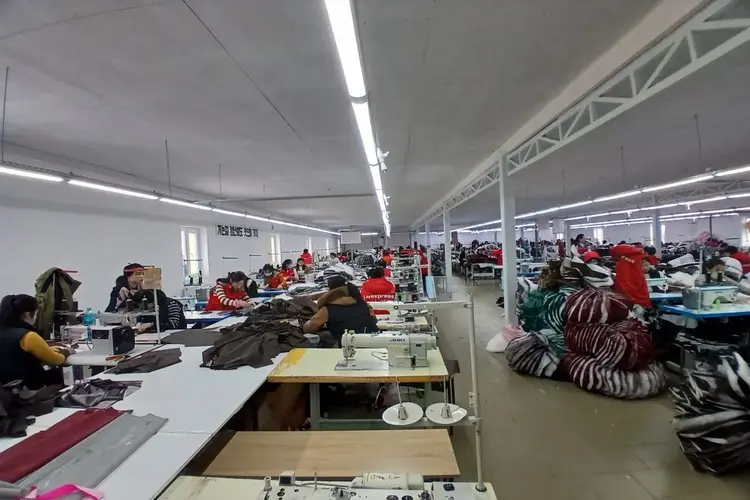
North Korean workers at a Garment factory in Chekhov, image posted to KNDR.SU
North Korean workers at a garment factory in Chekhov, image posted to KNDR.SU. Image: Global Rights Compliance

Investigation reveals a broker network exploiting workers to fund North Korea’s missile programme and bolster Russia’s economy


By Victoria Heath

A nine-month undercover investigation has revealed how Russian businesses are using North Korean workers in a state-sponsored forced labour programme, with a broker network charging a commission of up to £1,350 per worker.

Global Rights Compliance’s latest report documents the details of a broker network run by Moscow businessman Vladimir Sokolov, which places North Korean labourers at Russian worksites where they are forced to work up to 18-hour days and forfeit up to 90 per cent of their income to the DPRK government. Evidence shows that the broker network relies upon restrictions of labourers’ movement and the threat of ‘serious consequences in their country’ for workers in breach of their contracts. Labourers are also subjected to brutal working conditions, the report states.

The investigation revealed how Sokolov runs an online platform called KNDR.su that markets North Korean workers to potential Russian employers. Sokolov was sanctioned by the EU on 12 October 2026 and has had all assets frozen for his promotion of industrial cooperation projects with the DPRK.

Investigators posed undercover as a prospective employer seeking to recruit North Korean workers, directly contacting the operations director of Sokolov’s network, Ruslan Zhukov. Zhukov confirmed that North Koreans had been working in Russia since 2025.

According to the investigation, North Korean workers are fictitiously enrolled in Russian colleges before being placed in practical training at host companies. Such a structure ensures student visas are given, avoiding formal labour contracts prohibited under UN sanctions.
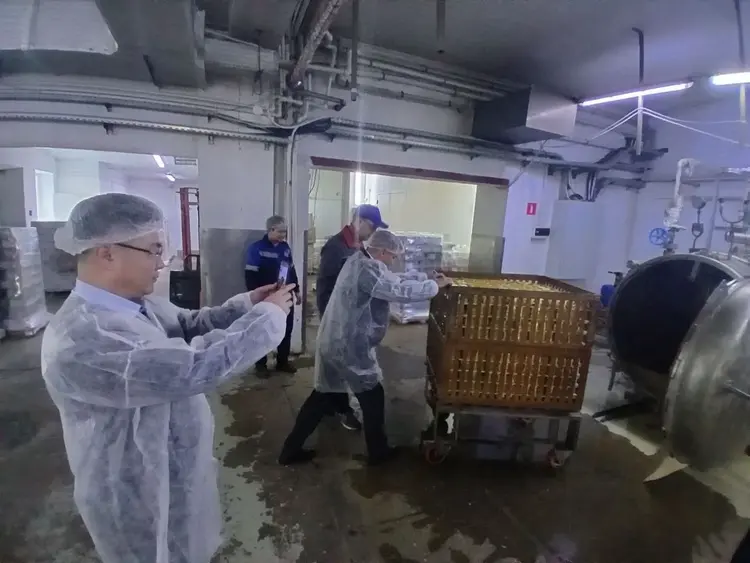
DPRK officials on a tour of KPP Ruskon, images posted to KNDR.SU
DPRK officials on a tour of KPP Ruskon, images posted to KNDR.su. Image: Global Rights Compliance

In 2025, Russia issued 36,413 visas to North Koreans – around four times as many as 2024. More than 98 per cent of these were student visas. According to South Korean intelligence, more than 50,000 North Korean labourers are present in Russia.

Currently, overseas forced labour is estimated to generate between $450-800million for North Korea, channelled into the military-industrial complex sustaining the DRPK’s ballistic missile programme.

The investigation also found that KNDR.su requires Russian companies who want to use North Korean workers to undergo an inspection visit from the DPRK embassy as part of certification, confirming the state-sponsored nature of the arrangement.

The report confirms that DPRK officials visited KPP Ruskon, a producer of military rations and canned and preserved foods in Moscow Oblast. Footage confirms 30 North Korean workers were also present at KPP Ruskon, but Global Rights Compliance investigators estimate the true number is likely to be much higher as the broker network’s minimum order for labourers is 50 workers.


Related reads…

  • Chinese tuna vessels used North Korean forced labour, new investigation finds
  • North Korea marches us nearer to a bipolar conflict
  • New book explores more than two millennia of Korean art and culture
  • Bangladesh garment workers protest over pay
  • Russian sanctions backfire as Putin profits from war economy

DPRK officials were also documented visiting Agrisovgaz in Kaluga Oblast, a US-sanctioned metalworking plant.

‘In Russia, slave labour is not only commodified, it is available to customers in just a few clicks,’ said lead investigator at Global Rights Compliance Dylan Carter. Large brigades of North Korean workers, operating under the thin veil of educational exchanges, are openly advertised online and marketed as commodities. ‘They won’t run away’, their recruiters boldly claim, while gruelling shifts are presented as something North Koreans particularly enjoy.’

‘These workers do not come cheap, yet little, if any, of the money paid for their labour reaches them. Instead, it lines the pockets of the DPRK state.’

Themes News Russia

Protected by Copyscape

Primary Sidebar

SUBSCRIBE

GEOGRAPHICAL WEEKLY LOGO FREE - Sign up to get context, clarity and perspective in a noisy world, every Friday

Popular Now

On The Ground: The Aberfan Tribunal

On The Ground: The Aberfan Tribunal

Shompen band traversing a river on Great Nicobar Island.

UN urges India to suspend controversial mega-project on Great Nicobar Island

3d globe inside digital scanning frame.

AI or climate change – which poses the greater threat to humanity?

A priest beside health workers in protective equipment outside a metal-walled building in Mongbwalu

Why war is making the DRC’s Ebola outbreak harder to stop

Copernicus Marine Service visualisations show the impact of Super Typhoon Champi on the Philippine Sea on 21 October 2026. With winds reaching 296 km/h, the Category 5 storm was the strongest tropical cyclone recorded in 2026. The images show the anticlockwise movement of wind-generated waves (left) and significant wave heights reaching 10 metres near the storm’s centre (right).

Typhoon Champi hits Taiwan

Footer

  • Facebook
  • Instagram
  • LinkedIn
  • Reddit
  • TikTok
  • Twitter
  • YouTube

Geographical print magazine cover

Published in the UK since 1935, Geographical is the official magazine of the Royal Geographical Society (with IBG).

Informative, authoritative and educational, this site’s content covers a wide range of subject areas, including geography, culture, wildlife and exploration, illustrated with superb photography.

Click Here for SUBSCRIPTION details

Want to access Geographical on your tablet or smartphone? Press the Apple, Android or PC/Mac image below to download the app for your device

Footer Apple Footer Android Footer Mac-PC

More from Geographical

  • Subscriptions
  • Get our Newsletter
  • About Us
  • Contact Us
  • Advertise with us
  • Privacy policy
  • Terms & Conditions

Copyright © 2026 · Site by Syon Media