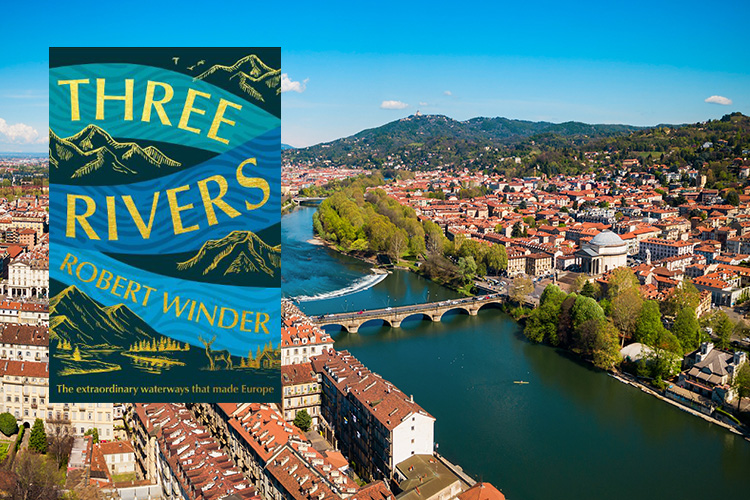
Robert Winder’s latest book tells the story of three rivers that defined our borders and built our nations
Standing in a tunnel, in a mountain in the Alps, literary editor Robert Winder had an epiphany. He had reached the source of three streams, each of which trickled out in a different direction, that – over millions of years – had carved out three valleys in the plains below, and given rise to powerful civilisations and distinct cultures.
His new book, Three Rivers, is a cultural and geographical history that recounts how these rivers – the Rhine, the Rhône, and the Po – formed the foundations of Germany, France, and Italy. ‘Without the pattern laid down by these waters,’ he writes, ‘Europe would simply not exist in the form we know it.’
The book follows the rivers from their source, using them as continuous threads to pull together seemingly disparate historical moments. Winder seamlessly blends geography, politics, art, and economics, showing how the physical landscape shaped everything from Roman expansion and the Renaissance, to agricultural expansion and now-famous local cuisines, to the complexities of modern nationalism and European unity.
We also hear how these civilisations shaped the rivers themselves, from the ‘corrections’ that attempted to control them (but which often resulted in yet more flooding), to other ‘improvements’ that killed the species the rivers had sustained
What makes this book such a compelling read is Winder’s infectious curiosity, resulting in an abundance of unexpected historical details, such as Da Vinci’s pioneering work on canal locks and the impact of the rivers on specific musical traditions like Wagnerian opera.
At the same time, Three Rivers is more than just a historical narrative; it is a cautious tale about our relationship with a feature of our landscapes that we have long taken for granted. ‘It is time to treat [rivers] as equals,’ he writes, ‘perhaps even to protect them as if they were endangered species – not least because if we do refuse to change our ways, then the rivers might well change them for us.’