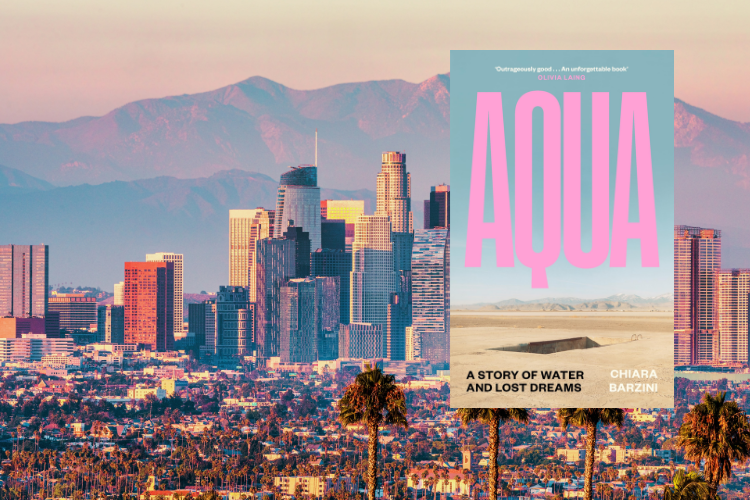
Chiara Barzini’s latest book looks at California’s relationship with water, blending travelogue, environmental politics and cultural memoir
By
Los Angeles is a paradigmatic American city: a place that conjures up images of glitz, sleaze and excess; a metropolis built in the desert that speaks to a continental empire’s ability to cleave a radical new human geography out of an uncompromising natural environment. At its cultural heart is the movie industry, but like all social and economic life in LA, filmmaking depends upon water. Open a tap – or rather, a faucet – in Hollywood and out will gush aqua that has been drawn to the coast from deep inland, springing from the Owens Valley 375 kilometres to the north in the eastern Sierra Nevada mountains.
Water transits to Los Angeles along an aqueduct that was the vision of William Mulholland. Built in 1913, the system is an amazing feat of civil and environmental engineering. The ambitious course crossed vast stretches of desert and rivals other great and more monumental early-20th-century feats of American construction such as the Hoover Dam and the Panama Canal. Building the aqueduct system was deeply controversial as it took water from the farming communities of Owens Valley, degrading that natural area. Mulholland’s story is partially told in Aqua, although that’s just one strand in the book, and this isn’t a read for those who want a straightforward hydrological history of LA’s waterscape.
Enjoying this article? Check out our related reads…
Aqua is more of a cultural memoir and travelogue that dips a toe in environmental politics. Early within the text, Italian writer Chiara Barzini recalls a conversation with the assistant to a Hollywood director (unnamed, but presumably Robert Zemeckis) who is interested in filming her previous novel. ‘I’m writing a non-fiction book about water,’ she tells her when discussing Aqua. ‘I feel there is an alchemical link between fever dreams and urban infrastructure.’ As Barzini begins to expand on her point, the assistant backs away from her, seeking a way out of the disorientating conversation. If the association between the metaphysical and the built environment holds little interest to you, I’d suggest also backing away from this book.

To do so would, however, be to neglect how California has long served as a place where cultural geographers have thought deeply about the symbolic meaning of landscape. Carl Sauer, professor of geography at the University of California at Berkeley and a contemporary of Mulholland, famously wrote: ‘Culture is the agent, the natural area is the medium, the cultural landscape is the result.’ The landscape of today’s Los Angeles has been shaped through cultural agency as well as the medium of the hinterland desert and the distant Owens Valley.
Another distinguished Californian environmental theorist, Mike Davis, makes a cameo appearance in Aqua. Davis, author of the peerless City of Quartz, on Los Angeles, directs Barzini towards the story of the St Francis Dam disaster of 1928. The dam formed part of the aqueduct’s hydrological system, and its collapse claimed 431 lives. Mulholland accepted responsibility and lived out his remaining years in seclusion, devastated by the tragedy.
Towards the end of the book, Barzini detours to discuss her interview with Robert Towne, the Academy Award-winning screenwriter of Chinatown. This Jack Nicholson-starring movie was inspired by the story of Mulholland and the water politics of LA. Towne passed away shortly afterwards, and this chapter is nauseatingly hagiographical. The lauded screenwriter fondly discusses his association with convicted sex offender and Chinatown director Roman Polanski, who is treated uncritically in Aqua. The continued reverence for such men in Hollywood is illustrative of what is most rotten in Los Angeles: it’s a globally significant cultural landscape summoned out of the desert by the flawed vision of Mulholland, whose actions led to tragedy – a place of nightmares as well as dreams.