
• Skip to main content
  • Skip to secondary menu
  • Skip to primary sidebar
  • Skip to footer
Geographical

Geographical

Official magazine of the Royal Geographical Society (with IBG)

  • Geographical Home
  • News
  • Features
  • Opinion
    • Climatewatch
    • Front Lines
  • Podcast
  • Travel
    • Discovering Britain
    • Passport
  • Culture
    • Book reviews
  • Quizzes
    • Crosswords
  • Choose Geography
    • University directory
    • Masters courses
    • Course guides
      • Climate change
      • Environmental science
      • Human geography
      • Physical geography
    • University pages
      • Aberystwyth University
      • Brunel University
      • Cardiff University
      • University of Chester
      • Edge Hill University
      • The University of Edinburgh
      • Newcastle University
      • Nottingham Trent University
      • Oxford Brookes University
      • The University of Plymouth
      • Queen Mary University of London
    • Geography careers
      • Charity/non-profit
      • Education & research
      • Environment
      • Finance & consulting
      • Government and Local Government
    • Applications and advice
  • Magazine
    • Issue previews
    • Subscribe
    • Manage My Subscription
    • Special Editions
    • Geographical Archive
    • Advertise with us
  • Subscribe
    • Direct Debit Changes

AI data centre developers turn to gas-fired power plants

12 November 2026
3 minutes


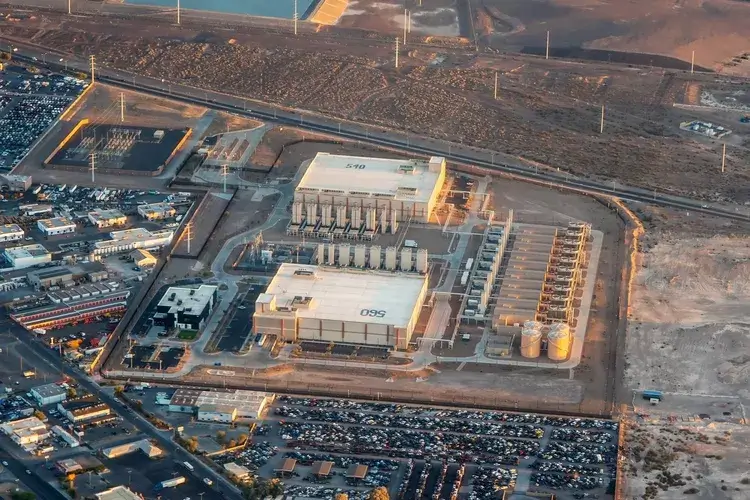
Henderson, NV, USA - September 17, 2022: Aerial view at the large-scale Google Data Center - Las Vegas Henderson, NV
A Google data centre in Henderson, a city near Las Vegas in Nevada. Image: Shutterstock

New report finds that some developers are constructing on-site gas-fired power as they await grid connections for AI data centres


By Victoria Heath

A new report by BloombergNEF (BNEF) found that some AI data centre developers, predominantly in the US, are building on-site gas-fired power as they await grid connections because of energy demand.

If all proposed on-site gas plants for US data centres were built and operated under BNEF’s assumptions, they would emit around 345 million metric tons of carbon dioxide equivalent each year.

Although these gas projects are intended only to supply power while data centres await grid connections, BNEF says developers could be encouraged to keep generating energy, creating a ‘longer-term fossil-fuel lock-in risk beyond the annual emissions’.

Many US data centres already rely on gas-powered electricity, including Elon Musk’s AI company xAI. The company has illegally operated at least 46 methane-powered generators, despite health risks to nearby residents from the release of toxic nitrogen oxides and formaldehyde.

The new report also looked at four emerging data centre markets across Brazil, India, Indonesia and Malaysia and how their electricity generation will fare in the coming years.

In Brazil, BNEF expects almost all incremental generation needed to meet data centre demand until 2035 to come from renewables. In India, existing coal plants will supply much of the additional electricity to meet data centre demand until 2035.


Enjoying this article? Check out our related reads…

  • Prioritising AI data centres could block new homes in UK
  • More than 100 data centres in UK to use gas for electricity
  • The race to build orbital data centres, and why doubts are mounting
  • The dramatic growth of data centres
  • How AI is reshaping land, power and democracy

However, the picture is slightly different in Indonesia, as current rules do not allow data centres to contract directly with independent renewable generators. As a result, they cannot access clean power. In Malaysia, additional demand is expected to increase use of existing coal and gas plants in the near term, while longer-term projections may see new gas capacity and extensions of coal plant life.

The report also found that data centre electricity demand is set to almost quadruple by 2035.

Editorial Use Only. Close-up view of a technician's hand working on the back of a server rack inside a modern data center. Photo taken in London, UK, 20 August 2026.
Some data centres are already planning to use gas for electricity in the UK. Image: Shutterstock

‘The extraordinary economics around AI are making speed to power one of the most important priorities for defining constraints on data centre developers. The climate outcome will depend not only on how much electricity these facilities use, but on how quickly grids can connect them and whether power systems add cleaner generation alongside that demand,’ said head of data centres and emerging technology at BloombergNEF Mark Daly.

According to the BBC, the world will spend around £ 2.2 trillion on data centres supporting AI between 2025 and 2029, a figure roughly equivalent to the size of the French economy.

The new BloombergNEF report follows analysis from the environmental charity Global Action Plan, which found the UK’s projected data centre growth could push tens of thousands more households into fuel poverty. By 2035, data centre growth could add up to £2.6billion to household electricity bills across the UK, the charity’s report revealed.

Earlier this year, Geographical reported that more than 100 new data centres in the UK planned to burn gas to generate electricity while they waited long periods to connect to the National Grid. Around 100 more data centres are planned for the UK, mostly in London and neighbouring counties, with completion expected around 2030.

Themes News

Protected by Copyscape

Primary Sidebar

SUBSCRIBE

GEOGRAPHICAL WEEKLY LOGO FREE - Sign up to get context, clarity and perspective in a noisy world, every Friday

Popular Now

China, US, Russia flags

Why Trump, Xi, and Putin can’t carve up the world like the…

Planet Earth, view from space. Our planet with world ocean and clouds on a starry sky. Earth Observation. England, France, La Manche or English Channel and sun glint. Elements of furnished by NASA.

A hole in Earth’s ozone layer is officially the largest recorded in…

Aerial view of solar panels

The future of green jobs is in our hands

Ballot paper into box US flag in background

What is the right to vote worth when the road disappears?

flags

QUIZ: Flags of the World – Hard

Footer

  • Facebook
  • Instagram
  • LinkedIn
  • Reddit
  • TikTok
  • Twitter
  • YouTube

Geographical print magazine cover

Published in the UK since 1935, Geographical is the official magazine of the Royal Geographical Society (with IBG).

Informative, authoritative and educational, this site’s content covers a wide range of subject areas, including geography, culture, wildlife and exploration, illustrated with superb photography.

Click Here for SUBSCRIPTION details

Want to access Geographical on your tablet or smartphone? Press the Apple, Android or PC/Mac image below to download the app for your device

Footer Apple Footer Android Footer Mac-PC

More from Geographical

  • Subscriptions
  • Get our Newsletter
  • About Us
  • Contact Us
  • Advertise with us
  • Privacy policy
  • Terms & Conditions

Copyright © 2026 · Site by Syon Media