
• Skip to main content
  • Skip to secondary menu
  • Skip to primary sidebar
  • Skip to footer
Geographical

Geographical

Official magazine of the Royal Geographical Society (with IBG)

  • Geographical Home
  • News
  • Features
  • Opinion
    • Climatewatch
    • Front Lines
  • Podcast
  • Travel
    • Discovering Britain
    • Passport
  • Culture
    • Book reviews
  • Quizzes
    • Crosswords
  • Choose Geography
    • University directory
    • Masters courses
    • Course guides
      • Climate change
      • Environmental science
      • Human geography
      • Physical geography
    • University pages
      • Aberystwyth University
      • Brunel University
      • Cardiff University
      • University of Chester
      • Edge Hill University
      • The University of Edinburgh
      • Newcastle University
      • Nottingham Trent University
      • Oxford Brookes University
      • The University of Plymouth
      • Queen Mary University of London
    • Geography careers
      • Charity/non-profit
      • Education & research
      • Environment
      • Finance & consulting
      • Government and Local Government
    • Applications and advice
  • Magazine
    • Issue previews
    • Subscribe
    • Manage My Subscription
    • Special Editions
    • Geographical Archive
    • Advertise with us
  • Subscribe
    • Direct Debit Changes

Nearly 90 million displaced people face severe climate risks, UN report finds

6 November 2026
3 minutes

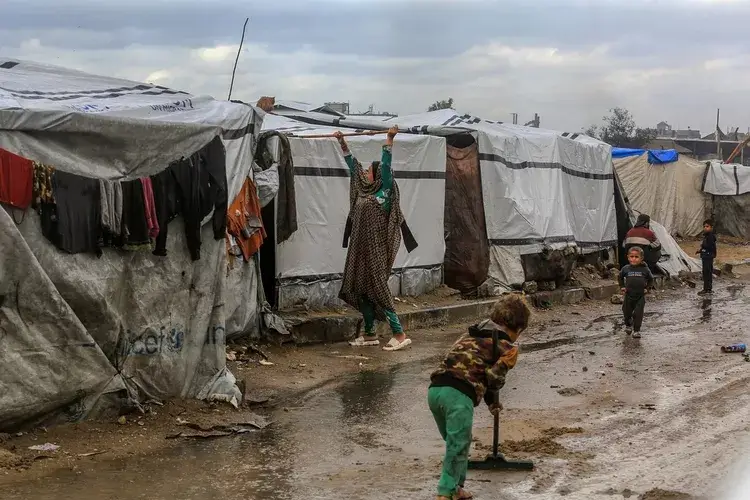
Rainwater flooded the streets and tents of displaced Palestinians, who are suffering from the bitter cold and torrential rain in Khan Younis, southern Gaza Strip ,on Nov 25, 2025 .Rainwater flooded the streets and tents of displaced Palestinians, who are suffering from the bitter cold and torrential rain in Khan Younis, southern Gaza Strip ,on Nov 25, 2025 .
Rainwater flooded the streets and tents of displaced Palestinians in Gaza. Image: Anas Mohammed/Shutterstock

By mid-2026, three in four forcibly displaced people worldwide were living in countries facing high to extreme exposure to climate-related hazards


By Victoria Heath

A new report by the UN Refugee Agency (UNHCR) has revealed that nearly 90 million forcibly displaced people are exposed to devastating climate impacts around the world.

Many refugee communities are located in ‘climate change hotspots’, placing them at risk of secondary displacement after they have fled conflict-afflicted regions.

‘Refugees face a double injustice. Forced to flee conflicts they did not cause, they are now on the frontlines of a climate crisis they have contributed least to,’ said UNHCR’s Assistant High Commissioner for Operations, Antón Leis García.

‘For millions, climate change is not a distant threat. It is destroying shelters, undermining livelihoods and putting their hopes of rebuilding their lives at risk. We cannot allow those who have already lost so much to be left behind in global climate action.’

In Syria – where nearly four million displaced people have recently returned – declining groundwater and severe climate shocks are threatening recovery. The Euphrates River also flooded earlier this year, damaging homes and displacing thousands of people.
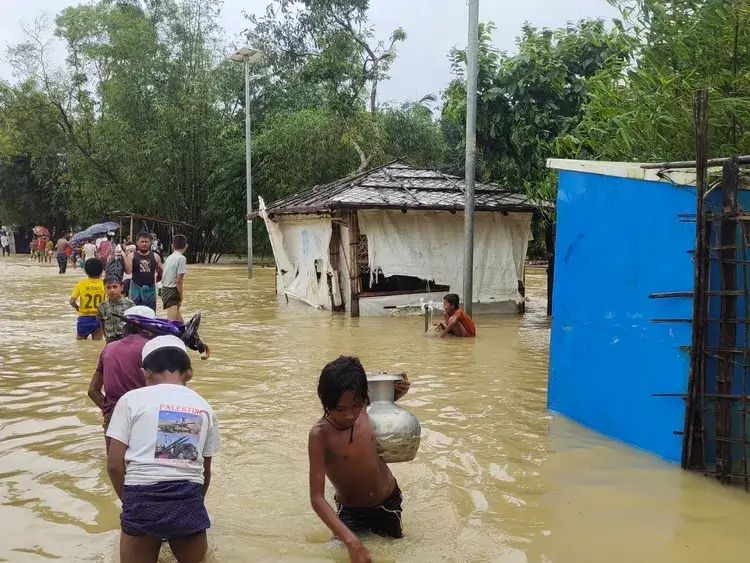

Cox's Bazar, Bangladesh – September 13, 2024: Flooding in the Rohingya refugee camps, where over a million Rohingya have been living since 2017.
Flooding in the Rohingya refugee camps in 2024. Image: Mohammed Zonaid/Shutterstock

Elsewhere, in the Sahel region of western Africa, where one of the world’s fastest-growing displacement crises is occurring, temperatures are rising 1.5 times faster than the global average, affecting agricultural activities that many rely on for their livelihoods.

The report finds that more than half of all assessed locations could experience at least 50 additional days of dangerous heat per year. In some Ethiopian settlements, dangerous heat could last more than 200 days a year.

The report also covered weather-related disasters. In the last decade alone, they triggered more than 255 million internal displacements worldwide – equivalent to approximately 70,000 each day. In East Africa, forecasts indicate that severe flooding associated with a very strong El Niño could displace up to three million people across Somalia, Kenya, South Sudan and Uganda by the end of 2026, depending on the floods’ severity.

In July 2026, severe monsoon rains, flooding and landslides in Cox’s Bazar, Bangladesh, affected more than 52,000 Rohingya refugees and displaced more than 13,000 refugees.


Related reads…

  • The rising levels of internally displaced people
  • Fresh violence forces more than 7,000 people to flee their homes in northern Mozambique
  • More than 300,000 people internally displaced in Lebanon since early March
  • The war the world forgot
  • The $82.8bn climate handbrake fossil fuel companies are using to slow the green transition

These risks affect millions of people as climate finance continues to fall short of reaching those in need. Conflict-afflicted, fragile countries receive just 10 per cent of global climate finance.

‘We need climate financing to reach the communities where the needs are greatest. Investing in resilience, livelihoods and sustainable solutions today can help prevent further displacement tomorrow. Refugees and their host communities must be part of these investments, not an afterthought,’ said UNHCR’s Assistant High Commissioner for Operations Antón Leis García.

The new report comes ahead of the UN Climate Change Conference (COP31) in Türkiye.

‘As Türkiye, one of the world’s largest refugee-hosting countries, hosts COP31, the conference offers an important opportunity to place displacement and the needs of host communities firmly within global climate action,’ said UNHCR.

Themes News Climate Refugees

Protected by Copyscape

Primary Sidebar

SUBSCRIBE

GEOGRAPHICAL WEEKLY LOGO FREE - Sign up to get context, clarity and perspective in a noisy world, every Friday
GIVE A GIFT

Give a year of Geographical - order a gift subscription

Popular Now

December 2026 Geographical crossword

December 2026 Geographical crossword

Stingrays laid out on a beach with fishing boats offshore in Thailand

The hidden stingray skin trade pushing endangered rays towards extinction

Stock Photo ID: 2698280741 Warsaw, Poland - November 3, 2025: Close-up view of a smartphone screen displaying an interface with the text Ask ChatGPT, highlighting modern technology usage.

AI models are easy to pressure into giving false climate information, report…

in the Al-Mawasi area of ​​Khan Yunis, southern Gaza, the tents of displaced Palestinians have been flooded by rainwater during a storm accompanied by heavy rain and strong winds. The displaced are living in dilapidated tents that offer no protection against the winter weather or the bitter cold , on 07 nov 2026 .

Gaza flooding compounds ‘already dire situation’, UN body reports

The weedkiller Reglone is banned in the UK but still manufactured in Huddersfield for export overseas. In Brazil it was cited in 44 poisoning reports last year, including four deaths

European and British pesticides named in 1,600 poisoning cases in Brazil in…

Footer

  • Facebook
  • Instagram
  • LinkedIn
  • Reddit
  • TikTok
  • Twitter
  • YouTube

Geographical print magazine cover

Published in the UK since 1935, Geographical is the official magazine of the Royal Geographical Society (with IBG).

Informative, authoritative and educational, this site’s content covers a wide range of subject areas, including geography, culture, wildlife and exploration, illustrated with superb photography.

Click Here for SUBSCRIPTION details

Want to access Geographical on your tablet or smartphone? Press the Apple, Android or PC/Mac image below to download the app for your device

Footer Apple Footer Android Footer Mac-PC

More from Geographical

  • Subscriptions
  • Get our Newsletter
  • About Us
  • Contact Us
  • Advertise with us
  • Privacy policy
  • Terms & Conditions

Copyright © 2026 · Site by Syon Media