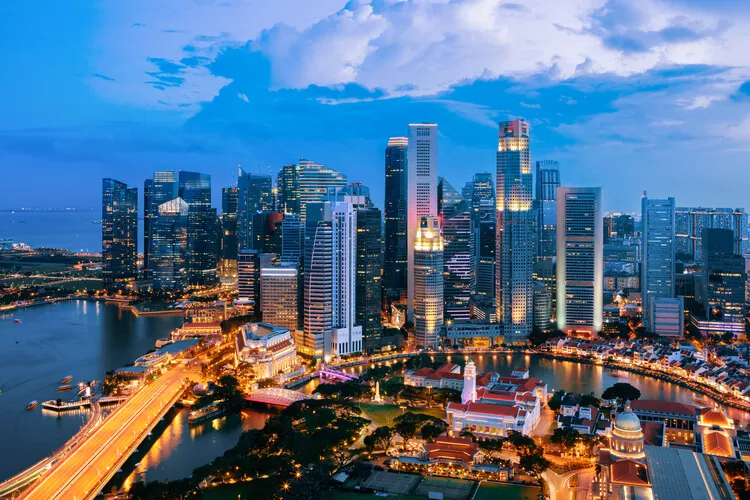
Created at extraordinary speed from political necessity, cultural diversity and global commerce, Singapore embodies many of the defining tensions of the modern age
By Tim Brinkhof
Singapore has long advertised itself as a global crossroads where East meets West, yet visitors from all over the world often find that the city-state — though convenient to live in and get around — can be difficult to truly get to know. My suggestion is that they may not be looking in the right places or, if they are, not looking hard enough.
Singapore’s perceived unknowability stems from its not-so-distant past. Born in 1965 out of economic and racial tensions that culminated in its expulsion from the Federation of Malaysia, this ‘reluctant nation’ — as it was called at the time — came into existence more as a result of circumstance than self-determination.
Its subsequent evolution from a regional port city into a global financial centre occurred more or less within the span of a single human lifetime. It didn’t proceed organically — had it done so, it would probably have taken longer — but followed the long-term vision of its technocratic leadership.
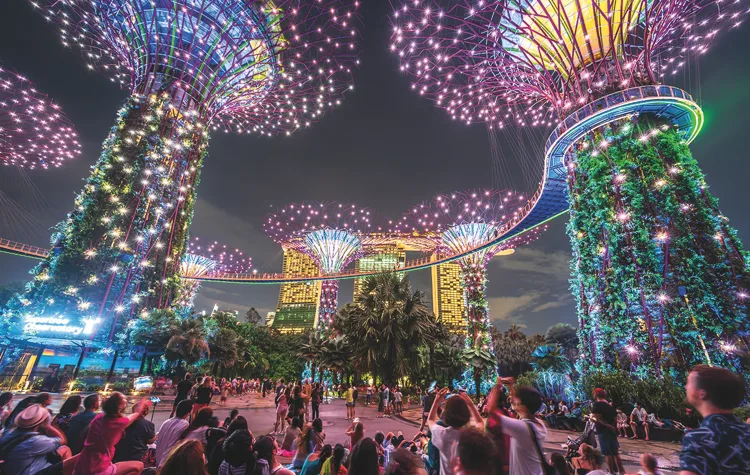
The result, as journalist Andrés Martinez wrote in a 2014 article for Time, is that for every Westerner who genuinely marvels at the nightly light shows at Supertree Grove, there’s another who feels the need to voice a preference for the ‘grittier authenticity of nearby Cambodia and Vietnam’.
Enjoying this article? Check out our related reads…
Such familiar sentiments not only betray what Martinez rightly identifies as a ‘form of colonial prejudice’ — one that presumes that the ‘real’ Asia only shows itself in poverty and disorder — but are also unfair. All collective identity is constructed, and Singapore — far from lacking one — offers a unique opportunity to witness that process in action.
Singapore’s current identity has two faces: one international, the other domestic. The former introduces itself on arrival at Changi Airport, where a stampless, automated immigration system allows travellers to enter the country without having to interact with a single government official.
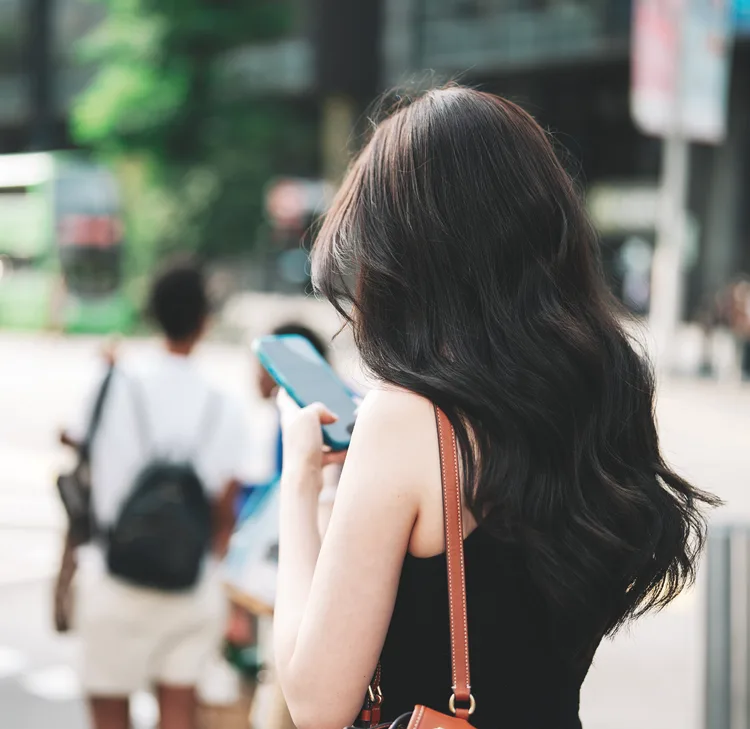
This system speaks not only to the city-state’s relationship with technology — many Singaporeans seem to go about their days without ever looking up from their phones, navigating their crowded surroundings as if by muscle memory alone — but also to its relationship with the rest of the world.
Lacking strategic depth and natural resources, Singapore has lived and thrived by making, in its government’s own words, ‘common cause with as many countries as possible’. This foreign policy, sometimes summed up as ‘practical idealism’, is both the foundation of its economic prosperity and the guarantor of its national security.
Singapore’s international identity can also be seen in its museums. At the National Museum of Singapore, the city-state’s aforementioned evolution into a financial centre is framed not as a departure from its origins as a port city but as an expansion of them. Now as before, Singapore functions as a neutral zone where people from across the globe can drop anchor and do business.
At the nearby Asian Civilisations Museum, Crosscurrents: Masterpieces of Mughal, Safavid and Ottoman Art from the Musée du Louvre, a temporary exhibition exploring how trade networks shaped Islamic art across India, the Middle East and Southeast Asia, spotlights not Singapore’s own history but the historical forces that led to its emergence.
Founded in the 1990s when, as arts researcher Hoe Su Fern notes in a research paper, ‘the rise of the Asian Tigers unsettled and contested the Eurocentric view of the West’, the museum also emphasises Asia’s important role in the early stages of globalisation — a role that both preceded and transcended the arrival of European colonial powers in the 16th century.

If the international dimension of Singapore’s identity serves a strategic purpose by conditioning how the city-state is seen abroad, its domestic dimension seeks to promote stability at home by mediating relations among Singapore’s ethnically, culturally and religiously diverse communities.
Jolted by riots between Malay and Chinese communities during the years in which Singapore was part of Malaysia, the city-state’s leadership initially pursued a policy of hard multiculturalism, acknowledging fundamental differences between groups while championing shared, market-oriented values such as pragmatism and entrepreneurship.
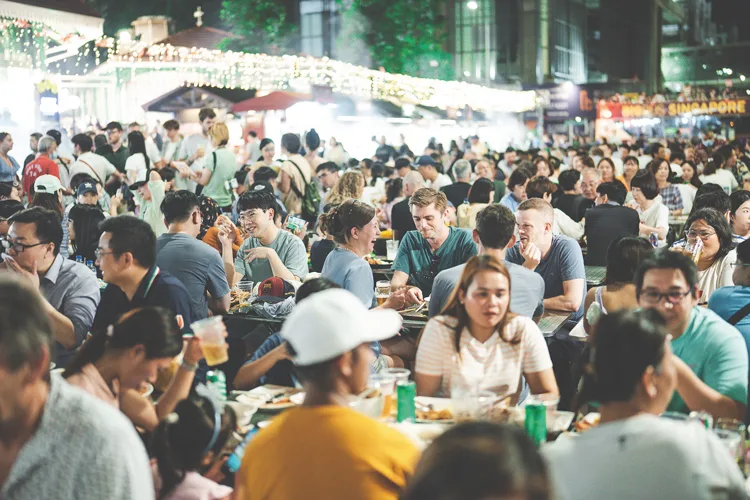
Since then, nation-building narratives have shifted towards a slightly softer multiculturalism. Singapore once conceived of itself as a mosaic or tapestry, its colours harmoniously arranged but static and separate. Today, it more often describes itself as a cosmopolis whose character is hybrid and in constant flux.
Hybridity features prominently at another cultural institution: the Peranakan Museum. Responding to a resurgent interest in all things Peranakan, its curators broaden the term beyond its common association with the Straits Chinese, or ‘Baba-Nyonya’, to encompass Singaporeans who consider themselves products of cultural mixing.
This Peranakan renaissance — reflected in the 2025 Netflix period drama Emerald Hill: The Little Nyonya Story — can be partly attributed to growing concern that the city-state’s rapid rise, encapsulated in the title of founding father Lee Kuan Yew’s memoir, From Third World to First, has come at the cost of its heritage, a loss that various preservation initiatives are now seeking to reverse.
Whether navigating the turbulent waters of geopolitics or mitigating the cultural ossification caused by rapid modernisation — what philosopher Kwame Anthony Appiah calls the ‘Medusa syndrome’ — Singapore shows that to construct identity in a global age is to walk a tightrope. To watch the spectacle, Automated Changi Airport visitors need only look around them.