
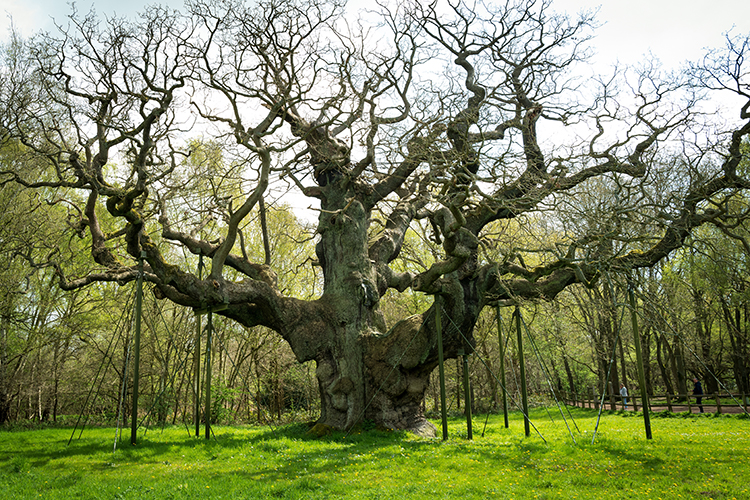
Despite years of tireless conservation, experts say the Major Oak – one of the world’s oldest and largest oak trees – has likely died
The Major Oak, the legendary oak tree at the heart of Sherwood Forest, is believed to have died. Experts say the tree, estimated to be up to 1,200 years old, failed to produce any leaves this spring.
While the tree has been in a slow, monitored decline for some time, this year marks the first without a canopy. Experts point to a complex mix of factors, including:
Soil compaction: Two centuries of human footfall have left the soil beneath the canopy as hard as concrete, preventing roots from accessing necessary oxygen and water.
Climate change: Five consecutive years of drought and record-breaking heat waves, including 40°C temperatures in 2022, have pushed the aging tree to its limit.
Historical interventions: Over a century of structural supports and human activity have also taken a toll.
‘Given the longevity of a tree such as this, it’s impossible to pinpoint a single cause for its decline,’ says Reg Harris, Director of Urban Forestry (Bury St Edmunds) Ltd. ‘Sadly, it seems probable the lack of summer rainfall over the last five years, coupled with the unprecedented high temperatures, have had a significant hand in it.’
Enjoying this article? Check out our related reads…
A witness to history
The Major Oak has stood since before the Norman Conquest. While its fame is cemented in folklore – most notably as the tree that sheltered Robin Hood – it has also been a silent observer of British history, standing through the industrial revolution when many other oaks were cut down to fuel the nation’s growth.
While the tree has been known by many names, ‘the Major’ stuck after the tree was mentioned in a book by Major Hayman Rooke in 1790, which began the first proper waves of tourism to the forest.
Branch supports have been in place since the early 20th century, marking the first of many human interventions meant to sustain the tree. While these efforts were well-intentioned, experts say they likely contributed to its eventual decline.
The importance of ancient oaks
Oaks are classified as ancient once they reach 400 years of age, a milestone that transforms them into vital ecological hubs. As these trees naturally hollow and shed limbs, they provide essential habitats for thousands of species, from rare invertebrates that thrive on decaying heartwood to birds nesting in their cavities. Sherwood Forest is home to one of the largest concentrations of these ancient and veteran oaks in Western Europe, acting as a miniature city for over 2,000 distinct forms of life.
Ed Pyne, Senior Conservation Adviser at the Woodland Trust, describes these trees as the conservation white rhinos of the UK, noting that their decline is often far less visible to the public. While the Major Oak was the first tree ever recorded on the Ancient Tree Inventory, Pyne warns that registration alone is not enough to stop their loss. He emphasizes that securing the future of these giants requires more than just recognition; it demands stronger legal protections for ancient woodlands and greater investment in active, long-term care.
A legacy that lives on
Though its life as a living organism has ended, Hollie Drake, Senior Site Manager at RSPB Sherwood Forest, says that the Major Oak will remain standing as a natural monument, ‘living on in the legend of Robin Hood and continuing to provide as much support to the forest’s ecosystem in death as in life.’
Beyond its physical presence, the tree has also made a significant contribution to other conservation efforts. ‘The invaluable knowledge gleaned from taking care of this beloved tree will inform best practice in how we look after ancient oak trees going forwards, not just here but around the world,’ says Drake.
Plans are already underway to ensure its lineage continues through saplings grown from the tree’s own acorns and cuttings. Chloe Ryder, the RSPB’s Estate Operations Manager at Sherwood Forest, says: ‘There are Major Oak saplings planted in locations right around the world, so we are planning work to ensure that its offspring will grow and generate their own acorns – and legends – for centuries to come.’