
• Skip to main content
  • Skip to secondary menu
  • Skip to primary sidebar
  • Skip to footer
Geographical

Geographical

Official magazine of the Royal Geographical Society (with IBG)

  • Geographical Home
  • News
  • Features
  • Opinion
    • Climatewatch
    • Front Lines
  • Podcast
  • Travel
    • Discovering Britain
    • Passport
  • Culture
    • Book reviews
  • Quizzes
    • Crosswords
  • Choose Geography
    • University directory
    • Masters courses
    • Course guides
      • Climate change
      • Environmental science
      • Human geography
      • Physical geography
    • University pages
      • Aberystwyth University
      • Brunel University
      • Cardiff University
      • University of Chester
      • Edge Hill University
      • The University of Edinburgh
      • Newcastle University
      • Nottingham Trent University
      • Oxford Brookes University
      • The University of Plymouth
      • Queen Mary University of London
    • Geography careers
      • Charity/non-profit
      • Education & research
      • Environment
      • Finance & consulting
      • Government and Local Government
    • Applications and advice
  • Magazine
    • Issue previews
    • Subscribe
    • Manage My Subscription
    • Special Editions
    • Geographical Archive
    • Advertise with us
  • Subscribe
    • Direct Debit Changes

2025 ranks among the three warmest ocean years since 1993

21 January 2026
3 minutes

Polar bear on ice floe
Sea ice was delayed across unusually large areas in the Antarctic. Image: Shutterstock

2025’s warming comes even despite the start of La Niña, which typically has a cooling effect on global temperatures


By Victoria Heath

Even with the start of a new La Niña phase – which typically has a cooling influence on temperatures – 2025 ranked among the three warmest years ever recorded for the surface global ocean, according to Mercator Ocean International.

These results are based on Mercator Ocean’s operational ocean monitoring systems, which deliver detailed analyses of sea surface temperatures and the global ocean state.

81 per cent of the ocean was above average temperatures, with 2025 being the hottest year for many regions including the eastern North Atlantic, parts of the Southern Ocean and the western Pacific.


Enjoying this article? Check out our related reads…

  • Old and new in El Alto, Bolivia’s highest city
  • Better World Video Awards 2025: Kao La Amani Children’s Village
  • Reducing exhaust pollution from ships accelerates global warming
  • Himalayan glaciers are fighting back against global warming
  • Scientists discover secrets of Earth’s climate past

In the North Atlantic, sea surface temperatures were the sixth warmest in 33 years, with 69 per cent of the basin in the warmest 10 years. In the Mediterranean, waters were in their second-warmest year, with 98 per cent of the basin above average.

89 per cent of the global ocean experienced marine heatwaves, while more than half of the global ocean (55 per cent) experienced intense marine heatwaves classified as strong, severe or extreme.
Antarctic sea ice
Despite the natural cooling influence of La Niña, 2025 was warmer on average than the strong El Niño years of 2015 and 2016. Image: Shutterstock

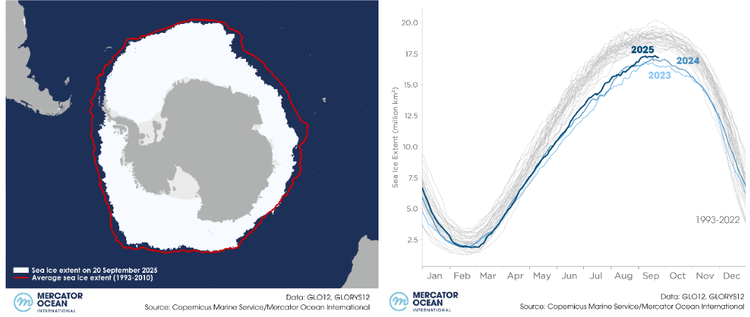
In 2025, sea ice extent was also impacted with Arctic and Antarctic sea ice well below long-term averages. For 11 out of.12 months of the year, global sea ice ranked within the top five lowest extents.

In Antarctica, sea ice formation was delayed across unusually large areas, particularly in the Indian Ocean sector. As a result, sea ice extent remained well below average for most of the winter.

Despite the natural cooling influence of La Niña, 2025 was warmer on average than the strong El Niño years of 2015 and 2016. This apparent paradox is largely explained by the long-term rise in global sea surface temperatures driven by human-induced climate change.

‘Despite being a La Niña year, 2025 ranks among the three warmest years ever recorded,’ said oceanographer at Mercator Ocean International, Romain Bourdalle-Badie. ‘In fact, what was considered ‘warm’ ten years ago has effectively become the new “cool” in today’s climate baseline – further evidence of the long-term rise in global sea surface temperatures driven by human-induced climate change.’

A warming planet

As well as 2025 being one of the warmest years for ocean temperatures, Copernicus revealed earlier this month that 2025 was the third-warmest year on record globally with average temperatures of almost 15C.

The period 2023–2025 marks the first time that a three-year span has exceeded 1.5C above pre-industrial levels, with extreme heat seen globally, particularly in the poles, and major heatwaves occurring across Europe.

Between 2023 and 2025, two main reasons combined to cause an exceptionally warm period. The first is the build-up of greenhouse gases in the atmsophere from continued emissions, as well as reduced uptake of carbon dioxide by natural sinks. Secondly, sea-surface temperatures reached high levels across the ocean, a phenomenon amplified by climate change. Additional factors include changes in the amount of aerosols and low cloud, and variations in atmospheric circulation.

Themes News

Protected by Copyscape

Primary Sidebar

SUMMER SALE

GEOGRAPHICAL WEEKLY LOGO FREE - Sign up to get context, clarity and perspective in a noisy world, every Friday

Popular Now

Floating island in Canada

The newly-discovered Canadian island that appeared to vanish

QUIZ: Country Shapes – Hard

QUIZ: Country Shapes – Hard

Mosquito close up

Invasive tropical mosquito species detected in London

Industrial waste flowing into a waterway

The whistleblower who says England’s pollution watchdog buried the evidence

QUIZ: Geography Extremes

QUIZ: Geography Extremes

Footer

  • Facebook
  • Instagram
  • LinkedIn
  • Reddit
  • TikTok
  • Twitter
  • YouTube

Geographical print magazine cover

Published in the UK since 1935, Geographical is the official magazine of the Royal Geographical Society (with IBG).

Informative, authoritative and educational, this site’s content covers a wide range of subject areas, including geography, culture, wildlife and exploration, illustrated with superb photography.

Click Here for SUBSCRIPTION details

Want to access Geographical on your tablet or smartphone? Press the Apple, Android or PC/Mac image below to download the app for your device

Footer Apple Footer Android Footer Mac-PC

More from Geographical

  • Subscriptions
  • Get our Newsletter
  • About Us
  • Contact Us
  • Advertise with us
  • Privacy policy
  • Terms & Conditions

Copyright © 2026 · Site by Syon Media