
• Skip to main content
  • Skip to secondary menu
  • Skip to primary sidebar
  • Skip to footer
Geographical

Geographical

Official magazine of the Royal Geographical Society (with IBG)

  • Home
  • Briefing
  • Science & Environment
  • Climate
    • Climatewatch
  • Wildlife
  • Culture
  • Geopolitics
    • Geopolitical hotspots
  • Study Geography
    • University directory
    • Masters courses
    • Course guides
      • Climate change
      • Environmental science
      • Human geography
      • Physical geography
    • University pages
      • Aberystwyth University
      • Brunel University
      • Cardiff University
      • University of Chester
      • Edge Hill University
      • The University of Edinburgh
      • Newcastle University
      • Nottingham Trent University
      • Oxford Brookes University
      • The University of Plymouth
      • Queen Mary University of London
    • Geography careers
      • Charity/non-profit
      • Education & research
      • Environment
      • Finance & consulting
      • Government and Local Government
    • Applications and advice
  • Quizzes
  • Magazine
    • Issue previews
    • Subscribe
    • Manage My Subscription
    • Special Editions
    • Podcasts
    • Geographical Archive
    • Book reviews
    • Crosswords
    • Advertise with us
  • Subscribe
    • Direct Debit Changes

Earth’s warming trajectory depicted in striking climate stripes graphic

15 January 2026
2 minutes

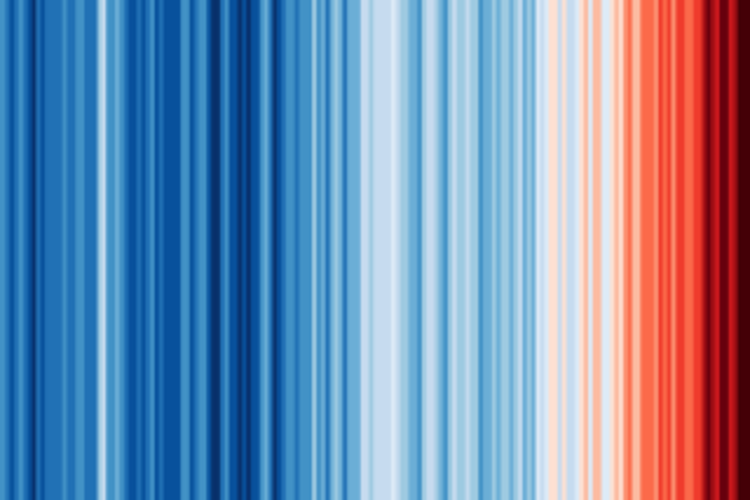
Global stripes warming graphic
The climate stripes graphic, updated for 2025. Image: University of Reading

The image reveals Earth’s increase in temperatures across the years, including 2025 – officially the planet’s third-warmest year on record 


By Victoria Heath

A picture can paint a thousand words. Such a sentiment is apt for the University of Reading’s latest climate stripes graphic, which highlights continued and unprecedented global heating in one singular image.

The University of Reading’s graphic shows how Earth has warmed across the past 176 years, using annual global temperature data from Copernicus Climate Change Service, ECMWF, NASA, NOAA, the UK Met Office, Berkeley Earth, and the World Meteorological Organisation (WMO). 


Enjoying this article? Check out our related reads…

  • Climate warming stripes light up the White Cliffs of Dover
  • 10 endangered species to watch in 2024
  • How maps tell the story of war in Ukraine
  • Hottest September on record shocks climate scientists
  • Europe swelters in July heatwave

The new data means the global climate stripes now have an extra dark red stripe to represent the extreme temperature of 2025.

‘2025 was slightly cooler than 2023 and 2024, but this drop should not be seen as a sign that things are getting better,’ said University of Reading scientist Professor Ed Hawkins.

‘The last 11 years have been the warmest 11 years on record, and 2026 is almost certain to continue this sequence due to the relentless accumulation of greenhouse gases in our atmosphere, primarily due to burning fossil fuels.’

The climate stripes show the change in annual average global temperatures since 1950. Red stripes indicate hotter years, while blue stripes show cooler years, against the average of the period 1961–2010.

Stripes for individual cities, countries and continents can be viewed at showyourstripes.info and will be updated to include the latest 2025 data in the coming months.

A warming planet

The planet is undeniably getting warmer. The last three years were Earth’s hottest on record, thanks to emissions caused by human activities. Such activities will likely lead to further temperature records – and worsening weather extremes – unless emissions are sharply reduced.

Two examples of weather events that scientists have partially linked to climate change include the Los Angeles blazes in January 2025, and Hurricane Melissa in October later that year.

‘If we go twenty years into the future and we look back at this period of the mid-2020s, we will see these years as relatively cool,’ said deputy director of Copernicus Dr Samantha Burgess.

Continued upticks in temperature bring Earth closer to breaching the Paris Agreement: the international target set to limit the rise in global temperatures to 1.5C above pre-industrial levels.

‘Looking at the most recent data, it looks like we’ll exceed that 1.5 degree level of long-term warming by the end of this decade,’ said Burgess.

Themes Briefing

Protected by Copyscape

Primary Sidebar

OUR UK DIRECT DEBITS ARE CHANGING
WINTER SALE

Geographical subscriptions

GEOGRAPHICAL WEEKLY LOGOFREE - Sign up to get global stories, told well, straight to your inbox every Friday

Popular Now

ADO Air Carbon: A new benchmark for lightweight folding e-bikes

ADO Air Carbon: A new benchmark for lightweight folding e-bikes

Trump

Why Trump’s latest move to pull out of UNFCCC is the most…

Oil tanker Russia

Geo explainer: What are shadow fleets?

QUIZ: Physical Geography Quiz

QUIZ: Physical Geography Quiz

Biochar in hands

Using biochar could cut emissions of China’s croplands by up to half,…

Footer

  • Facebook
  • Instagram
  • LinkedIn
  • Reddit
  • TikTok
  • Twitter
  • YouTube

Published in the UK since 1935, Geographical is the official magazine of the Royal Geographical Society (with IBG).

Informative, authoritative and educational, this site’s content covers a wide range of subject areas, including geography, culture, wildlife and exploration, illustrated with superb photography.

Click Here for SUBSCRIPTION details

Want to access Geographical on your tablet or smartphone? Press the Apple, Android or PC/Mac image below to download the app for your device

Footer Apple Footer Android Footer Mac-PC

More from Geographical

  • Subscriptions
  • Get our Newsletter
  • About Us
  • Contact Us
  • Advertise with us
  • Privacy policy
  • Terms & Conditions

Copyright © 2026 · Site by Syon Media