
• Skip to main content
  • Skip to secondary menu
  • Skip to primary sidebar
  • Skip to footer
Geographical

Geographical

Official magazine of the Royal Geographical Society (with IBG)

  • Geographical Home
  • News
  • Features
  • Opinion
    • Climatewatch
    • Front Lines
  • Podcast
  • Travel
    • Discovering Britain
    • Passport
  • Culture
    • Book reviews
  • Quizzes
    • Crosswords
  • Choose Geography
    • University directory
    • Masters courses
    • Course guides
      • Climate change
      • Environmental science
      • Human geography
      • Physical geography
    • University pages
      • Aberystwyth University
      • Brunel University
      • Cardiff University
      • University of Chester
      • Edge Hill University
      • The University of Edinburgh
      • Newcastle University
      • Nottingham Trent University
      • Oxford Brookes University
      • The University of Plymouth
      • Queen Mary University of London
    • Geography careers
      • Charity/non-profit
      • Education & research
      • Environment
      • Finance & consulting
      • Government and Local Government
    • Applications and advice
  • Magazine
    • Issue previews
    • Subscribe
    • Manage My Subscription
    • Special Editions
    • Geographical Archive
    • Advertise with us
  • Subscribe
    • Direct Debit Changes

Penguin poop seen from space reveals stark reality for future of iconic polar species

13 July 2026
2 minutes

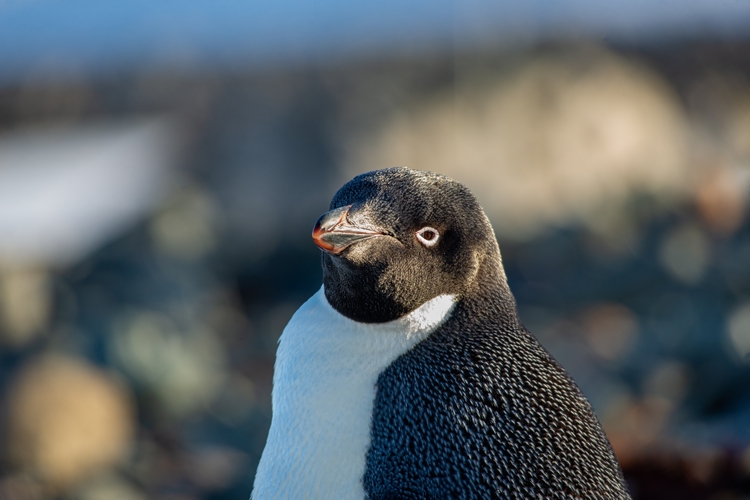
Adelie penguin

By analysing satellite images of penguin guano, scientists found diets of Adélie penguins are shifting as sea ice melts in Antarctica


By Victoria Heath

Scientists have used NASA satellite images of penguin poop (guano) to determine how Adélie penguins’ diets are shifting in the wake of climate change.

The new study, published in Current Biology, found satellite images to be the best way of studying penguin colonies across the Antarctic continent to figure out their diets. Scientists used measurements of the colour of guano across visible and infrared wavelengths to infer what penguins had been eating.


Enjoying this article? Check out our related reads…

  • Vegan diets can halve your carbon footprint, study shows
  • Five unusual climate solutions you probably haven’t heard of
  • The people saving South Africa’s last penguins
  • The icy world of penguin colonies
  • Why tourism needs a conscience

‘Antarctica has experienced rapid environmental change in recent decades, and this approach gives us a new and powerful tool to learn how it has affected penguins,’ said co-author Michael Polito.

Their findings were concerning: over a 30-year period, Adélie penguins in places with sea ice ate more fish – but in regions and years with less sea ice, they relied more heavily on krill.

Populations with more krill-based diets were likely to be declining faster than colonies with fish-based diets. Previously, research has found that chicks fed more fish become larger and have better chances of survival than chicks fed more krill.

Adélie penguins depend on a relatively small number of prey species to survive, such as Antarctic silverfish and krill. Apart from being less nourishing than fish, krill is becoming less abundant in parts of Antarctica due to both climate change and increased consumption by recovering whale and seal populations.
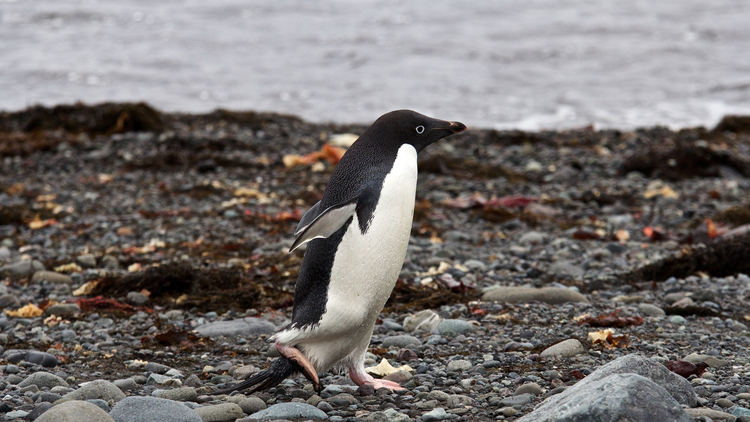
Adelie penguin on rocks
Adelie penguins primarily feed on Antarctic silverfish or krill – but a predominantly fish-based diet is thought to make chicks larger and have better survival chances. Image: Shutterstock

The study marks the first time that satellites have been used to capture food-web dynamics at both a continental scale and across decades.

‘Satellites enabled us to do something that would otherwise be impossible,’ said researcher on the study and assistant professor Casey Youngflesh.

‘The innovation wasn’t the satellite technology itself, but the ability to leverage these decades of satellite imagery with modern geochemical, statistical and computational tools. No one intended for these satellites to be used to monitor penguins, but now we’re able to use them in these novel ways.’

Until now, studying the diet of Adélie penguins has been difficult, largely due to the continent’s vast, icy terrain, which makes fieldwork logistically challenging. Researchers can visit some penguin colonies and collect samples, but it remains almost impossible to sample every colony repeatedly across decades.
Themes Wildlife Antarctica

Protected by Copyscape

Primary Sidebar

SUMMER SALE

GEOGRAPHICAL WEEKLY LOGO FREE - Sign up to get context, clarity and perspective in a noisy world, every Friday

Popular Now

Review: The Savage Landscape by Cal Flyn

Review: The Savage Landscape by Cal Flyn

QUIZ: Geography Extremes

QUIZ: Geography Extremes

Mount Etna erupting

Ancient supervolcano found in England

QUIZ: Flags of the World – South America

QUIZ: Flags of the World – South America

Ukraine destroyed building

The unseen geography of Ukraine’s reconstruction

Footer

  • Facebook
  • Instagram
  • LinkedIn
  • Reddit
  • TikTok
  • Twitter
  • YouTube

Geographical print magazine cover

Published in the UK since 1935, Geographical is the official magazine of the Royal Geographical Society (with IBG).

Informative, authoritative and educational, this site’s content covers a wide range of subject areas, including geography, culture, wildlife and exploration, illustrated with superb photography.

Click Here for SUBSCRIPTION details

Want to access Geographical on your tablet or smartphone? Press the Apple, Android or PC/Mac image below to download the app for your device

Footer Apple Footer Android Footer Mac-PC

More from Geographical

  • Subscriptions
  • Get our Newsletter
  • About Us
  • Contact Us
  • Advertise with us
  • Privacy policy
  • Terms & Conditions

Copyright © 2026 · Site by Syon Media