On the tourist trails of Komodo National Park, the world’s largest lizard is no longer quite the fearsome creature early visitors described. Whether that counts as conservation is another matter
By Lila Roberts
Indonesia has just announced new visitor restrictions for Komodo National Park: a quota of 1,000 visitors a day. Officials say the move is intended to limit environmental degradation as visitor numbers have started to rapidly grow after Covid. It may be too little, too late – not for the park, but for the animals most visitors actually come to see, the world’s largest lizard, the carnivorous Komodo dragon.
The Wallace Line passes roughly through the middle of the Indonesian archipelago, dividing species with Asian ancestry from those with Australasian roots. West of Bali, the islands once held tigers and rhinos. To the east, in Sulawesi and West Papua, cute marsupials move through the trees and cockatoos replace jungle fowl. And on Flores and the neighbouring islands of Komodo National Park, lives Varanus komodoensis – the famed Komodo dragon.
Enjoying this article? Check out our related reads…
Fossil evidence suggests that Komodo dragons evolved in Australia around four million years ago and had reached Flores by at least 1.4 million years ago. They have outlasted pygmy elephants, giant storks and even the ‘hobbit-sized’ Homo floresiensis they once shared these islands with. Paradoxically, Homo sapiens may have helped them endure: deer and pigs introduced by people became their prey, while Flores’s harshness kept human populations relatively sparse for much of the islands’ history. On my own arrival on Komodo Island, blinking up at the dusty Jurassic peaks beneath the glaring sun, I understood why lizards, not humans, thrived here.
They have outlasted everything this rugged archipelago has thrown at them for more than a million years. What may yet prove harder to survive is half a century of tourism. One of the most famous early tourism-era stories dates from 1974, when the Swiss baron Rudolf Reding von Biberegg disappeared on Komodo Island and was widely presumed to have been killed by dragons. The story has since passed into local lore, but the details are hazy enough that it is safer to describe it as a presumed dragon killing rather than an established fact.
I first encountered these creatures through Ring of Fire: An Indonesian Odyssey by Lawrence Blair, written as a companion to the Emmy Award-winning BBC series he made with his brother, Lorne. He visited Komodo in the 1970s, and his writing seared itself into my mind. His dragons bore little resemblance to the ones I found. Blair described villagers living in fear, their homes built high on stilts for safety. After landing in the churning blue bay, his group hiked inland to watch the dragons from a plateau above the riverbed. The guides were so terrified of losing another visitor that when Blair’s brother edged within fifteen feet of a dragon to take a photograph, one violently dragged him away. On his return visit in the 1980s, Blair found the animals already transformed.
A viewing platform protected by an iron cage had been constructed over the riverbed, with meat lowered by pulley to draw the dragons in. Seven were already there waiting. Blair attempted to approach on foot as they had done before. Three immediately rose, ambled over and, in his words, salivated at him with a sickening stench of excitement. He retreated to the enclosure. The brothers were only able to get close enough to take some dramatic photographs when other tourists turned up with the expected sacrificial goat. With the dragons distracted, ripping the offering to shreds, they were able to sneak around and get the close-ups required. ‘They had become communal half-hearted welfare citizens, lurking lazily for months … they had learnt that, sooner or later, dead or living food would come’ Reflecting on this change, Blair wrote: ‘They had become communal half-hearted welfare citizens, lurking lazily for months on the fringes of these spots where they had learnt that, sooner or later, dead or living food would come to provide their next free meal.’
Then, ships were bringing visitors four or five times a year. Now the park is dealing with a tourist invasion and the management problems that come with it. Last year a record number of 432,000 visitors were recorded. A 2023 carrying-capacity study estimated the maximum annual visitation should be 219,000 for Komodo Island and 39,420 for Padar Island. UNESCO and the The International Union for Conservation of Nature (IUCN) have continued to warn that tourism expansion must be managed carefully to avoid damaging the site’s World Heritage value. Clambering on to the dock of Komodo Island from our wildly rocking boat in the harsh midday light, I felt a flutter of excitement. I braced for a sweaty hike and followed our guide into the park.
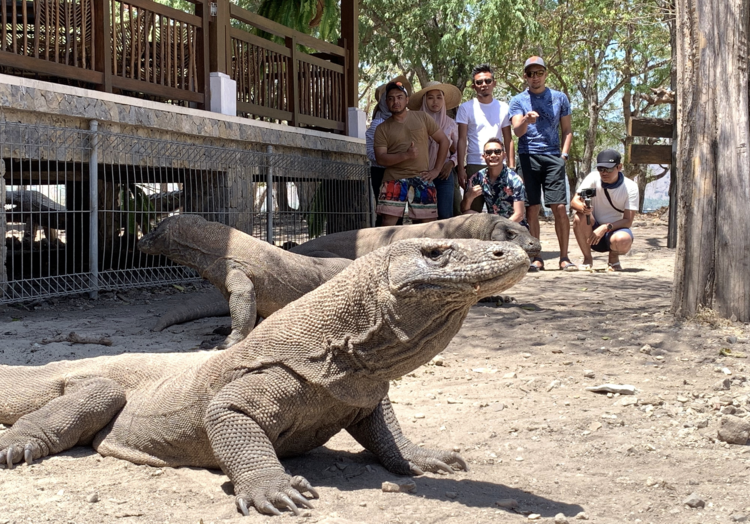
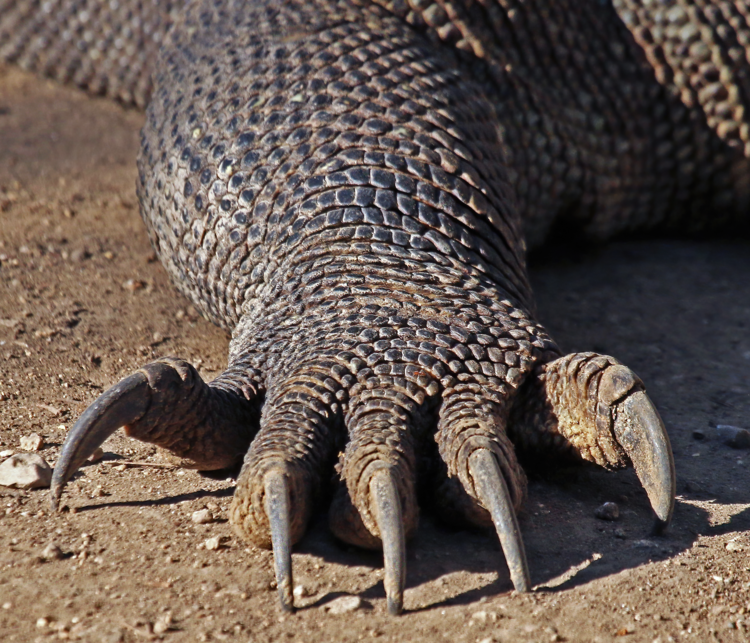
After less than five minutes, I was delighted to spot a dragon, eyes closed beneath a tree. Completely still, twenty talons curled against the ground, skin hanging in sinister folds around its leg joints, it seemed impossible that it could move, and yet the thought of seeing it do so was terrifying. I stood trying to pick out the size of its eyes against the dark mottled scales, thinking about how I was looking at one of the most ancient creatures I had ever seen. Then our guide’s voice cut through my thoughts, asking who wanted to get closer for a photo. When, less than a minute later, we spotted another dragon, I was somewhat taken aback. When the guide ushered us forward, and then forward again, I was perturbed. And when another tour group asked us to move so they could get even closer for selfies, mere steps from the dragon, I couldn’t help but feel disappointed.
Our guide seemed disappointed, too, that none of us wanted a selfie, possibly thinking about his tip. Our trek, advertised as forty to fifty minutes, took fifteen. We saw three Komodo dragons within the first seven minutes, all of them completely inanimate. We then looped round, saw a bloated spider hanging between trees, and were out, ready to run a gauntlet of tourist shops. It felt as though it took a similar amount of time to get through these as the trek did. Blair’s dragons were full of waiting menace, looking around constantly, tongues waving to taste the air, and oozing a terrible stench. These ones looked like toys by contrast. I couldn’t help but think of a slumped Beanie Baby.
A friend googled ‘are the Komodo dragons drugged for tourists?’ to inconclusive results. The truth may be more mundane. The strongest published evidence suggests that dragons in high-tourism areas are not drugged but habituated and nutritionally subsidised. A 2018 study in Biodiversity and Conservation found that Komodo dragons exposed to tourism were significantly less wary of people, larger in body mass, in better condition and had higher survival rates than dragons in areas with low or negligible human activity. The authors concluded that these changes were consistent with long-term feeding and the consumption of human derived food refuse. That study also warned of possible downsides: altered behaviour, adult-biased populations in tourist areas, and the risk that subsidies may reshape competition and predation among the dragons themselves.

A more recent study carried out in Loh Buaya, a visitor area on Rinca island, reported signs of habituation even during mating and nesting periods, suggesting that at least some dragons now show reduced sensitivity to tourist presence in one of the park’s busiest visitor zones. Herry has been guiding in Komodo National Park for seven years. I met him in Labuan Bajo in Flores, the port town that serves as the park’s main gateway and which the Indonesian government has promoted as one of its ‘10 New Balis’. He has watched this transformation happen in real time. Research published this year on visitor behaviour in Labuan Bajo and Komodo National Park describes rapid growth in nature-based and super-premium tourism, alongside rising concern about biodiversity pressure and the need for stronger green-tourism management. ‘They have adapted and become accustomed to the large number of tourists,’ he tells me. ‘This is especially true for the Komodo dragons that live and nest around Komodo Village and Loh Buaya’ – the two park habitats where visitors are allowed. ‘They are more relaxed. This is likely different for Komodo dragons that live or nest in other parts of Komodo Island, which rarely interact with tourists.’
It is an important distinction. Visitors encounter only a small, highly managed portion of the park. UNESCO’s warning about tourist numbers acknowledged that the Komodo dragon population remains stable overall, but it also stressed the need for continued monitoring and long-term protection from the impacts of tourist expansion. The story here is not one of immediate park-wide collapse. It is that the dragons most tourists meet may also be the ones most changed by regular human presence. Within Komodo National Park, the population is broadly stable. But stability does not necessarily mean wildness in the traditional sense of the word. In 2022, Indonesian authorities proposed a radical intervention: cutting visitors to 200,000 and charging $250 per entry. That’s approximately half of the new limit. It might have allowed parts of the park to recover – not just ecologically, but behaviourally.
It didn’t happen due to a huge local backlash. Tour operators, boat crews, shop owners – everyone whose livelihood depends on volume rather than margin – pushed back hard, including protests shutting the airport on Flores. Now, the government has tried again, this time with a cap of 365,000 and a booking system to manage daily flows. It limits daily visitors to 1,000, split into three sessions that must be booked in advance through a visitor app or via an arranged tour with pre-booked slots. On Padar Island, where images of tourists queuing hundreds-deep at the sunset viewpoint have gone viral, the impact will likely be visible, reducing the erosion and congestion those images made hard to ignore.
But these are measures designed to manage people. Whether they meaningfully reduce pressure on the dragons themselves is less clear. While the new cap is a huge step back from the more stringent ideas floated earlier, locals still have concerns. Herry is direct about where he stands. He and his colleagues in the tourism industry strongly oppose it, not out of indifference to the dragons, but out of a well-founded fear of what restricted quotas do in practice. ‘The potential for corruption is very high,’ he says. ‘There’s a potential black market because the public doesn’t know how many quotas are remaining each day.’ He is concerned about who benefits. Smaller, locally run operations that cater more to last-minute, lower-budget travellers are more vulnerable to restricted access, while larger companies are better positioned to secure permits and absorb costs.
That anxiety sits within a wider conservation reality. The greatest long-term pressure on Komodo dragons now appears to lie outside the park. Indonesia’s new ten-year Komodo conservation action plan says there are approximately 3,200 dragons within Komodo National Park and around 700 outside it on Flores. It also notes that the biggest conservation challenges lie beyond protected areas, where human activity is shrinking habitat. Komodo Survival Program material is even blunter: less than 15 per cent of total Komodo dragon habitat on Flores is formally protected, leaving the remainder exposed to prey depletion, slash-and-burn farming, feral dogs and human encroachment.
The community that lives alongside the dragons has watched enormous sums flow through its region with very little trickling down. A cap that further restricts local income, while leaving that structural inequality untouched, is a legitimate grievance. On the boat back from Komodo Island, the question that lingered was not whether the dragons were safe, but what kind of safety this represented. I asked Herry whether he thought that the more relaxed dragons were a bad thing. He didn’t hesitate. ‘Komodo dragons are inherently lazy animals, spending most of their time resting when they’re full,’ he said. ‘However, they become aggressive when hungry and on the prowl. For us as guides, this is beneficial. It makes it easier to guide guests, eliminating the need to trek far into the forest to find them. And with plenty of food and the dragons always full, there’s no risk of them attacking tourists.’
He doesn’t see it as unnatural. He sees it as being well-fed. The day before my visit to the dragons, I had stood atop the viewpoint on Padar Island and gazed out over the Flores Sea. No dragons were visible, just the soaring jagged peaks, the cerulean water, and the knowledge that the animals still prowl untouched in parts of this landscape. I let my imagination fill in the blanks. It felt more real than anything I would see on the trek.
Komodo dragons are classified as Endangered on the IUCN Red List. The total population is estimated at 1,383 mature individuals, or about 3,458 individuals if juveniles are included but arboreal hatchlings are not. Most of that population lies inside the national park, where long-term monitoring still points to relative stability. But the picture on Flores is more precarious. Research published in 2021 found that the species’ predicted range on Flores had contracted by about 44 per cent compared with occupied coastal areas known from previous decades.
Climate change sharpens that vulnerability even further. Rising temperatures and sea levels are expected to reduce suitable Komodo dragon habitat by at least 30 per cent over the next 45 years. Outside the park, where much of the habitat is already fragmented and poorly protected, that pressure may prove especially severe. For over a million years, Komodo dragons have proved themselves deeply resilient. It remains to be seen what version of them will emerge from the pressures of 21st-century tourism. And whether that is the thing we believe we are protecting.