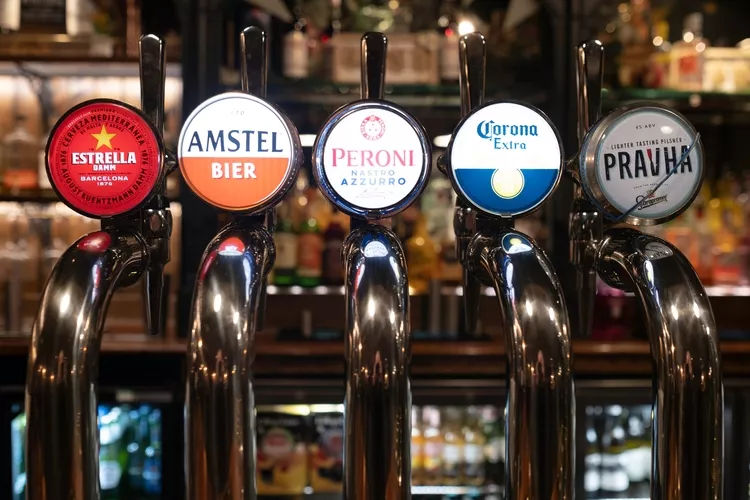

The geography behind some of our most familiar lagers is more complicated than it seems

By
Stella Artois had a busy summer. Cooling pints of the lager were among the most popular drinks in sun-scorched beer gardens. Stella was heavily marketed during both Wimbledon and the FIFA World Cup. As a gimmick, the beer came in purple cans to match the branding of the famous tennis venue, and there was a strawberries-and-cream limited edition. During the football tournament, David Beckham served as a global brand ambassador. In the States, the former England captain lent a sense of European sophistication to the golden lager, despite it being a Belgian brand. The effect of this association with sporting events and icons was to transport drinkers to different places. Most beer is sold through its real, or imagined, geographical relationships.
Madrí Excepcional launched in 2020 and is now a familiar sight on supermarket shelves and at bar pumps. This Spanish-sounding lager has attracted dismay. Madrí is a confected brand. The name and labelling suggest a connection to Madrid, but it’s brewed in Britain by Molson Coors, the beer multinational and parent company of Carling. Molson Coors says the beer was developed in collaboration with La Sagra, a Spanish brewery based near Madrid.
When the controversy garnered popular attention, a Spanish friend of mine was apoplectic at the cynicism and the way in which his heritage had been co-opted by Molson Coors. He asked me why British drinkers don’t choose a genuine Spanish lager.
Both Madrí and Carling feature glucose syrup among their ingredients. Madrí tastes remarkably like Carling. The flavour is so reminiscent that some cerevisaphiles (beer lovers) have speculated that Madrí, rather than being ‘excepcional’, is essentially Carling with a similar bland flavour profile and a different alcohol by volume.
Meanwhile, Carling has long been marketed as a quintessential British lager. Now 37 years old, the famous ‘Dambusters’ advert is among the most iconic modern promotional campaigns. It featured a British tourist bouncing his Union Jack towel over a swimming pool to capture a prized sunlounger ahead of German holidaymakers before enjoying a refreshing pint. Today, Carling is proudly brewed with 100 per cent British, Red Tractor-approved barley.
Enjoying this article? Check out our related reads…
Carling must be British then. Indeed, Carling hails from London. However, this isn’t the English capital, but London in Ontario. Carling beers have been brewed in Canada since 1840. The brand first came to the UK in 1952 and became one of the country’s best-selling beers as lager grew in popularity in the 1980s.
International lagers such as Carling displaced regional beers that had strong local associations. When I was growing up in Nottinghamshire in the late 1990s, Mansfield Bitter was a popular brew; it was the first pint I had in a pub. Mansfield Brewery was bought by Wolverhampton & Dudley Breweries in 1999, which closed the Nottinghamshire plant. The company renamed itself Marston’s in 2007. In 2020, Marston’s combined its brewing operations with Carlsberg UK to form the Carlsberg Marston’s Brewing Company; Carlsberg bought Marston’s remaining stake in 2024.
This trajectory illustrates the rapid concentration and globalisation of brewing businesses. Mansfield Bitter no longer exists in any form and the distinctive taste that came from the hard Nottinghamshire water has been lost for ever.
The perceived sophistication of continental drinking culture has influenced lager marketing in the UK. Stella Artois has persistently been sold via cartoonish Francophone messaging that belies its Belgian origins. Effete Parisian and French Riviera imagery gave a chic and relatable sheen to the brand in a way that concealed its home: the Dutch-speaking city of Leuven. Here, British consumers are as naïve about its origins as their counterparts in the USA who are drawn to the brand by Beckham’s suave aura. All of this is eurotrash gloss. Much of the Stella sold in Britain is brewed by AB InBev in the UK, including at its Magor brewery in South Wales.
Stella Artois isn’t necessarily Belgian, Madrí isn’t Spanish and Carling isn’t straightforwardly British — each is a world beer. To think otherwise is to listen to the stories advertisers are spinning. In an era of globalisation, how do we find beers that have a genuine connection to somewhere — rather than beers with a pretend geography? The simple answer is to look for smaller local brands, although these tend not to compete directly with accessible and refreshing mass-market lagers. Another is to seek out German lagers brewed according to traditional purity rules. German beer regulations retain restrictions derived from the historic Reinheitsgebot, although the modern legal position is more complicated than the familiar claim that beer may contain only barley, hops, water and yeast.