
A mistranslated sentence in a Managua plaza became a global headline about the end of Nicaraguan democracy

By
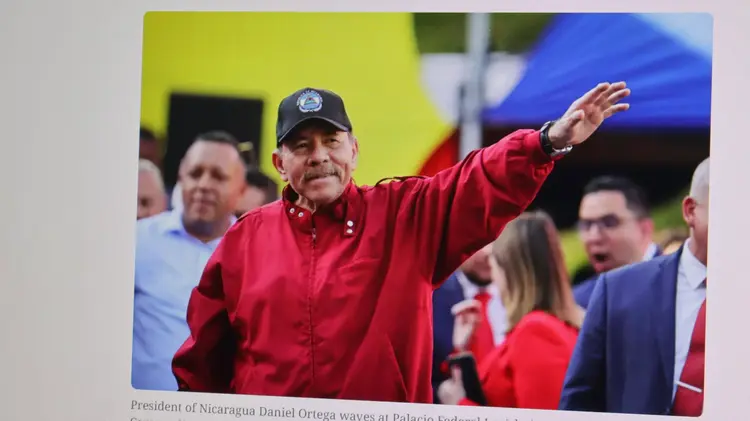
On the evening of 19 July, some 70,000 people filled the Plaza de la Fe in Managua in Nicaragua to mark the forty-seventh anniversary of the Sandinista triumph. Daniel Ortega, now co-president, spoke in the manner he has used for four decades: long, digressive, built on pauses and on the repetition of phrases until they acquire the weight of liturgy. Towards the end he turned to the opposition groups that receive American funding.
Enjoying this article? Check out our related reads…
‘They wish that they could have elections so that they could make money off of schools,’ he said. Then: ‘But they can forget that. There will no longer be elections here, there will no longer be elections here for them to capture the government and trap the people.’
Both phrases draw on Nicaragua’s political history. Ortega had spent the preceding minutes listing what the state now provides without charge, including education. Primary, secondary and university education is free by law, and his government has continued to build schools. His accusation is that an American-funded opposition, if returned to office, would begin charging for public services again, as occurred under earlier administrations, turning nominally free provision into a source of private income.
His second claim is broader. In Ortega’s account, to ‘capture the government’ means using elections, backed by foreign money, to take control of the state without a genuine domestic mandate. To ‘trap the people’ describes what he says would follow: a population governed by an administration it did not freely choose and could not subsequently remove. His reference point is the Somoza era, when a US-backed political order maintained its grip on Nicaragua through elections that offered the appearance of democratic legitimacy.
The following morning, the New York Times ran the headline ‘Nicaraguan Leader Says He Plans to Abolish Elections’ The sentence had been cut at the comma, and the clause that governed its meaning had gone. That clause is restrictive, rather than incidental. With it, Ortega is saying that there will be no more elections of that kind, no more elections serving as a mechanism for foreign-funded capture: a claim about who may stand and under what rules, not an announcement that Nicaraguans will stop voting. Cut at the comma, a qualified boast about closing off one route becomes the abolition of the ballot itself, and it was the second version that travelled. That the National Assembly then began drafting new electoral rules is difficult to reconcile with elections having been abolished at all.
What a severed clause can do
Within a day, the headline had been reproduced across most of the world’s wire services and broadsheets. Within two days, the US Secretary of State had a statement out. Ortega’s declaration, Marco Rubio wrote, it ‘lays bare their true authoritarian nature,’ and Washington called on ‘the international community to join forces’ against what he termed the Murillo-Ortega dictatorship. Reuters reported the same day that Washington was urging the region to isolate Managua.
Jill Clark-Gollub, a translator certified to interpret in the US federal courts, has called the rendering a professional failure rather than an innocent trim. Ortega uses pause and repetition structurally, she notes; to stop him before the sentence closes is to reverse what he said, and an interpreter who did it in court would face disciplinary action.
The corrections came, and travelled less far. Gustavo Porras, president of the Nicaragua National Assembly, told reporters that Nicaraguans would decide when and how their elections were held. Rosario Murillo, co-president, put it more compactly: Elections, yes, but our own elections.’ By then the diplomatic machinery had moved on and the error had created a narrative that the corrections cannot undo.
Two hundred years of the same argument
Ortega’s remarks were, as they often are, the conclusion of a history lecture rather than the opening of a policy. He began his speech in the 1850s with William Walker, the Tennessee filibuster who invaded Nicaragua with a private army and installed himself as president. He moved to the US Marine occupation of 1927–33 and Augusto Sandino’s insurgency against it, then to Sandino’s assassination in 1934 by the National Guard, an act long alleged to have had the American ambassador’s foreknowledge, and to the installing of the Somoza dynasty that Washington armed and sustained until the revolution in 1979.
After the revolution, the United States organised and financed the contra forces; the decade of war that followed killed tens of thousands. In 1986 the International Court of Justice found the United States in breach of international law in Nicaragua v. United States of America, a judgment Washington declined to recognise. In 1990 Nicaraguans voted knowing that a Sandinista victory meant the war would continue. The Sandinistas would not hold government again until 2007, when Ortega was voted in with the FSLN party.
This is the history beneath the current dispute. In Nicaragua, the phrase ‘free and fair election’ has for a century arrived with an American hand somewhere inside it. Sovereignty over the ballot is not, in that setting, an abstraction or rhetorical.
Nor is the present pressure confined to Managua. Over the past twelve months the United States has tied economic support to preferred candidates in Argentina, Bolivia, Honduras, Peru and Colombia; US lawmakers mobilised Colombian expatriate voters whose ballots proved decisive; and two days before Hondurans voted last November, Donald Trump pardoned Juan Orlando Hernández, the country’s former president and a convicted narcotrafficker.
The leaked recordings since dubbed ‘Hondurasgate’ indicate coordination between Hernández and Republican party officials in producing material against progressive governments across the region. The framework for isolating Nicaragua, ‘Shield of the Americas’, is hemispheric by design.
A closing loop
Nicaragua, like many countries eyed by the US, finds itself in an increasingly tight loop. External pressure produces a genuine, documented threat. The threat justifies closing political space: emergency powers, de-registered parties, prosecutions. The closure furnishes the evidence for the authoritarian charge. The charge licenses further pressure. Every turn is rational for whoever takes it, and every turn narrows the ground on which ordinary Nicaraguans are left to stand. Political siege is a real condition; it is also the most useful thing that can happen to a government that has stopped wanting to be voted out.
This loop reached a climax in 2018 when anti-government protests left around 270 dead. The Nicaraguan government describes an American-funded coup attempt; human rights bodies describe state and paramilitary killing. Both accounts carry evidence, and neither is complete. In 2021, seven potential opposition candidates were arrested before nomination, others fled, a party was disqualified, and the European Union, the Organisation of American States and CELAC all declined to accept the result.
In 2025, a constitutional reform created the co-presidency and consolidated executive control. Against this, the government established 50 new hospitals, free universal healthcare and education, thousands of kilometres of road, growth around four per cent and one of the lowest homicide rates in Central America. Inside Nicaragua, the government reports approval figures of 88.5 per cent.
So, a false headline, or mistranslation, then, does not make a true democracy, and an accurate criticism does not make for an honest intervention.
Return, then, to the plaza and the severed clause. The mistranslation matters not because it was unfair to Ortega, but because it flattened a two-hundred-year argument about who controls Nicaraguan sovereignty into a single day’s news about one man. Nicaraguans will decide their next election. What is genuinely in question is how much room they will be left in which to decide it, and how much of that room has been taken by Managua, and how much by Washington.