Alastair Bonnett’s forthcoming book New Ruins looks at how the debris of our disposable culture is changing the world. In this extract, he focuses on space junk
A new phase in Moon exploration is underway. It’s hoped that in 2028, Artemis IV will land astronauts near the lunar South Pole, marking the first human landing since 1972. A habitable, permanent Moon base is within touching distance. But our ambitions in space face a hurdle, for they have to find safe passage through a thickening ring of fast-moving debris that now circles the Earth.
At 10.26pm on 4 October 1957, the world changed forever. This was the moment that Sputnik, the first satellite, was launched. We stretched out our hand and placed something in space and, with every passing year, we have added new stuff. Sputnik didn’t survive long; its battery lasted 22 days.
Enjoying this article? Check out our related reads…
After circling the planet 1,440 times, it began losing altitude and arced back into the atmosphere, where it burned up on 4 January 1958. Orbiting space ruins all eventually return home. If they are in low orbit, below 600 kilometres, this normally takes a few years. The higher they are, the longer the wait. Beyond a certain point, it takes decades.
In 2025, the dead hulk of Kosmos 482 finally returned to its maker. Kosmos 482 was a Soviet spacecraft that had spent 53 lifeless, unresponsive years in orbit. Its battered, grey corpse came down, probably with a big splash, somewhere in the Indian Ocean.
It was born as a gleaming white example of Soviet technology and designed to travel to Venus and touch down on that forbidding planet. Unfortunately, its Soyuz rocket malfunctioned and, not long after launch, Kosmos 482 was cut adrift and doomed to circle the Earth. Its return could have been disastrous. It was lucky not intelligent, that guided it into the sea. We’re still not good at working out where space junk will fall. Between 2020 and 2022, four Chinese rocket boosters showered wreckage along a huge arc between Ivory Coast and the Philippines.
The early 2020s also saw debris from SpaceX rockets smash down onto farms in the USA and Australia. Crashes like this are rare, but they’re on the rise. Earth’s orbit is getting busy. Once, there were just a few satellites; then a few hundred. Eventually, we became used to the idea that a satellite is often passing overhead. I don’t think we’re up to speed with the fact that there are now thousands of them and there will soon be tens of thousands. Earth’s orbit is the new Wild West. It’s still pretty lightly regulated. Dr Jonathan McDowell, from the Harvard & Smithsonian Center for Astrophysics, offers a warning: ‘It’s going to be like an interstate highway at rush hour in a snowstorm with everyone driving much too fast.’
Working satellites are just a fraction of the stuff whizzing above our heads. There are millions of fragments now in orbit. The majority of this wreckage has been spun off from collisions and explosions. The smallest are the size of gravel chippings, so they might be imagined not to matter much. While they may be tiny, they’re very hard and they are travelling very fast – much like bullets, but at a far higher velocity.
It’s tempting, but it’s thought that the number of particles between one centimetre and ten centimetres in diameter is around 12 million, while the number between one millimetre and one centimetre may exceed 100 million. We are creating a planet-wide hazard zone.
Another way of thinking about this is as a space version of the tragedy of the commons. This is the theory that, in a situation where everyone has unlimited access to a resource, it will be used up and, eventually, be good for no one. In space circles, it’s referred to as the Kessler Syndrome.
Donald Kessler is an American astrophysicist who theorised that because collisions between orbiting debris create more debris, the amount of debris will keep increasing and, eventually, make Earth’s orbit unusable. Although there are a lot of tiny bits of space junk, there are also some hulks up there. Many are American, but one of the biggest is SL-16, a nine-tonne, 11-metre-long stage of Russia’s Zenit rocket. There is also the European Space Agency’s defunct Earth-observation satellite Envisat. This is an eight-tonne heavyweight. They are scary beasts. Any spacecraft that got in their way would be obliterated. They have no thrusters or boosters; they are out of control.
Modern satellites have manoeuvring techniques to help them avoid hazards, but they only work for a while. Space ruins have nothing. Darren McKnight, who works at a private space-debris monitoring firm called LeoLabs, explains that ‘they’re like a big yellow school bus without a driver, without brakes’. Paying attention to large space junk is what firms such as LeoLabs do, but often it’s just a question of monitoring and hoping for the best.
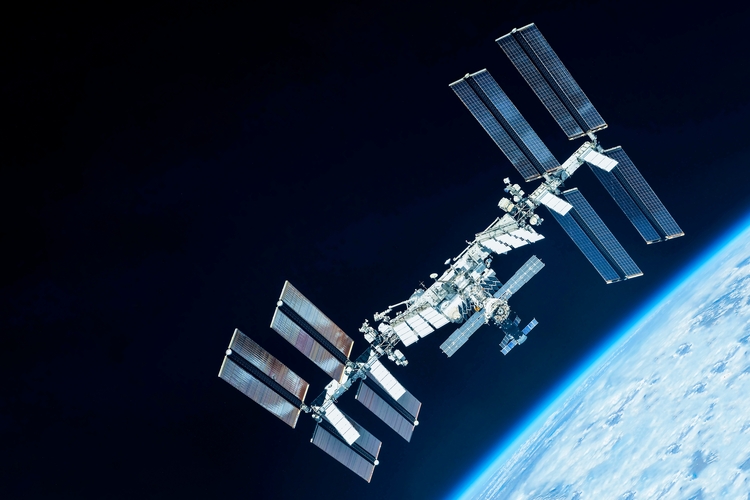
Aside from accidental impacts, the other reason why there are so many deadly fragments hurtling around our planet is because we have invented weapons that blow up satellites, and they are regularly tested. The Soviet Union tested its first anti-satellite weapon, the Polyot interceptor, in 1963. In the 2020s, Russia tested various anti-satellite missiles. Among its targets was an old intelligence satellite called Kosmos-1408. The destruction of Kosmos-1408 created a debris field that threatened the International Space Station. Astronauts on the space station were told to close the hatches between its modules and hide in the Dragon and Soyuz capsules that were then docked to the ship. Russia’s space agency, Roscosmos, sought to save the day and salvage the country’s reputation by making use of the thrusters on a Russian cargo ship that was also docked to the space station in an attempt to shove it clear. The cargo vessel fired its thrusters for exactly four minutes and 34 seconds. It worked. Thankfully, the giant structure was inched out of harm’s way, but it was a close call.
It’s not just Russia that blows up satellites: the USA, India and China have also tested anti-satellite weapons. Deliberately blasting satellites to bits makes it even more likely that one day we won’t be able to have any, because as soon as one got into orbit, it would be shredded. These tests should be included near the top of any list of dumb things that Homo sapiens has ever done.
The Blue Marble is adrift in a sea of wreckage. So how will we clean it up? There are plenty of ideas. Officials at the European Space Agency have started talking about a ‘circular space economy’. This appears to mean the reusing, repairing and recycling of all the stuff we fling up there. It sounds good, but thus far progress has been minimal. Spacecraft grabbing, netting and somehow capturing defunct items in orbit has been shown to work, but it isn’t a funding priority.
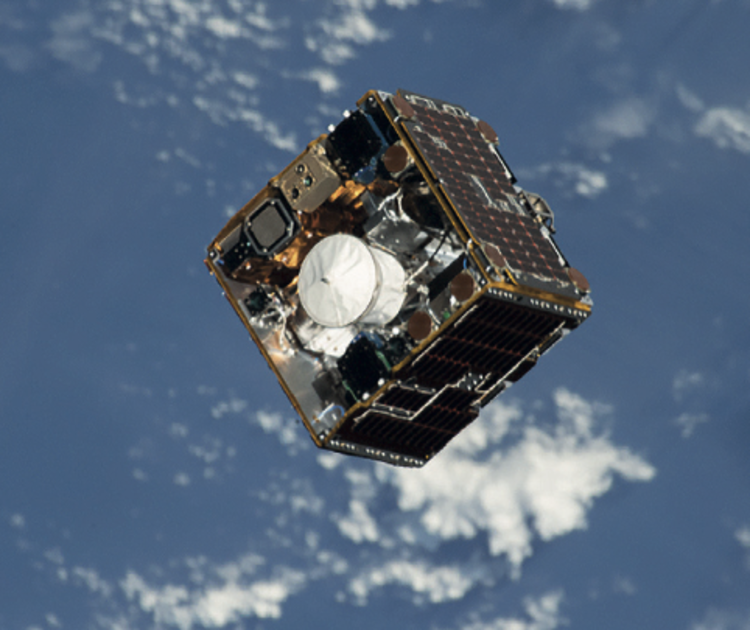
Meanwhile, the number of launches is going through the roof. The best solution is to make satellites that don’t create hazards in the first place. LignoSat, the world’s first wooden satellite, was built by Kyoto University and Sumitomo Forestry, launched to the International Space Station in November 2024 and deployed into orbit the following month. It may sound far-fetched, but biomaterials weigh less than metals and can be very robust. It’s the kind of lateral thinking we need if we want to keep Earth’s orbit in use.