

Doug Specht unpacks Gaza’s new ‘Board of Peace’ and its inherent contradictions
In September, I wrote on the risks of appointing Tony Blair to oversee the administration of Gaza. Four months on, on the heels of the US kidnapping of a head of state, and as Gaza’s ceasefire teeters on the brink of collapse, President Donald Trump unveiled his ‘Board of Peace’ for Gaza. A governance structure that would have been familiar to Lord Cromer or General MacArthur.
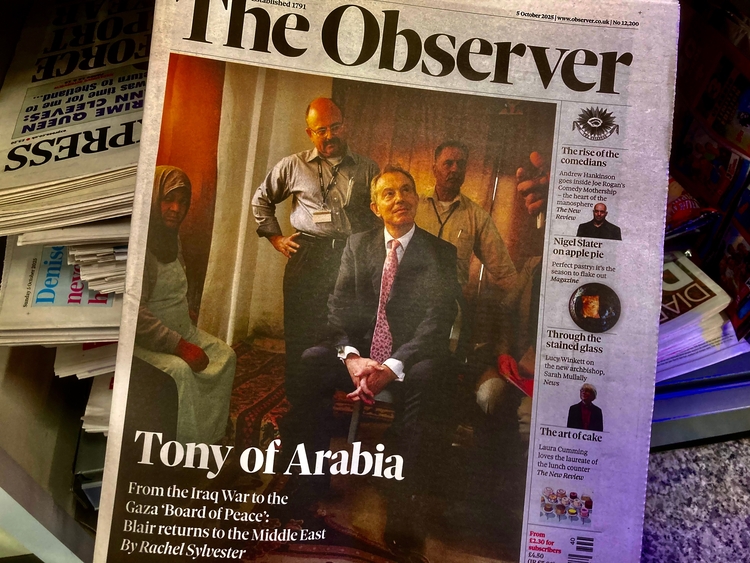
At Trump’s side stood Tony Blair, the same Blair who as Quartet Envoy had presided over Gaza’s isolation from 2007 to 2015, now returning to finish what he had started.
Enjoying this article? Check out our related reads…
The structure is audacious, a three-tiered hierarchy placing a US-led board at the strategic apex, an international executive committee in the middle, and Palestinian technocrats plus an American-commanded security force at the operational base.
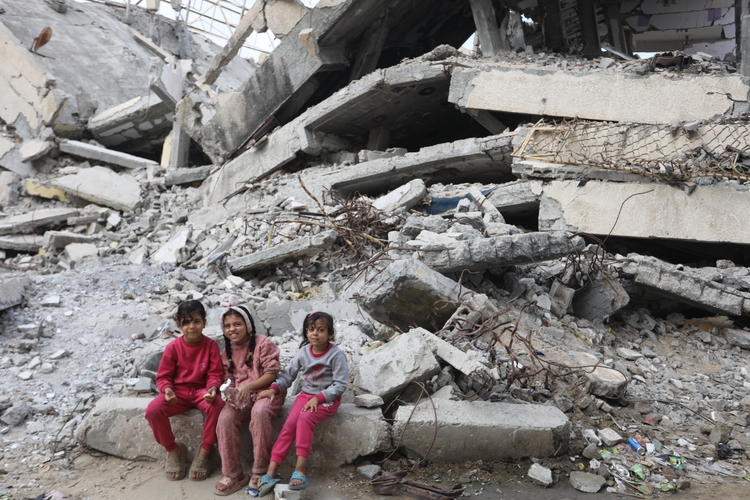
For Gaza’s 2.3 million Palestinians, this offers not self-determination but administered dependency. For the international community, it establishes a template for great-power trusteeship in the twenty-first century. For the region, it represents the most explicit assertion of American imperial authority since the 2003 Iraq invasion.
The governance architecture: imperial hierarchy disguised as partnership
The plan’s tripartite structure mimics colonial administration manuals. At the summit sits the Board of Peace, chaired by Trump himself, with Blair, Rubio, Canadian Prime Minister Mark Carney, Turkish President Recep Tayyip Erdogan, and Egyptian President Abdel Fattah al-Sisi as invited members. This body claims ‘final authority’ over Gaza’s governance, yet answers to no electorate, no parliament, no international law.
Beneath them, Nickolay Mladenov, the Bulgarian diplomat who served as UN Middle East envoy, operates as High Representative, the proconsul who translates strategic diktats into operational reality. His executive board includes Trump’s trusted envoys Steve Witkoff and Jared Kushner, regional intelligence chiefs, and financial mandarins such as Apollo Global Management’s Marc Rowan and World Bank President Ajay Banga. Palestinian governance will be designed in boardrooms and secured by intelligence services.
At the bottom, two operational bodies execute decisions made above. The National Committee for the Administration of Gaza (NCAG), led by Gaza-born engineer Dr Ali Shaath, comprises fifteen Palestinian technocrats tasked with restoring public services and rebuilding civil institutions. They have authority over sanitation and schools but none over borders, security, or political destiny. Meanwhile, Major General Jasper Jeffers, former chief of US Special Operations Command Central, commands the International Stabilization Force (ISF), an international military presence under American command authorised by UN mandate until at least 2027.
This is sovereignty sliced into irrelevance. Palestinians may administer daily life while Americans control strategy, Israelis maintain the blockade, and an American general commands foreign troops policing Palestinian streets.
The imperial personnel: viceroys for a new age
The appointments reveal how personal networks and imperial nostalgia have replaced institutional diplomacy. Trump’s direct chairmanship extends his instinct for personal control into international governance. However, it is Tony Blair’s rehabilitation that is particularly revealing. As Quartet Envoy, he championed ‘economic peace’ while Gaza’s economy collapsed under blockade.
His 2011 claim that ‘Gaza’s potential is huge’ rings hollow recalling poverty rates exceeding 50 per cent during his tenure. For Palestinians, Blair embodies Western interventionism without accountability, a man whose Iraq War lies destroyed one society now appointed to administer another. His presence signals that the “peace plan” prioritises Western comfort over Palestinian consent.

The financial viceroys, Marc Rowan and Ajay Banga, view Gaza’s devastation as an investment opportunity. Rowan’s private equity background suggests reconstruction driven by return on investment rather than humanitarian obligation. Banga’s World Bank presidency provides multilateral cover for what is essentially a unilateral American project. This public-private partnership model transforms reparations into revenue streams, making Gaza’s suffering profitable.
Regional powers have also been co-opted as sub-imperial agents. Erdogan, al-Sisi, and Qatar’s Ali Al-Thawadi lend Arab-Islamic legitimacy while subordinating their autonomy to American strategic oversight. Turkey’s inclusion attempts to pull Ankara back toward NATO alignment, but embeds it in a structure Palestinians view as neocolonial. These states exercise delegated authority for American hegemony, not independent regional leadership.
Most tragically, Dr Ali Shaath faces an impossible burden. The Gaza-born engineer must lead a Palestinian administration lacking sovereign authority, resources, or democratic mandate. He becomes the indigenous face of foreign rule, the technocrat who legitimises occupation through competent administration. His committee’s success depends on delivering tangible improvements while navigating political constraints designed to make genuine sovereignty impossible.
The inherent contradictions
The plan’s contradictions are already visible. More than 440 Palestinians have been killed since the October ceasefire began, demonstrating the fragility of any ‘peace’ built on force. Israeli far-right ministers Itamar Ben-Gvir and Bezalel Smotrich threaten to collapse Netanyahu’s coalition, with Smotrich declaring that ‘countries that kept Hamas alive cannot be the ones that replace it’.
Yet the plan requires Israeli consent while incorporating actors Israel opposes, a fundamental paradox. Furthermore, the Board of Peace plan does not move towards disarmament by Hamas. The plan offers no political horizon, no sovereignty, no end to occupation, no comprehensive prisoner release. Why would Hamas relinquish its arms when the alternative is permanent administration by foreign appointees? Its military capability and political incentive to sabotage the process remain intact
Palestinian rejection is near-universal. Civil society groups view it as neocolonial imposition. The NCAG’s technocratic competence cannot compensate for its democratic deficit. Palestinians recall the British Mandate (1917-1948) as a prelude to dispossession; they recognise trusteeship when they see it. Even if there were support, reconstruction funding remains a mirage. The $50billion required has not been committed, no donor conference scheduled, and the private equity model repels traditional donors. The NCAG may inherit responsibility for an ungovernable territory with shattered infrastructure and no resources, a setup for failure that will inevitably be blamed on Palestinian incompetence rather than imperial overreach.
The imperial moment and its discontents
The Gaza Board of Peace is not a peace plan but an imperial project that treats Palestinians as subjects to be administered rather than citizens to be empowered. It prioritises American hegemony over Palestinian rights and recycles failed colonial methods for contemporary conflicts. Its appointments are not peacemakers but viceroys; its governance structure is not partnership but hierarchy.
Three scenarios loom. Collapse: Palestinian resistance, Israeli opposition, and regional ambivalence doom the project. Entrenchment: ‘temporary’ administration becomes permanent, creating Gaza as international protectorate. Escalation: Hamas sabotage or Israeli provocations restart conflict, discrediting imperial peace-making for a generation.
For Gaza’s residents, these appointments offer both hope for reconstruction and fear of renewed occupation, this time under international mandate rather than Israeli military rule. They understand what the board’s architects ignore: that liberation through foreign administration is a contradiction in terms.
The plan’s mere existence marks a watershed: the open embrace of imperial governance after decades of rhetorical commitment to self-determination. It establishes that sovereignty is conditional and great powers remain final arbiters of who governs whom.