Dolphins were driven towards shoreline before being bludgeoned with long knives and hooks in largest ‘grind’ killing of the year
By
Around 700 dolphins were killed in the Faroe Islands on one day last week – more than two-thirds of the approximately 1,000 marine mammals killed across the entirety of last year on the islands.
Graphic scenes show hundreds of dolphins being driven toward the shore before being killed using both long knives and hooks in a series of three hunts.
Related reads…
In total, 706 dolphins were killed across the three hunts, with 406 killed in the island’s capital, Tórshavn, alone. These figures do not include pregnant females or juveniles.
The hunts quickly descended into chaos as whalers admitted there was a shortage of spinal lances – a mandatory tool normally used in the grind, which leaves dolphins immediately unconscious before dying. Instead, multiple marine mammals were killed using knives only.
Reports also suggest that the lack of equipment and shortage of participants led to dolphins being crushed against rocks, driven over and cut by boat propellers.
Two marine conservation crew members from NGO Sea Shepherd were arrested for documenting the hunts and now face the likelihood of deportation. They were reported to the police by whalers after allegedly interfering with hunts. However, the group maintains that crew members were simply documenting the events unfolding.
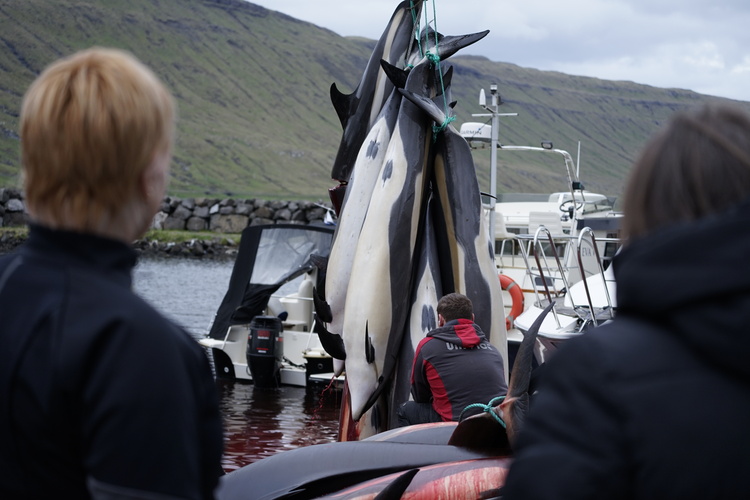
Hunts are legal under Faroese rules; however, laws impose some regulations on them. Campaigners argue all aspects of the hunts involve unnecessary cruelty and impact the pilot whale and dolphin population around the Faroe Islands. Crucially, no kill quotas are enforced – so those taking part in hunts can theoretically kill as many whales as they would like.
In the last 20 years, more than 20,000 dolphins and small whales have been killed in the grind.
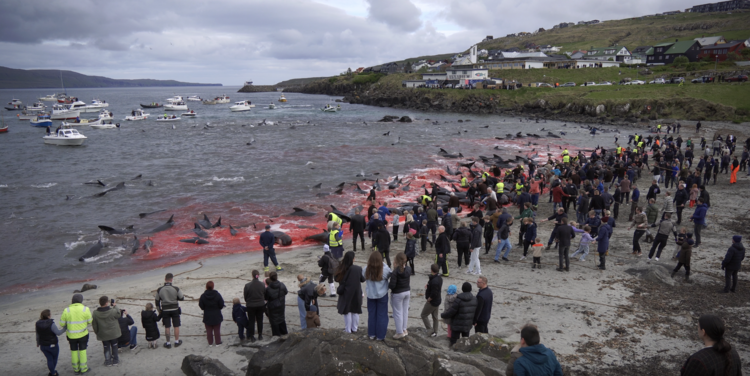
‘The events unfolding this week are not a cultural tradition on display. They are chaotic scenes of extreme animal cruelty, producing a death toll exceeding two-thirds of last year’s entire annual figure,’ said campaign director for the Faroe Islands at Sea Shepherd, Valentina Crast.
‘Dolphins were killed without the mandatory equipment. Animals were crushed against rocks and struck by boat propellers. And when a third, secret grind began, one deliberately hidden from public channels, marine conservationists were arrested for documenting it.’
‘Nobody can ever justify this level of intense suffering inflicted on innocent animals. We call on governments across Europe to stand up to see these hunts banned once and for all,’ Crast continued.
What is the grind?
Every year, hundreds of whales and dolphins – primarily long-finned pilot whales and Atlantic white-sided dolphins – are killed as part of the grindrarap (also known as the grind), a centuries-old hunting tradition in the Faroe Islands.
There is no fixed date for the grind, but most hunts usually occur between June and October as weather conditions are better.
Animals are herded by motorboats into shallow waters before becoming beached on the shore. Then, they are pulled ashore using hooks before being brutally killed using blades.
The grind dates back to the 9th century, when whale meat provided an important food source. Today, whales are still hunted for meat, with much of it frozen to be eaten later, often at celebratory occasions or parties. However, whale meat is so heavily contaminated by heavy metals that authorities discourage its consumption.
Still, the pilot whale killing and eating of whale meat are considered integral parts of Faroese culture. Campaigners argue that cultural justifications alone cannot defend such ‘senseless slaughter’, as director of World Animal Protection Denmark, Gitte Buchhave said.