

One of the most remote locations in the world, Svalbard’s Seed Vault safeguards global food security by storing 1.4 million seed samples
By
Svalbard is a Norwegian archipelago in the Arctic Ocean, roughly halfway between mainland Norway and the North Pole. Home to about 2,900 people from more than 50 nationalities, it has been under Norwegian sovereignty since the 1920 Svalbard Treaty. Before then, the islands were an international commons used by whalers, trappers and miners from several countries.
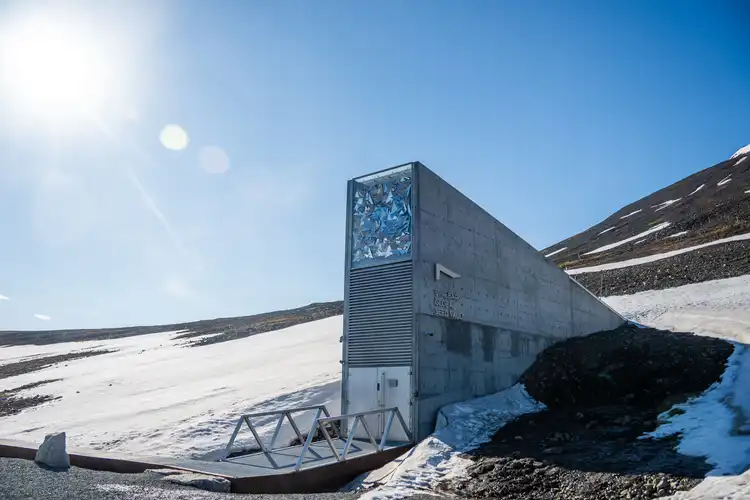
Much of Svalbard is protected to preserve its fragile Arctic environment, making it an ideal location for long-term seed storage. Built deep inside Platåberget mountain lies the Svalbard Seed Vault, a storage facility holding around 40–50 per cent of the world’s unique agricultural seed collections.
Established by the Norwegian government, NordGen and co-founding charity Crop Trust, the seed vault was created to protect the world’s crop diversity in case of a global emergency.
Enjoying this article? Check out our related reads…
Around 69 per cent of the seeds stored in the vault are grains such as rice, maize and legumes. According to NordGen, the largest global depositor in the Svalbard seed vault is the International Maize and Wheat Improvement Centre (CIMMYT), a global research centre based in Mexico. They have safeguarded over 177,000 seed samples of wheat and maize. These seeds are frozen at minus 18 degrees Celsius, the perfect temperature to prevent seeds from ageing.
How has the seed vault been used so far?
The Svalbard Seed Vault enables nations to cooperate rather than compete to protect some of humanity’s most essential food resources. When Syria broke out in war in 2011, the country’s most significant seed bank was instantly put at risk. Formerly based in Aleppo, it holds the world’s largest collection of crop diversity from the Fertile Crescent, including ancient varieties of wheat, barley, lentils, and chickpeas.
Svalbard’s seed vault proved to be an essential tool in managing the loss of produce. Scientists withdrew 100,000 vital seed samples from the centre to be deposited in Svalbard for safekeeping.
The global food crisis
According to the World Food Programme (WFP), 266 million people worldwide are at risk of acute hunger, with 17 per cent of those affected by the conflict in the Middle East alone. The challenge of food insecurity is expected to intensify as the global population grows to an estimated 10.8 billion by 2100.
The Svalbard Global Seed Vault was created to safeguard crop diversity against future global catastrophes, preserving seeds that could one day help rebuild food systems after disasters. But while it serves as an insurance policy for the future, it does little to address the immediate causes of today’s food insecurity.
That disconnect has prompted criticism from some scientists. Harvard University professor Naomi Oreskes argues that the Seed Vault is no substitute for tackling the root causes of climate change. Rather than relying on a repository designed for worst-case scenarios, she believes greater investment should be directed towards restoring damaged food systems, strengthening climate resilience and supporting climate-smart agriculture – measures that would improve food security today as well as in the future.
The global conservation effort
As of 17 June 2026, the Svalbard Seed Vault surpassed a major milestone, receiving more than 15,000 new seed samples from every continent. A representative from Crop Trust said that ‘geopolitics hold little sway’ inside the vault, where seeds from North and South Korea are stored side by side. Its purpose is simple: to preserve the genetic diversity of the world’s crops for future generations.
As climate change, conflict and food insecurity place growing pressure on global agriculture, the vault stands as both a safeguard for crop diversity and an uncommon example of international cooperation in protecting the future of food.
To see what the inside of the seed vault looks like, click here.


