
With carbon budgets tightening and clean fuels still scarce, the push for airport expansion is becoming a high stakes gamble in the UK
By Laura Cole and Bryony Cottam
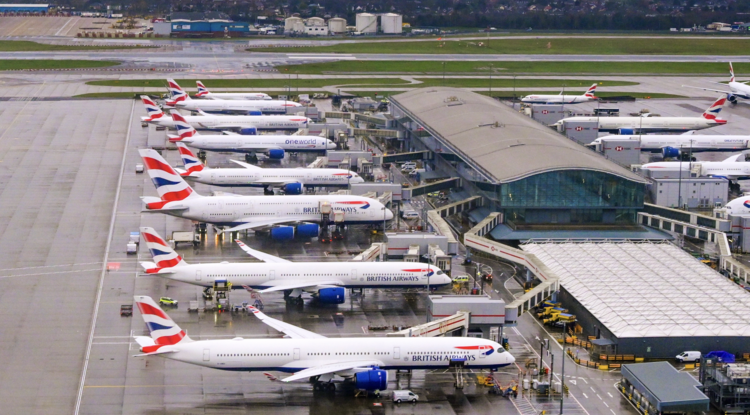
In 2025, a record 302 million passengers passed through UK airports – a figure that exceeds the combined populations of the UK, France, Germany, Spain, Portugal and the Netherlands.
These numbers solidify the UK’s position as the world’s third-largest aviation market, behind only the USA and China, and demand is only going to grow: the UK aviation regulator’s latest survey found that one in three Britons plan to fly more in 2026 than they did last year. Announcing the news, Keir Mather, the aviation, maritime and decarbonisation minister, said: ‘A record year for passenger numbers underlines the importance of boosting airport capacity as we progress our work to prepare for a third runway at Heathrow, and drive forward approved expansion plans at Gatwick and Luton.’
In On the Ground, we talk to locals fighting the expansion of a UK airport – one owned by a group of Canadian teachers. Listen now
Yet in October 2025, the UK’s cross-party Environmental Audit Committee (EAC) challenged this agenda, urging the government to rethink its support for expansion, which it claims is fundamentally incompatible with legally binding carbon budgets. These budgets act as stepping stones to the UK’s ultimate goal of reaching net zero by 2050 – a goal now in serious jeopardy.
According to the Carbon Budget and Growth Delivery Plan – revised in October 2025 after the High Court ruled the previous version lacked sufficient detail – ministers calculate that national emissions will fall 66 per cent below 1990 levels by 2030, and 81 per cent by 2035. But even before accounting for further airport expansions, the EAC report identifies aviation as one of the UK’s slowest decarbonising industries. At the same time, the UK’s Climate Change Committee (CCC) warns that the aviation sector is already pushing the limits of its projected path to net zero.
One key concern for the EAC is a lack of strategic oversight. The committee warns that by green-lighting airport expansions, the government fails to weigh the ‘cumulative effect of all expansion proposals together’, allowing total emissions to creep upwards unchecked.
In 2018, the Department for Transport calculated that existing UK airports already had the infrastructure to handle 409 million passengers per annum. However, analysis by the Aviation Environment Federation shows that current expansion plans could push total capacity to 529 million passengers per annum. This 30 per cent increase directly contradicts the CCC’s Seventh Carbon Budget (published February 2025), which advises capping passenger numbers at roughly 402 million by 2050 to stay on a net-zero trajectory.
The committee also notes that the rules used to approve or reject new developments still rely on the 2018 Airports National Policy Statement (ANPS). This document was written before the UK passed its 2050 net-zero target into law, meaning major decisions are still guided by outdated standards that fail to account for current, legally binding environmental commitments. And while UK international aviation emissions are part of the 2050 net-zero target, they aren’t yet formally included in the carbon budgets.
According to David Metz, a researcher at UCL and former chief scientist at the Department for Transport, the government’s conflicting stance on UK carbon targets and airport expansion comes down to one thing. ‘I think it stems from the desire, particularly on the part of the chancellor of the exchequer, to signal that the government is very positive about economic growth. And airport expansion doesn’t cost the Treasury anything, because the airports are all in the private sector.’
Key to the economic argument is the idea that large airports promote trade and attract business travellers whose higher-priced tickets pay for long-haul routes. But Metz argues that the economic case for expansion is ‘not at all convincing’ since the bulk of air travel – even at major hubs such as Heathrow – is for leisure. ‘That doesn’t figure in the government’s analysis.’
And while local businesses such as hospitality and high-end retail would likely welcome more inbound tourists, Metz points out that UK residents going abroad spend more than twice as much as overseas visitors spend here. In 2019, the ONS recorded £62.3 billion in outbound spend against only £28.4 billion coming in. Consequently, he says, increasing airport capacity is more likely to drain money from the UK economy than to grow it.
Enjoying this article? Check out our related reads…
The government’s plan to decarbonise aviation without limiting the sector’s growth lies in its 2022 Jet Zero Strategy, which relies on new technology and system efficiencies to reach net zero by 2050. TheDepartment for Transport claims that instead of clipping the industry’s wings, this strategy will future-proof aviation, ensuring that passengers can look forward to a future of ‘guilt-free travel’.
A central part of this strategy is the shift towards sustainable aviation fuels (SAFs). These are low-carbon alternatives produced from waste materials, such as household rubbish or used cooking oil, which can be used by existing aircraft engines without the need for structural changes. To accelerate the shift to SAFs, the government introduced two new initiatives: the SAF Mandate, which legally requires fuel suppliers to use a higher blend of sustainable fuels, and the Revenue Certainty Mechanism, which provides the financial stability needed to attract investment in UK fuel plants.
Despite their potential, as of early 2026, SAFs remain a very small part of the UK aviation sector. Provisional data published in December 2025 suggests the UK is on course to miss its first annual target of two per cent. Furthermore, the current supply is exclusively produced from recycled cooking oil imported from Asia, which is a finite resource. As more countries set their own targets, the UK will have to compete for this limited supply. This raises serious questions about whether there will ever be enough fuel to support the government’s expansion plans, especially as there is no proof that production can be scaled up without damaging food production or using up vast amounts of land.
The EAC argues that by focusing so heavily on fuels that don’t yet exist at scale, the government is overlooking the most effective solution: capping the number of flights.
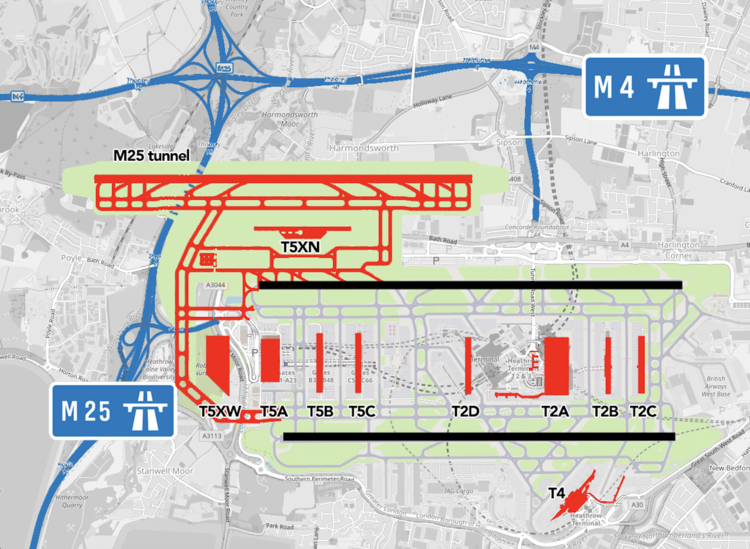
At the heart of the expansion debate is Heathrow’s Northwest Runway, a project that would increase flights from 480,000 a year to roughly 756,000. The plan is physically immense: a 3,500-metre runway constructed over the M25 motorway. To make it happen, engineers would have to shift the motorway itself, reconfiguring a vital piece of transport infrastructure just to accommodate the surge in air traffic.
Heathrow Airport occupies a unique position as Europe’s busiest gateway and the UK’s primary global hub. In a recent interview with journalist Simon Calder, Heathrow’s chief executive Thomas Woldbye stated that the airport’s third runway should have been built ten years ago. ‘We really need it, and the country really needs it.’
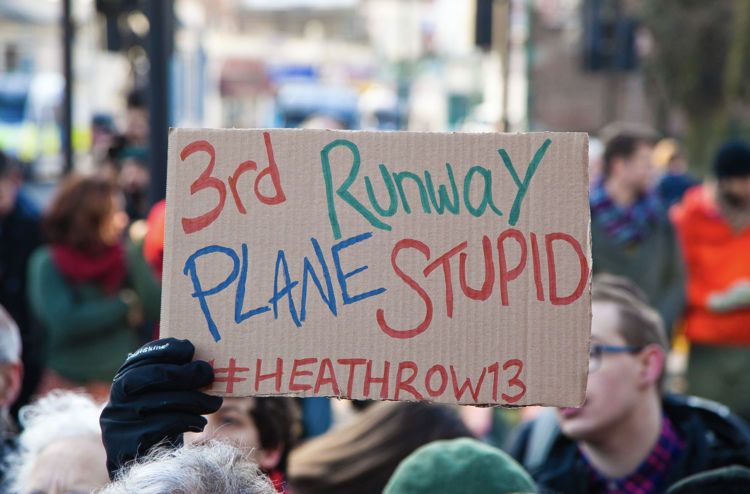
Last year, the Treasury officially backed the expansion of Heathrow, ending years of uncertainty and providing the project with its strongest political momentum in more than a decade. Despite this momentum, there’s still significant opposition to the plan. Even the airlines – including Heathrow’s biggest customers, British Airways and Virgin Atlantic – are pushing back, worried that the £49 billion cost is far too high and will lead to increased landing fees that make them less competitive.

Transport for London says that by 2050, an expanded Heathrow would be responsible for nearly 30 per cent of all London carbon emissions – a big jump from the 17 per cent expected if no new runway is built. This would make the airport the single biggest source of carbon in the UK, even out-polluting Drax power station. Beyond the climate, local people are worried about the daily reality of living near a much busier airport. More than half a million people already deal with harmful noise levels, and experts warn that official reports are underestimating how much extra noise and traffic pollution the project will actually bring to the area.
In January, the government announced a review of the ANPS, with a final version expected later this year. Ministers have identified the Heathrow Northwest Runway as the primary model for this review, but they will have to prove that such a massive expansion can coexist with the country’s carbon limits. It’s uncertain whether it will. Metz suggests that because the 2050 target is net zero rather than absolute zero, the government might claim there is still room for aviation – and emissions – to grow. The logic relies on the hope that any extra pollution can be cancelled out later by future technology, such as carbon capture and storage. ‘We’ll have to see to what extent it’s a fudge when they publish,’ he says.