Discover some of the most important facts about Greenland – along with a deep dive into its geography, history and Trump’s desire to buy the nation
By
Fact file
Area and topography
At 2,166,086 square kilometres, Greenland is the world’s largest island. Around 80 per cent of its surface is buried beneath the Greenland Ice Sheet, up to three kilometres thick, holding roughly 2.9 million cubic kilometres of
ice — enough to raise global sea levels by around seven metres if melted. The island’s spine is a high, frozen plateau, fringed by rugged mountains and dissected by fjords. Only a narrow coastal strip remains ice-free, where most of the population lives.
Climate and environment
Greenland sits firmly within the Arctic Circle. Winters are long and severe, with average temperatures of –20°C in the north and –5°C in the south. In summer, the sun barely sets and temperatures hover near freezing.
Enjoying this article? Check out our other country profiles…
The ice sheet is losing mass more rapidly than at any point in the past 12,000 years – an average thinning of 1.2 metres annually between 2010 and 2023, rising to more than six metres at the edges. Current melt rates contribute roughly 0.7 millimetres to global sea levels every year.
Population
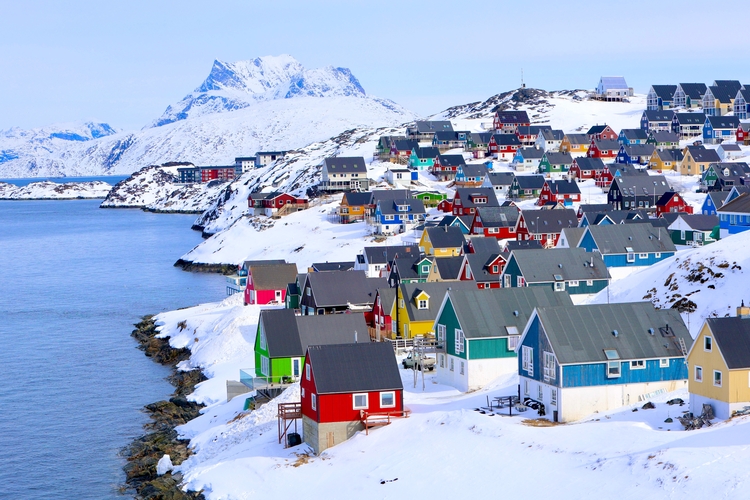
Home to around 56,000 people, Greenland is one of the most sparsely populated places on Earth. The majority are Inuit (around 89 per cent), descended from the Thule culture. Settlements hug the coast, with Nuuk, the capital, housing roughly 19,000 people. Other towns include Ilulissat, known for its ice fjord, and Sisimiut, the country’s industrial centre.
Economy
Fishing remains the economic backbone, accounting for more than 90 per cent of exports – primarily prawns and halibut. Tourism is expanding rapidly, driven by adventure travel and climate science expeditions. Mining and rare-earth exploration are growing sectors, with deposits of neodymium, dysprosium, terbium and other key materials for wind turbines, electric vehicles and electronics. Hydropower offers a clean energy advantage, though large-scale development remains limited.
Environmental status

Greenland is at the forefront of climate change. Its glaciers are retreating, tundra permafrost is thawing and rainfall is replacing snow further north each year. Scientists estimate that even if global emissions stopped today, a significant portion of the ice sheet would continue to melt, crossing what researchers call a tipping point for irreversible loss.
Flora and fauna
Despite its icy core, Greenland’s tundra supports hardy plants and animals. Lichens, mosses and Arctic flowers carpet the ground in summer. Reindeer, musk oxen
and Arctic foxes roam inland; polar bears, walruses and whales dominate the coasts. Migratory birds such as geese, puffins and terns arrive in their millions each summer.
Timeline – ice, empires and independence
c. 2500 BCE – The first known inhabitants, the Saqqaq people, arrive from Siberia, followed later by the Dorset culture.
c. 1000 CE – The Thule culture, ancestors of modern Inuit Greenlanders, spreads across the Arctic, developing technologies such as kayaks, harpoons and dog sledges that enable permanent settlement along the coasts.
985 CE – Norse explorer Erik the Red, exiled from Iceland, lands on Greenland’s southern coast and establishes the first European settlements. To entice others to follow, he names the island Grœnland – ‘Green Land’.
14th–15th centuries – The Norse colonies disappear, likely due to the Little Ice Age, isolation and shifting trade routes. The Inuit remain the island’s primary inhabitants.
1721 – Danish–Norwegian missionary Hans Egede founds a mission at Nuuk, marking the start of continuous Danish involvement in Greenland.
1814 – The Treaty of Kiel ends Danish–Norwegian union; Greenland becomes a Danish colony.

1905–45 – Greenland’s isolation deepens; only a few trading stations connect it to the outside world. During the Second World War, the USA establishes bases to defend North America’s Arctic flank, cementing Greenland’s strategic importance.
1953 – Greenland ceases to be a colony and becomes part of the Kingdom of Denmark, represented in the Danish parliament.
1979 – Greenland gains home rule, taking control of domestic affairs, including education, health and fisheries.
2009 – The island achieves self-government, with Greenlandic (Kalaallisut) becoming the official language. Denmark retains control of foreign and defence policy, but Greenland can pursue international agreements in areas of local jurisdiction.
The new Arctic rush
When Donald Trump reignited talk of ‘buying’ Greenland in March 2025, it drew international mockery – but also highlighted how fiercely contested the Arctic has become. Beneath its ice and tundra, Greenland holds what many call the new oil of the 21st century: rare earth minerals essential for green energy generation and digital technology.
Greenland’s deposits of neodymium-, praseodymium-, dysprosium-, terbium- and uranium- bearing ores are among the most promising outside China. These elements are vital for manufacturing wind turbines, smartphones, electric vehicles and guided-missile systems. With China currently controlling around 85 per cent of the global supply, Western nations see Greenland as a potential strategic alternative.
The most controversial site is the Kvanefjeld deposit in southern Greenland, once backed by an Australian–Chinese joint venture. Environmental concerns and fears over uranium by-products halted development in 2021, but renewed US interest – including quiet approaches from American defence-linked companies – has put the project back under discussion.
Beyond mining, Greenland’s melting sea ice is opening up new Arctic shipping routes, potentially cutting travel times between Asia and Europe by almost 40 per cent. For Washington, Copenhagen and Beijing alike, control of these emerging trade lanes could reshape global logistics and military reach.
Yet for most Greenlanders, the question is not who ‘owns’ the island, but how to balance economic opportunity, self-rule and environmental responsibility. As one Nuuk official told Geographical: ‘We don’t need to be bought. We just need to decide what kind of future we want to sell.’