Rory Walsh pays homage to ‘the Queen of Welsh resorts’ on a walk through Llandudno’s Victorian past
On the lower slopes of a steep, grey cliff, a zigzag footpath climbs towards a small wooden hut. The tarmac is narrow and bumpy. Grasses and wildflowers dance on either side in the breeze. It’s a blustery but warm June morning. On my left, banks of greenery shade routes to the summit. To the right, a large bay arcs towards the horizon. Its row of seafront buildings, pale and even as teeth, smiles at rolling waves. The hut, a camera obscura, is ahead on a grassy bank. Then a stranger appears.
The white figure emerges suddenly, rushing down the path with a quivering cry. He’s shorter than I am, with flaxen hair. Our eyes meet. We both stop. There’s only room for one of us to continue. I’m suddenly aware of his sinewy legs – and useful-looking horns. I retrace my steps, and he follows at a distance. It feels best to ignore him. When we reach the road at the bottom, he trots towards the pier. A man locking his car watches with a chuckle. ‘You look like you’ve seen a goat.’
Enjoying this article? Check out our related reads…
More than 180 goats live wild on the Great Orme, the larger of two craggy headlands that bookend Llandudno Bay. Located on a peninsula on the north Wales coast, Llandudno is surrounded by water on three sides. The town is also noted for its elegant Victorian architecture, including grand hotels, a wide promenade and an ornate pier. Originally a small mining village, Llandudno was transformed into a seaside resort in the 1840s. This walk, devised by retired town planner Martin Haslett, explores why and how.
Behind Llandudno’s Victorian façade is a much older settlement. Millennia of coastal erosion created the peninsula’s two natural bays. The Great and Little Orme, outcrops of Carboniferous limestone, remained too tough for the sea’s clutches. They later provided shelter for Neolithic people. A carved horse jaw found inside a burial chamber on the Great Orme is thought to be around 13,500 years old, making it the earliest known example of portable Welsh art.
After taking in the vast views beside the camera obscura, I follow the walk downhill. Today, around 19,700 people live in Llandudno. In 1801, Britain’s first census recorded 318 residents. Below the Great Orme cliff, small houses huddle on irregular plots. Welsh names abound: Tan yr Ogo, Ty Coch, Ty Gwyn. These narrow streets are the remains of Llandudno’s historic mining village. Copper ore was mined on the Great Orme for at least 4,000 years. Pn. Trwyn, a former Bronze Age copper mine on the headland, is now a fascinating visitor attraction.
Another popular draw is the Great Orme Tramway. Opened in 1902, the line takes passengers to and from the summit. Watching the bright blue tramcars go up and down the rails, it’s almost easy to miss the building next to the station. Yet accounts claim that Llandudno’s future was decided in the King’s Head pub. In 1846, Liverpool architect Owen Williams met there with local mine investors. Over a meal, Williams persuaded them that the low-lying expanse beside the Great Orme was ripe for turning into a resort.
While the Great Orme could be mined and supported a small working community, the flat land below was marshy and too salty for crops. In rough weather, the sea poured across it. Mainly fields, with a few smallholdings, the area belonged to the Mostyn family. The Mostyns supported the development proposals, and in 1848, Lord Mostyn obtained an Act of Parliament to enclose the land. A building project spanning 3.9 square kilometres was soon underway.
The rest of the walk explores the impressive Victorian town that Mostyn commissioned. A short stroll from the tram station leads to the Empire Hotel. Here, I join Llandudno’s main shopping thoroughfare, Mostyn Street. Unlike in the cramped village, the roads were wide enough for horses and carriages to pass each other. Though flowing with modern traffic, they still feel spacious. Several shops retain their original cast-iron verandas. These decorative features prove practical when rain arrives.
Such architectural devices were carefully employed throughout. The street plan followed a grid. To maintain a sense of proportion, building heights couldn’t exceed road widths. Though formal, the layout embraced natural features. Major junctions are placed to frame scenic views, such as distant mountains. The end of North Parade funnels outward, offering an enticing glimpse of the sea. Mostyn Street curves out of sight. Maps and aerial photos show that, unusually, the street plan bends to run parallel with the bay.
Lord Mostyn and his agent, John Williams, specified that ‘the town that is to be shall resemble, as far as practicable, the country’. As a result, green spaces were included, from flower beds to public gardens. North Western Gardens is affectionately known as ‘Bog Island’ after the public toilets built discreetly underground. With its mix of modern design and stunning scenery, early guidebooks promoted Llandudno as ‘the Naples of the North’ and ‘Queen of Welsh resorts’. The grandest area of all remains the seafront.
With the beach on my right, the Great Orme rises above. Below it, Llandudno Pier juts into the water. As in the Victorian era, visitors of varied ages stroll along the Promenade or relax on benches. The Promenade is so vast that there’s room for a display of 200 classic Jaguar cars, chrome glinting in the sun. Built for enjoying the views and fresh air, the Promenade also helped to establish the resort. The immense structure prevented the sea from reaching the marshy lowland. It still acts as a flood and storm defence.
Lining the Promenade is a series of luxurious hotels. Over time, they’ve welcomed many notable guests. Those at the St George’s Hotel have included Napoleon III, the Queen of Romania, several British prime ministers and Alice Liddell, the girl who inspired family friend Lewis Carroll to write Alice’s Adventures in Wonderland. The nearby Imperial Hotel, meanwhile, was requisitioned by the UK government during the Second World War. London-based Inland Revenue staff were relocated there to escape the Blitz.
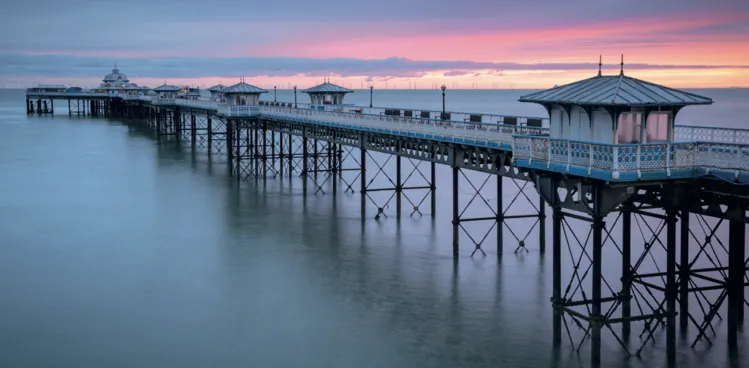
The walk concludes at the end of the Promenade. Before then, I go onto Llandudno Pier. A fairground, complete with Ferris wheel, whirs and dings among a forest of flashing lights. Intricate ironwork adorns the railings, kiosks and balustrade. The British Tourist Authority once likened Llandudno Pier to ‘a floating Maharajah’s palace.’ The National Pier Society voted it Pier of the Year 2025. Spanning 700 metres, it’s the longest pier in Wales. Towards the end, there’s a sizeable queue. They are waiting to board the PS Waverley, the world’s last seagoing passenger paddle steamer.
For this weekend only, the Waverley is cruising between Llandudno and Holyhead. As it shimmers upon the horizon, people on the pier stop walking on water to watch it arrive. Before the railway came to Llandudno in 1858, the first holidaymakers arrived by steamship from Liverpool. The long pier allowed vessels to dock in Llandudno’s shallow bay. Tasteful yet striking, a reminder of another age, the Waverley looks at home in Llandudno. When the large white ship wafts near, twin funnels emitting wisps of smoke, it almost feels like seeing a ghost.