
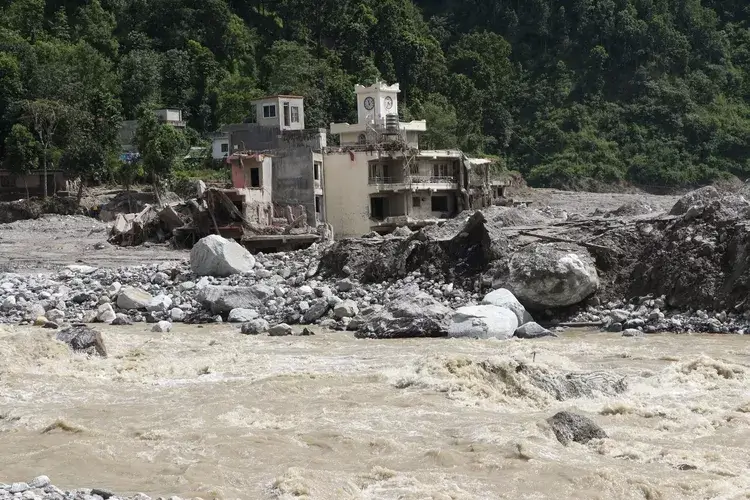
Human-induced climate change played a role in the ‘preconditioning of the disaster’ that killed 1,400 and left 6,150 missing
By
A new study by research group World Weather Attribution has revealed how climate change was a likely factor leading to the devastating floods across Nepal and Tibet.
Published on Thursday, the report stated how human-caused global warming thinned glaciers and melted mountain permafrost – ground that usually stays frozen – and ultimately intensified processes that destabilised the glacier ice and rock wall near the peak of Langtang Lirung mountain. The collapse led to 110 million cubic metres of rock and ice hitting the valley below, triggering huge flash floods that travelled at more than 177 kilometres per hour (110mph).
Enjoying this article? Check out our related reads…
‘Rock avalanches of this size are rare, with annual frequency estimates of approximately one event this size every 1,000–10,000 years,’ said the study. ‘This event shows that limits to adaptation are already being reached.’
Crucially, the report states that climate change was not the only factor causing the disaster, but rather a ‘destabilising factor acting on a pre-existing geological predisposition.’
The 7.8-magnitude 2015 earthquake in Nepal may have weakened the slope and its rocks many years before its eventual collapse, although researchers could not confirm how it specifically contributed to the disaster back in August.
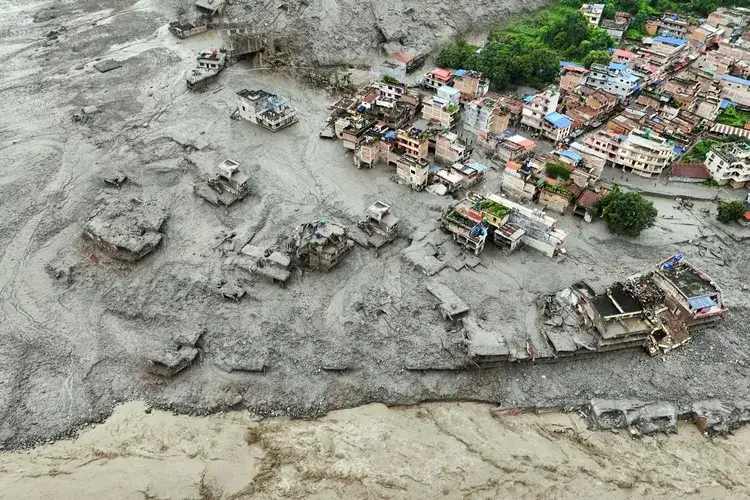
The report also found that July and August 2026 were locally the warmest months on record, with temperatures 5°C above the 30-year average in the several days leading up to the floods.
Last week, Nepal announced it would seek around $20million from the UN Fund for Responding to Loss and Damage to rebuild. According to spokesperson for Nepal’s Ministry of Agriculture, Forest and Environment Maheshwar Dhakal, the latest report ‘will be the main basis of our claim as it has detailed what role climate has played in this disaster.’
What are the impacts of melting glaciers?
Back in 2023, the UN reported that Nepal’s glaciers lost almost a third of their volume due to global warming, with glaciers melting 65 per cent faster in the last decade than in the previous one.
A UN report back in 2025 also revealed how glaciers in many regions will not survive to the end of the century if current melt rates continue. Since 1975, glaciers – excluding the Greenland and Antarctic ice sheets – have lost more than 9,000 billion tonnes of mass – equivalent to a 25-metre thick ice block the size of Germany.
Data shows that 25 to 30 per cent of sea level rise originates from glacier melt, with melting snowcaps causing sea levels to rise around one millimetre higher every year. While it may seem a small number, a rise of this amount will expose another 200,000 to 300,000 people to flooding every year.


