The Iran War has shattered the ‘Dubai Dream’ for many expats. So, the question arises: is Dubai able to get out from under such a huge geopolitical shock?
By
It’s one of the most diverse cities on Earth, drawing in millions of expats from around the world. Around 90 per cent of Dubai’s 3.8 million-strong population are expats, with 240,000 of these from the UK alone. What made Dubai so appealing to potential residents is manifold: its status as a tax-free nation draws in one of the world’s highest concentrations of billionaires, as well as perks such as modern infrastructure, ample career opportunities, and high safety standards.
Enjoying this article? Check out our related reads…
Until recent times, Dubai was, as the New Yorker describes, a relative ‘safe haven’ for those living there; ‘a sanctuary of unadulterated consumerism‘ according to The Guardian. Since the advent of the Iran War back in February, that has changed. More than two-thirds of Iran’s strikes have reportedly targeted the UAE — analysts suggest the country has been singled out, in part, for its role as a global financial hub and its military and intelligence partnerships with Western nations. Ninety per cent of the 1,700 Iranian projectiles have been blocked by the UAE’s defence systems, but some got through and struck targets including Dubai Airport and the five-star Fairmont The Palm Hotel. To date, six people have been killed and 141 have been injured across the UAE.
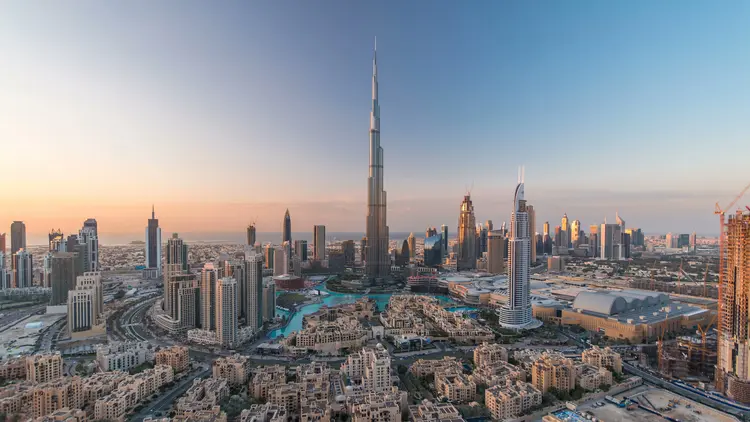
As it stands, the ‘Dubai Dream’ that so many foreigners have bought into has been drastically reshaped. Although numbers are not available as to exactly how many foreign residents have left Dubai since the conflict, reports suggest tens of thousands of residents and tourists have fled. UK media reports that between 10 and 15 per cent of the pre-war population of 240,000 Britons have also left Dubai.
The economic impacts of the conflict are likely to be severe for the UAE, but Dubai will bear the brunt of such fallout. Tourism generates around $30billion every year for the nation and it doesn’t have vast oil resources to fall back on like other Gulf countries. Analysts predict financial losses will be stark if the war continues, and Dubai’s reputation becomes eroded along with a decline in Western confidence in the city-state.
So, such a situation begs the question: can Dubai step out from under its complex present? And how did such a bustling metropolis come about in the first place?
A step back in time
The United Arab Emirates was founded in 1971, when six emirates – Abu Dhabi, Dubai, Sharjah, Ajman, Umm Al Quwain and Fujairah – joined together after Britain ended its treaty relationships in the Gulf. Ras Al Khaimah joined in 1972, creating the federation that exists today. Before unification, the region’s economy was built on pearling, fishing and trade, with Dubai and Abu Dhabi developing as important coastal centres. The discovery of oil, especially in Abu Dhabi, transformed the federation’s fortunes in the second half of the 20th century.
The UAE is a federation of seven hereditary monarchies, each ruled by its own emir. Power is shared between the federal government and the individual emirates, but Abu Dhabi and Dubai dominate politically and economically. Abu Dhabi is the capital and holds most of the oil wealth; Dubai has become the federation’s commercial, financial and tourism hub.
Dubai wasn’t always the metropolis that it is today – its rapid urbanisation brought about many changes to its status around the world. The beginning of its urbanisation began when oil was discovered offshore in 1966. After that, exports began.
But unlike its neighbour Abu Dhabi, Dubai had relatively modest oil reserves. So rather than relying on oil long term, the ruling Al Maktoum family reinvested revenues into infrastructure such as ports, roads and airports. Projects such as Port Rashid, Dubai International Airport and Jebel Ali Port – one of the largest man-made harbours – were constructed in quick succession, helping to support urbanisation. Combined with this, urbanisation was also fuelled by a dramatic influx of workers.
The city continued to diversify away from oil as its population grew – today, oil contributes less than one per cent of its GDP. Instead, urban growth has been driven by free economic zones attracting businesses, tourism and real estate megaprojects such as Palm Jumeirah and Burj Khalifa, as well as aviation and finance hubs connecting Europe, Asia and Africa.
Put simply, an effective strategy was implemented to turn Dubai into a place where capital, people and goods can move easily. Until the Iranian conflict, that strategy had proven effective.
How will Dubai’s reputation fare in the short- and long-term?
It remains a contested question whether Dubai’s brand as an ‘island of stability’ will escape unscathed or not amid the Iranian war. Many analysts are concerned with the threat such a war poses to the city-state’s security.
‘The U.S.-Israel war on Iran is upending that crucial aura of security in Dubai,’ said fellow at Rice University’s Baker Institute Jim Krane. ‘Dubai’s economic model is based on expatriate residents providing the brains, brawn and investment capital. You need stability and security to bring in smart foreigners.’
For some, like Middle East political economy expert Christopher Davidson, the attacks may impact Dubai’s appeal in the short term. For example, tourism inflows have been substantially reduced, with Dubai hotel occupancy rates significantly down. Real estate prices have also fallen from record highs and market observers have noted buyers are withdrawing from planned purchases. Prior to the war, its real estate prices were surging, boosted by the city-state’s golden visa programme that gives foreigners a 10-year renewable visa for buying a property of $550,000 or more.
However, local authorities are trying to help businesses where possible. In the last month, the UAE has put together a package of measures worth around $272million, such as granting businesses three additional months to pay government fees. According to the Financial Times, the UAE also want to relax rules on tax status and residency for foreigners, to persuade those who have left to come back.
Head of the German-Emirati Joint Council for Industry and Commerce, Martin Henkelmann, believes that the UAE – of which Dubai is located within – remains strong. ‘In my assessment, the UAE’s core strengths remain intact. Even in the face of current challenges, the UAE is well-positioned to recover quickly.’
As for the long-term impact, that depends on how the conflict unfolds. ‘A weakened Iran could enhance the UAE’s appeal even further,’ says Davidson. However, if the regime continues, tensions with Gulf neighbours may increase. ‘That’s a concern. If any of the banks or financial institutions get hit then that could impact the sentiment for businesses,’ he says.
Ultimately, the impact of the Iranian war on Dubai relies on how the conflict continues to play out in the coming weeks.