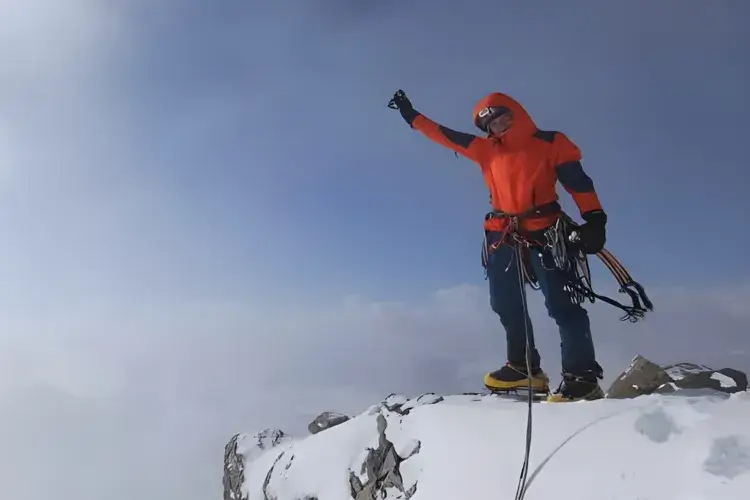
Bears in base camp, an unexpected storm and a freezing bivvy all threatened Anja Petek and Patricija Verdev’s first Himalayan expedition. Tristan Kennedy hears how they kept going
If you’re planning an expedition to summit a previously unclimbed Himalayan peak, you’ve obviously got to anticipate a certain amount of danger. Route-finding. Weather. Logistics. Climbers of the calibre needed to attempt such feats will tell you that any, or all, of these can present serious problems. But one thing that Slovenian mountaineer Anja Petek wasn’t expecting, when she set off to make the first ascent of the Indian peak Lalung I, was for her base camp to be raided by bears.
‘I was sleeping and I heard a bear who was sniffing around and breathing just behind my head,’ Petek remembered. ‘And I was like, “Whoa, this is one big, big animal.”’ Not knowing much about bears herself, she later talked to some hunters back home in Slovenia to get some perspective. ‘I asked some hunters if these bears are dangerous and they said, “Absolutely! If they found food, they would come back – and they found food.’
Enjoying this article? Check out our related reads…
Petek told me this story at the most recent Piolets d’Or awards, commonly known as the Oscars of mountaineering, where she and her climbing partner Patricija Verdev were picking up a prize for their climb. More than a year after the incident, she could laugh about the details. But at the time, she was really scared. ‘I was like, “I don’t know if I will survive this,”’ she said.
It wasn’t as if their trip had been particularly straightforward up to this point, either. Petek and Verdev aren’t full-time professional climbers, and had never climbed in the Himalayas before. But they’re both hugely experienced, and had done their homework carefully. They’d picked out Lalung I, a 6,234-metre-high virgin peak in a largely unexplored valley, as a possible objective. But they’d reserved judgement on whether to attempt it until they’d made acclimatisation climbs, and carefully scouted a route up the east ridge before deciding to go for it.
‘We expected maybe we will have some problems with difficulty, maybe we will have some problems with searching for the line and so on,’ said Petek. And so it proved. Their second day of climbing was far more technical than expected, and the pair took six hours to gain just 150 vertical metres. ‘After that, we were exhausted, and we put our tent up at 3am,’ Petek said. Worse was to come the following morning, however, when ‘we opened our tent and we saw that it was snowing, like it was Christmas.’
Based on information from their Garmin inReach satellite comms devices, and the paper forecasts brought up by their local porters from the valley, Petek and Verdev had chosen what looked like a long, clear weather window to attempt the climb. The blizzard had rolled in out of nowhere, bringing heavy flakes, which would slow them down, and potentially dangerous snow-loading on any avalanche-prone slopes above them. And because it still wasn’t showing up on their devices, they had no idea how long it would last. Petek describes feeling utterly helpless as they sat in their tent, not knowing whether ‘it will be maybe ten days of snowing, and two fresh metres of new snow’.
They were pinned down for two days before the storm abated. ‘I said to Patricija, “What do you think we should do now?” and she said, “Let’s try,”’ Petek remembers. They agreed that they would take the rest of the climb one pitch at a time, and if there was too much snow, they would try to descend down an escape route they’d identified as a plan B.
As they climbed, however, the line came together more easily. ‘If you can imagine, because it’s a ridge, and it’s steep this side and steep that side, there’s always wind, and that blew the fresh snow away,’ Petek explained. On the penultimate night, the same wind snatched away their tent poles as they tried to pitch camp, and they were forced to spend a cold night in bivvy sacks. But on the morning of the fifth day, they finally reached the summit, stopping for a few, greatly relieved, photographs, before descending down Lalung I’s western ridge to complete their east-to-west traverse.
Having all the right gear – including ice axes, large enough climbing racks, down jackets, inReach devices and bivvy sacks as backups to their tent – undoubtedly played a huge role in their eventual success. But mental preparation was also key. Petek, who is a psychotherapist in civilian life, believes that it’s the feeling of uncertainty that makes this kind of adventure particularly challenging. Physically, you can prepare for expeditions all you want, she said. But ‘if the uncertainty is too big,’ and you’re not able to deal with that mentally, you’ll struggle.
Whether it’s route-finding, weather, logistics or bears, you really have to embrace the unexpected when you’re on an expedition. ‘I had read about this before, but I’d never experienced it,’ Petek said. Even now, a year on, she still felt ‘it was too strong an experience for me to process everything.’
In the end, she explained, the Indian porters she and Verdev had hired chased the bears off with burning logs from the fire, and they made it down the valley safely. Having achieved a groundbreaking first, Petek and Verdev decided to name the route ‘Here Comes the Sun,’ reflecting their feelings of relief when the weather finally cleared on the ascent. Enough time has passed that she now enjoys retelling the story of the whole adventure – even the part with the bears. So would she do it again, I asked? ‘No!’ she laughed. ‘No. Once was enough.’
Wishlist – three items that will make adventurous expeditions easier
The Essential: Petzl Swift RL Headtorch – £120

Whatever kind of expedition you’re on, whether it’s a groundbreaking new climb, a guided, multi-day trek or just an overnight campout, a reliable headtorch is a must. The Swift RL, made by family-run French mountaineering specialists Petzl, is a solid option that won’t break the bank. Delivering up to 1,200 lumens, it throws out an impressively powerful beam while remaining compact enough to disappear into a jacket pocket. Its standout feature is Petzl’s Reactive Lighting technology, which automatically adjusts brightness depending on ambient light and where you’re looking. This helps preserve battery life, which is essential in remote areas, where you don’t want the weight of spares, and where charging opportunities may be scarce. petzl.com
The Surprisingly Useful: Teva Hurricane XLT3 Sandals – £75

Obviously you can’t climb alpine peaks in shoes like these, but a pair of hard-wearing sandals are an incredibly useful addition to any expedition kit bag. These Hurricane XLT3s are a slightly updated version of the brand’s best-selling XLT2 model, with a softer EVA midsole, and additional cushioning around the heel. Like their predecessor, they essentially kill two birds with one stone, being comfy enough to wear instead of slippers in a refuge or around a campsite, but sturdy enough for some pretty serious hiking, doubling up as a pair of warm weather approach shoes. They’ll take up very little space in your pack (or they’re light enough to strap to the outside if you prefer) and they’re so versatile, you’ll end up wearing them far more often than expected. teva.com
The Luxury: Petzl Quark Ice Age – £240
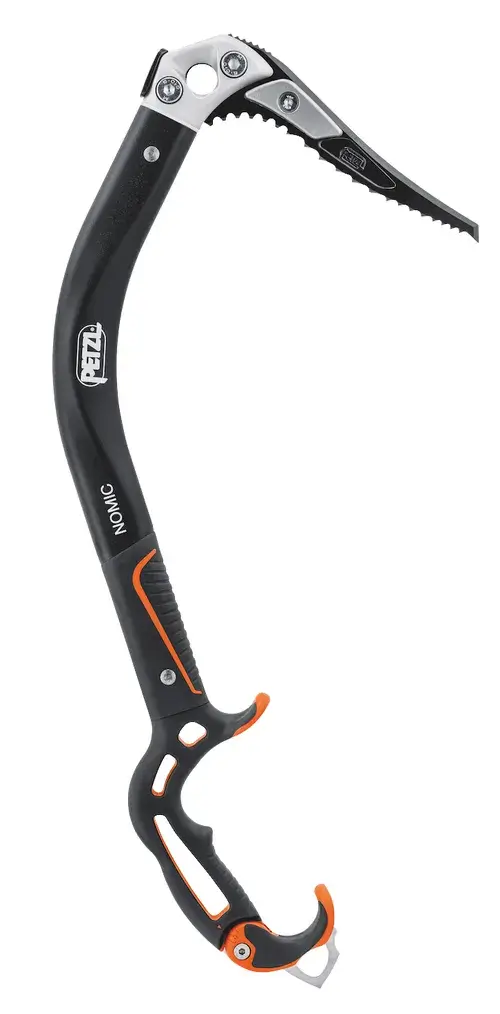
Ice tools of some kind are obviously essential if you’re attempting serious alpine ascents. But the reason we’ve listed the Quark as a luxury is because this axe from Petzl is one of the best on the market, with a price to match. That said, it’s well worth the investment, having achieved legendary status since its launch in the early 2000s. Designed to be equally comfortable on snow and ice, the axe strikes an impressive balance between precision and versatility. The aggressively curved shaft improves clearance on steep ground, while the ergonomic grip offers confidence-inspiring handling even with bulky gloves. petzl.com