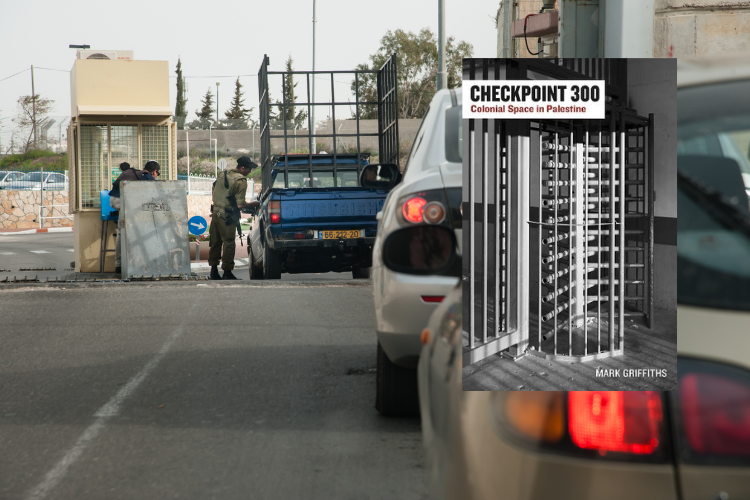
Andrew Brooks reviews Checkpoint 300, a sobering insight into the main crossing between Bethlehem and Jerusalem
The click, clack, clunk rotation of a steel turnstile is a jarring movement, harsh and unyielding to the human body.The staccato turning of a security barrier momently opens and then abruptly closes – the hard boundary between two spaces.These could be a ticket booth and the football terraces, a station concourse and the platform, or freedom and a prison.
At Checkpoint 300, turnstiles separate Bethlehem and Jerusalem. Like a stadium approach on match day, the walk up to the border is packed with people, but rather than a crowd moving steadily forward in collective anticipation, the narrowing concrete passageway leading to the border crossing is filled with a mass of Palestinian workers held for hours in a claustrophobic crush as they attempt the slow and dehumanising movement into the Israeli colonial economy. As with rail commuters, they make a daily journey, but this is one marked by brutality, as they face casual violence, gun-toting private security guards and humiliating searches rather than ticket inspectors.
Enjoying this article? Check out our related reads…
Like a prisoner, as they make the jolting walk through the stile, they enter a new place where their basic rights of citizenship are denied. These men, however, are guilty of nothing more than being born Palestinian and are moving between spaces for work that are, historically, both Palestine. Border posts are an embodiment of the politics of geography. They are places where the abstract ideas and grand theories of geopolitics touch the ground. In this book, Mark Griffiths from Newcastle University presents an academic, yet highly readable, account that expands outward from the concrete boundary.
We travel around the borderscape that bisects the colonial economy of Palestine, including the highly politicised spaces of Rachel’s Tomb, also known as the Bilal bin Rabah Mosque, and the Apartheid wall, with it’s watchtowers, graffiti and infamous Banksy cartoons,places that are emblematic of segregation. This work brings into view the everyday, mundane impacts of Israeli colonialism on the lives of women and men.
As a West Bank account, which was completed as the war in Gaza was unfolding, this is a less visceral story than the cataclysmic violence that has befallen the Gaza Strip, but understanding the normalised, pugnacious operation of Israeli colonial militarism is essential for conceptualising the wider struggle.As a signal example of feminist geopolitics – a corrective to the old ‘maps and chaps’ approach to the geography of the Middle East – the entry point is not the political decision of world leaders.
Neither is it primarily an account from the male day workers who undertake insecure, poorly paid and exploitative work in the Israeli economy, but instead, what are centered are the stories of the wives who are left behind in this highly gendered labour system. Women remain to deal with the constant deprivations the border brings to bear on daily life.Importantly, the book works across scales. The geopolitics of the Palestinian–Israeli struggle may b emade real at the border, but it’s impact extends from the turnstiles and into the kitchens and living rooms of the surrounding villages.
As Griffiths shows us, thisgeography has unique place-based impacts on thelives of those who are dehumanised and othered hereby Israel and much further afield. The effects stretchoutwards as part of a globalised military-industrialsector. Places such as Checkpoint 300 are a chokepointon Palestinian life, as well as acting as a showcase fornew Israeli security and surveillance technologies, suchas small arms, facial-recognition software and drones,that are now sold internationally and used by police andmilitaries around the world, including in the UK.