
How heavy rainfall in the Navajo Nation exposed the barriers to voting and raised questions about democracy in a changing climate
By
Much has already been written about the US midterms, possibly the most important American election in a generation. The scale of the swing, the seats that changed hands and the consequences for the rest of Donald Trump’s presidency have been analysed from every angle. Rather less attention has been paid to a smaller story unfolding at the same time, in places where the question was not how people would vote but whether they could reach a polling station at all.
In Rock Point, a community on the Navajo Nation in northeastern Arizona, the weekend before the election brought rainfall that washed out roads and bridges across the region. As Americans voted on 3 November, Valinda Shirley – vice-president of the local chapter – described residents on the west side of the community who could no longer drive to the chapter house. Some planned to walk. Others had been unable to leave their homes for days. ‘I am angry that people won’t get a chance to vote,’ she said. ‘That’s every American’s right.’
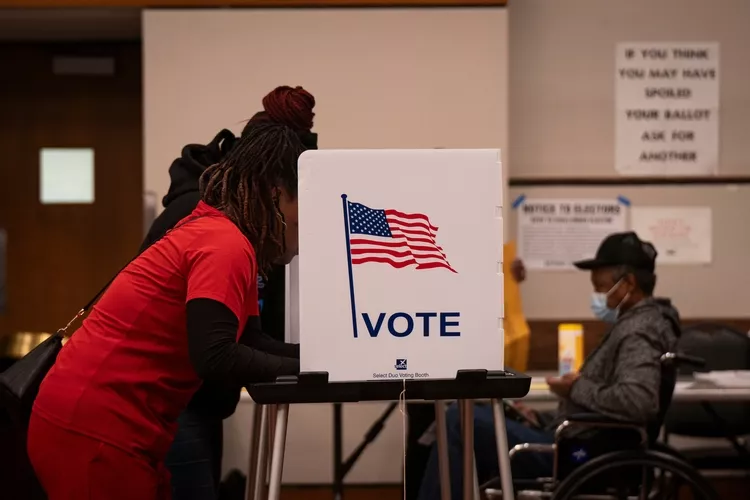
Her frustration points to a distinction that election coverage tends to obscure. A polling station can be open, staffed and run to the letter while the people it serves remain unable to reach it. Judged from inside the building, an election looks accessible. Judged from a stranded household, the same arrangements look very different.
Arizona’s secretary of state, Adrian Fontes, advised affected residents to find a more accessible voting centre, pointing to Round Rock, 27 kilometres (17 miles) away, and Many Farms, at 55 kilometres (34 miles). His office said it had offered county officials whatever resources it had. Shirley’s response was blunt: for her community, a closer centre was not an option. Another place to vote is not another way of getting there.
It would be easy to treat Rock Point as an unfortunate collision between an election and exceptional weather, but that misses the longer history. The Native American Rights Fund has documented for years how vast distances, unpaved roads, unreliable mail service and the absence of conventional street addresses already make voting harder in heavily Native counties than almost anywhere else in the country.
Calling these kinds of disruptions natural makes their consequences appear politically unavoidable, but rainfall does not decide where polling stations are placed, which roads receive investment, or what alternatives exist when travel becomes dangerous. Those decisions belong to institutions whose responsibilities do not end at the polling station door.
Across the state line in Utah, the same storm produced a different response. In San Juan County, where flooding destroyed bridges and cut off communities including Bluff and Montezuma Creek, the lieutenant governor issued an emergency declaration the day before the election allowing voters who could not reasonably reach a polling station or drop box to receive and return ballots electronically.
The state’s election director later said 244 people had used the system, which normally serves military, overseas and disabled voters. Electronic voting is not an automatic answer; it must be secure and usable by people whose electricity and phone signal may have failed too. The point is not that one state got it right and another wrong, but that access had been planned in one place and improvised in another. The more pertinent question is about why emergency access to a democratic right should depend so heavily on which side of a state boundary a flooded home happens to sit.
Enjoying this article? Check out our related reads…
Nor is this a uniquely American problem. International IDEA has identified at least 94 electoral events across 52 countries disrupted by natural hazards between 2006 and 2025. Its researchers make the point that elections depend on the same roads, power supplies and public buildings that disasters routinely damage, yet they are rarely named in national disaster planning or climate adaptation strategies. Resilience should mean designing systems that assume disruption will come, rather than relocating a polling station at the last minute.
For election authorities, that means asking in advance how voters will be contacted, which routes are vulnerable and what happens when the designated alternative is itself cut off. It means planning with tribal governments and residents rather than assuming a distant administrative centre understands the journeys people actually make. Equal treatment cannot mean offering everyone the same arrangements. Someone within walking distance of several polling places does not face the same choices as someone whose only road has gone, and protecting an equal right may require unequal levels of practical support.
Nothing in the reporting suggests the floods changed the national outcome, but that is not the threshold at which exclusion should trouble us. A person’s ability to vote deserves protection whether their ballot might decide a marginal seat or simply join a landslide. The midterms will be remembered for their result, but also remind us that democracy requires more than just permission to enter a polling station. It requires institutions prepared to take responsibility for the journey.