
• Skip to main content
  • Skip to secondary menu
  • Skip to primary sidebar
  • Skip to footer
Geographical

Geographical

Official magazine of the Royal Geographical Society (with IBG)

  • Home
  • Briefing
  • Science & Environment
  • Climate
    • Climatewatch
  • Wildlife
  • Culture
  • Geopolitics
    • Geopolitical hotspots
  • Study Geography
    • University directory
    • Masters courses
    • Course guides
      • Climate change
      • Environmental science
      • Human geography
      • Physical geography
    • University pages
      • Aberystwyth University
      • Brunel University
      • Cardiff University
      • University of Chester
      • Edge Hill University
      • The University of Edinburgh
      • Newcastle University
      • Nottingham Trent University
      • Oxford Brookes University
      • The University of Plymouth
      • Queen Mary University of London
    • Geography careers
      • Charity/non-profit
      • Education & research
      • Environment
      • Finance & consulting
      • Government and Local Government
    • Applications and advice
  • Quizzes
  • Magazine
    • Issue previews
    • Subscribe
    • Manage My Subscription
    • Special Editions
    • Podcasts
    • Geographical Archive
    • Book reviews
    • Crosswords
    • Advertise with us
  • Subscribe
    • Direct Debit Changes

North Sea scampi fishing may carry a hidden climate cost

9 March 2026
2 minutes

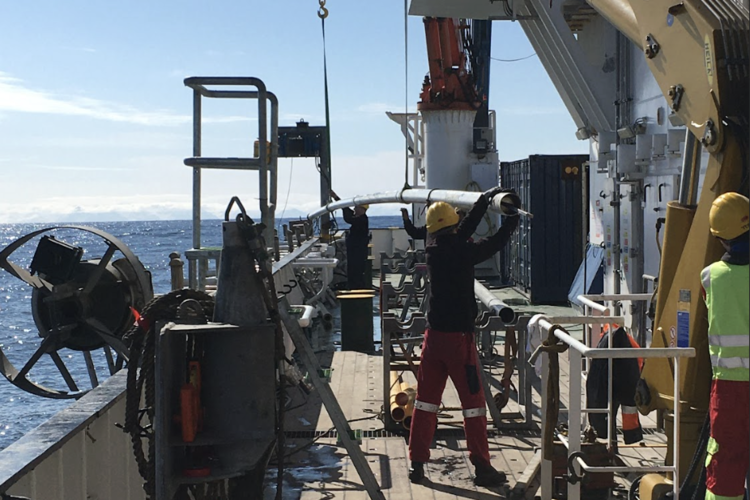
Fladen ground
Analysis conducted near Fladen Ground. Image: Jamie Scourse

New research shows bottom trawling during scampi fishing can disturb carbon buried in seabed muds for thousands of years


By Victoria Heath

A new study has revealed how crustacean fishing – including that of Norway lobster, which is used to make scampi –  could be driving a ‘largely invisible’ climate cost in the North Sea. Essentially, the process could disturb carbon that has been buried in the seabed for thousands of years.


Enjoying this article? Check out our related reads…

  • Pledges alone won’t protect the Congo rainforest’s peatlands
  • Tyranny, treason and a walk through Westminster
  • Extended seabed geology map of the Bristol Channel published
  • UK against trawling in protected seas in wake of Attenborough film
  • Review: The Deepest Map by Laura Trethewey

Researchers at the University of Exeter examined carbon levels of the seabed of Fladen Ground – a large seabed east of Scotland, which is one of the North Sea’s most commercially important fishing grounds. These muddy seabeds are also important long-term carbon stores, which are vital for climate regulation.

When fishing occurs – usually via bottom trawling, a process by which nets are dragged across sea floor habitats – sediment is churned up and carbon levels cannot replenish themselves quickly. Researchers also stress that ancient stores are likely to be affected.

While scampi is often marketed as a sustainable seafood choice, many people don’t realise that catching Norway lobsters involves towing nets directly across the seabed. That makes the environmental cost of scampi largely invisible to consumers.

The study argues that effective marine management should consider not only how much carbon is stored in seabed sediments, but how quickly it is being buried and how vulnerable it is to being released.

‘For fisheries to be genuinely sustainable, we have to consider where fishing takes place and how different seabed habitats function in the carbon cycle,’ said co-author of the study Professor Callum Roberts. ‘This isn’t an argument against eating scampi or against fishing itself. But if seafood is to be climate-smart, we need to think not just about what we catch, but how and where we catch it, and use smarter spatial management to avoid disturbing seabeds that are actively accumulating and efficiently burying more vulnerable carbon.’

Is bottom trawling bad for the environment?

In short, yes. The method is popular with commercial fishing companies, precisely because it makes it easy to catch large quantities of fish in one go. However, it also damages the seafloor, releasing carbon and killing non-target marine life – like coral, seals, dolphins and seabirds.

Bottom trawling in New Zealand fisheries. Video: Greenpeace

Bottom trawling is responsible for more than a quarter of all global catch, and targets a huge variety of wild species both for human consumption and for making feed for farmed animals.

Latest figures show that 522 seabirds (including albatross) and 152 mammals (including fur seals and dolphins) were killed by bottom trawling across a 12-month period.
Themes Briefing Oceans

Protected by Copyscape

Primary Sidebar

OUR UK DIRECT DEBITS ARE CHANGING
SPRING SALE

Geographical subscriptions

GEOGRAPHICAL WEEKLY LOGOFREE - Sign up to get global stories, told well, straight to your inbox every Friday

Popular Now

April 2026 Geographical crossword

April 2026 Geographical crossword

Kharg Island

Kharg Island: the small but vitally important piece of land powering Iran’s…

QUIZ: Physical Geography Trivia

QUIZ: Physical Geography Trivia

QUIZ: True or False – Physical Geography

QUIZ: True or False – Physical Geography

Flags of Europe

Is the world abandoning soft power?

Footer

  • Facebook
  • Instagram
  • LinkedIn
  • Reddit
  • TikTok
  • Twitter
  • YouTube

Geographical print magazine cover

Published in the UK since 1935, Geographical is the official magazine of the Royal Geographical Society (with IBG).

Informative, authoritative and educational, this site’s content covers a wide range of subject areas, including geography, culture, wildlife and exploration, illustrated with superb photography.

Click Here for SUBSCRIPTION details

Want to access Geographical on your tablet or smartphone? Press the Apple, Android or PC/Mac image below to download the app for your device

Footer Apple Footer Android Footer Mac-PC

More from Geographical

  • Subscriptions
  • Get our Newsletter
  • About Us
  • Contact Us
  • Advertise with us
  • Privacy policy
  • Terms & Conditions

Copyright © 2026 · Site by Syon Media