
Discover how history is helping to revive a former English mining town
By
It’s early in the afternoon when my train pulls into Bishop Auckland. Under grey clouds that threaten rain, I make my way down Newgate Street – the long, straight road leading to the town hall. It’s a jumble of terraced houses and shops, plywood-boarded windows and vacant plots, each one concealed behind a bright placard announcing a £53million regeneration project.
At Chittock’s, a small deli serving cheese, meat and sandwiches, a friendly shopkeeper takes my order. Behind her, wooden shelves lined with paper doilies display jams, chutneys and local honey; the chilled counter is stocked with homemade scones, caramel shortbread and flapjack selling at 30p a slice. When I mention that I’m here to see Kynren, the shopkeeper’s eyes light up.
Enjoying this article? Check out our related reads…
Bishop Auckland, or Alclit, as it was first known, began life as a lookout post in a string of forts that once lined Dere Street, a Roman-built road from Eboracum (York) to Hadrian’s Wall. The Romans, who had a knack for road building, chose the most logical path for their conquest of Scotland and laid the foundations for Dere Street straight through the low-lying Vales of York and Mowbray – a natural north–south route carved out by glaciers many millennia before, between the Pennines and the North York Moors. Today, much of Dere Street lives on as the northern stretch of the A1. It isn’t until 1020 CE, however, that the first record of a settlement called Alclit appears in the chronicles of Symeon, a Benedictine monk at Durham Priory, who notes that the land had been gifted to Bishop Eadmund by the Danish King Canute.
At the top of Newgate Street, Bishop Auckland opens up into a historic marketplace that extends between the town hall – a 19th-century Gothic Revival building that would look at home in any French city – and, at the other end, Auckland Palace. For centuries, this palace was the official country residence of the Prince-Bishops of Durham.

By the time I reach the cobbled marketplace, and my accommodation for the night – a red-roofed cottage adjacent to the palace’s walled gardens – the sun has finally broken through the dark clouds. It’s a good sign for the day’s main event: Kynren – a vast, live-action outdoor night show, performed by a cast of more than 1,000 volunteers, that tells the story of 2,000 years of English history and the often-forgotten significance of Bishop Auckland.
At the rear of the palace, overlooking a green field where a Scout troop has erected a handful of canvas tents, a metal-railed fence surrounds a recently covered trench – the final stage in a ten-year excavation project involving close to 1,000 people. ‘We’ve uncovered 300 boxes’ worth of objects from a huge area across the site,’ says John Castling, a researcher of Roman and post-Roman history at Durham University, and curator of archaeology and social history at The Auckland Project.
The Bishops of Durham have always enjoyed a uniquely powerful status. Fifty years after Canute gave Eadmund Alclit, another king – William the Conqueror – appointed William Walcher as the first Prince-Bishop of Durham, creating a buffer between Scotland and the south. It was a role that granted successive bishops extensive powers to govern County Durham almost independently of the English Crown for nearly 800 years. Yet, for all its importance, Castling says that we’ve known relatively little about Auckland Palace’s medieval history until quite recently. ‘The big research question when we started was, what did it look like? That sounds like a very basic question to ask about a really significant site, but we just didn’t know.’

Up until it was sold 14 years ago, Auckland Palace was still the working home and office of the Bishop of Durham. ‘It wasn’t really open to the public,’ says Castling, ‘and archaeology wasn’t very high on the Bishop’s agenda.’ The last major renovation to the palace building was made around 200 years ago and, consequently, there had been little need for archaeological excavations.
Castling suggests that the unique nature of the site could also have contributed to the historical blind spot. ‘An episcopate palatinate, to use its formal term, is a bit of an anomaly in British history. And it’s in the north, where traditionally there haven’t been as many big institutions doing historical and academic research. Even when they are, it’s often focused on the Romans or on the city of Durham itself. Since archaeologists began excavating the site, however, they’ve uncovered a wealth of information. It’s now probably one of the best-understood episcopal palaces in Western Europe.’
Castling says that none of this work would have happened without The Auckland Project, a charity owned by multi-millionaire investor and art collector Jonathan Ruffer. In 2012, the 74-year-old bought and began to restore Auckland Palace. A dedicated team has meticulously recreated furniture and fabrics, designing each room to reflect distinct eras of the Prince-Bishops’ long residence. Today, the palace is one of five attractions around the marketplace that visitors can access with the ‘Bishop’s Key’, a 12-month pass. Nearby, visitors can also experience the Deer Park, Weardale Railway and Binchester Roman Fort – all operated by The Auckland Project.
At the top of Auckland Tower, I meet Elizabeth, a young woman dressed in the khaki-brown uniform and red lipstick of the Second World War women’s auxiliary forces. The tower is a modern, 15-metre viewing platform that bears a slight resemblance to a trebuchet and offers panoramic views of the town and palace. Elizabeth, a volunteer at The Auckland Project who helps me to identify key sights, tells me that she comes from a long family of miners – some local, some who relocated from Ireland after the closure of the tin mines. Next door, the town’s Mining Gallery reveals the story of a community whose history is deeply entwined with the coal industry and its dramatic decline.

Over the years, the unique power of the Prince-Bishops eventually waned, and the land that had once elevated their princely status became prized instead for its vast subterranean coal seams. With the arrival of the railways, which enabled the transport of huge quantities of coal from the pits west of Bishop Auckland to the coast, the town’s population and industrial employment rapidly boomed.
It’s been more than 40 years since the strikes that officially drew the curtain on the coal era, but, like many former British mining towns, Bishop Auckland is still suffering. The latest State of the Coalfields report, commissioned by the Coalfields Regeneration Trust in 2024, reveals that former coalfield communities still have significantly fewer job opportunities than the national average, and lower hourly earnings. Steve Fothergill, an economist at Sheffield Hallam University and co-author of the report, says that while some progress has been made improve livelihoods, ‘the full benefits of job growth have not always filtered through to local residents, leaving behind many people and communities’.
‘County Durham has rather lost its sense of who it is,’ says Jonathan Ruffer when I ask about his vision for Bishop Auckland. The acquisition of Auckland Palace quickly raised a defining question: how do you preserve heritage in a way that also benefits the community? ‘The site was clearly an asset to the town that needed safeguarding. But what use is that to someone living at the other end of town who can’t afford to pay their electric bill?’ asks Jane Ruffer, CEO of The Auckland Project and wife of Jonathan Ruffer.
After lengthy discussions, the National Trust agreed that Auckland Palace could function as one of its smaller visitor sites, provided it could demonstrate 50 years of financial sustainability. ‘That came out at £23million, which we hadn’t got because we’d just spent it buying the palace.’ When the Ruffers asked how many new jobs it would create, the answer was one and a half. Instead, they established The Auckland Project. ‘It’s not just a heritage charity,’ says Castling. ‘It’s about regeneration – using the assets of history to bring about positive change in the present and for the future.’
Kynren, however, was more of an afterthought. ‘We really had no plans for a night show at all,’ Jonathan Ruffer tells me. Inspired by the model of Puy du Fou, a historical theme park in western France that attracts more than 2.5 million visitors a year with a spectacular live show performed by 4,000 local volunteers, a new project was conceived.
From that point, things began moving very quickly. ‘It was an intense coming together of people saying: “We can do this, we can get this done”,’ says Jane Ruffer. She likens the complexity of staging a 90-minute historical epic – and coordinating the teams of amateur performers, horses and farm animals that bring the show to life – to a small-scale Olympic opening ceremony. ‘There was all the building to be done, the calls for volunteers, the training of the dancers and the jousters, and the sets to design and pyrotechnics to plan. That very first year they trained through the rain and the mud.’
Now it runs every Saturday night from mid-July to mid-September to sell-out crowds. ‘It’s a well-oiled machine,’ says Jaden Dixon, Kynren’s 19-year-old visitor operations manager. He tells me he was nine when he first joined Kynren’s children’s team. ‘It was the first season; no-one really knew what Kynren was or what we would be doing. I’d just heard that this really cool thing was going on in Bishop Auckland. I signed up with my mum and my nana, and I’ve never looked back.’ After reaching the right age to play Young Arthur, the star of the show, Dixon was hooked, and what began as a family pastime soon became his vocation.
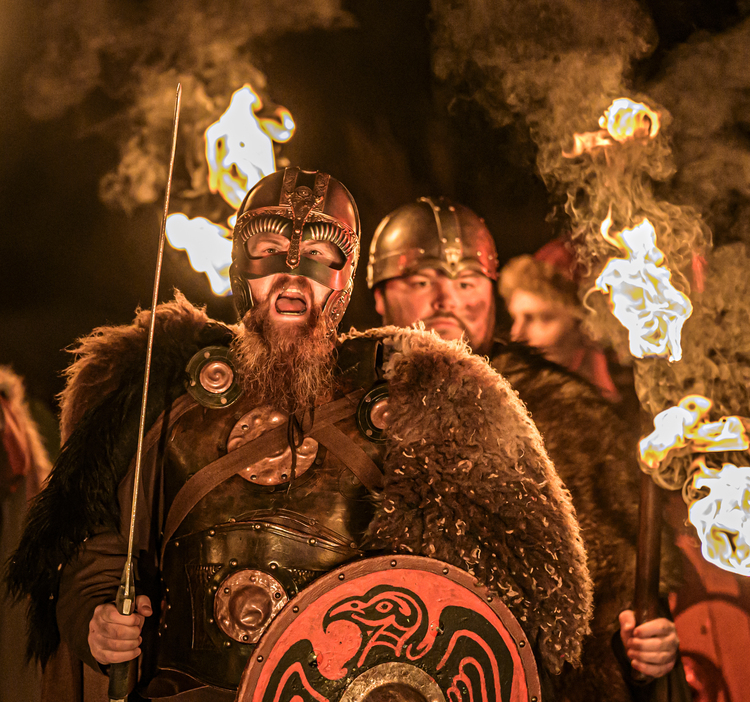
Each night of the show, an audience of 8,000 spectators watches the performance unfold through Young Arthur’s eyes across a three-hectare stage that features giant shifting set pieces – a Viking longship that rises from a purpose-built lake, a castle that emerges from the hillside and a full-size replica of George Stephenson’s Locomotion No. 1 that steams across the field. ‘The atmosphere on site is absolutely brilliant,’ says Dixon. ‘I’ve always loved the colossal effort that went into bringing all the different moving pieces together.’

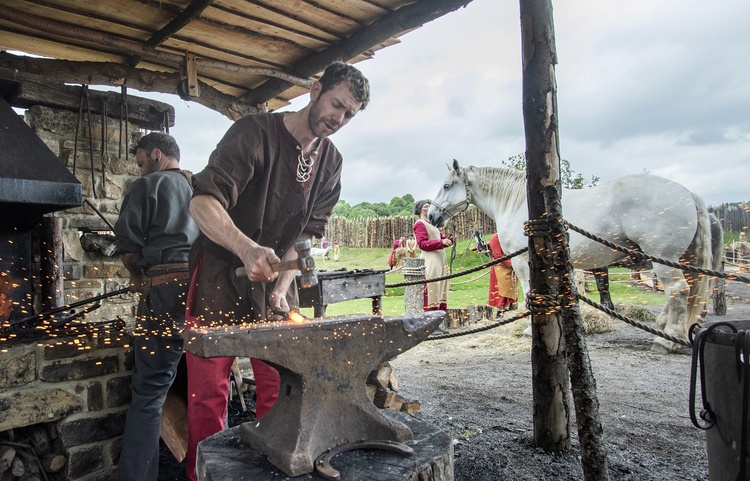
The rain holds off that evening, but Dixon tells me that the show goes on whatever the weather. I make a beeline straight for the Viking Village at the back of the stadium seating, where I discover a working blacksmith’s forge, craftspeople weaving and whittling, and a menagerie of goats, curly-haired sheep and Icelandic chickens. By the following summer, the Ruffers plan to significantly expand this area, turning it into a major daytime attraction featuring five immersive new shows.
Since its conception, Kynren has injected £65.5million into the regional economy and directly generated 146 jobs. Meanwhile, The Auckland Project has contributed a further 200 jobs, while meticulously conserving, repairing and repurposing 20 Grade-listed buildings.
Combined, they’ve helped to secure some of the £53million in government funding already designated for the regeneration of Bishop Auckland, including the high street.
While the Ruffers haven’t convinced everyone of their vision for the town, many of the dedicated volunteers who bring that vision to life enthusiastically return year after year. ‘The community is brilliant,’ says Sally Ryan, who volunteers as a visitor guide in the palace. ‘Especially the family element,’ she adds. Quite a few people in my team joined with both their children and their own parents.’ Last year, she tells me, she took her own son to watch Kynren for the first time. ‘I was so moved by what everyone’s achieved that I cried,’ she says. ‘Everybody always says volunteering is good for your soul, and I think it is, but I also think that The Auckland Project is special.’