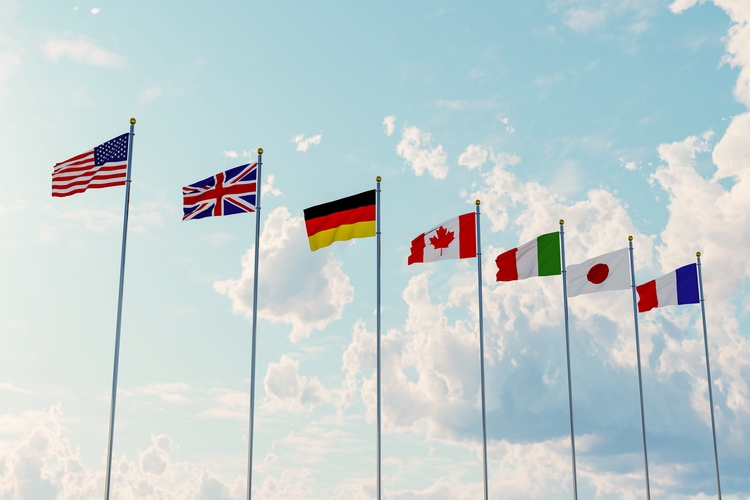
From supporting COVID-19 vaccine rollout to coordinating responses to the 2008 financial crisis, here are the ways the G7 have helped the world
By
First established in 1973, the G7 is a group comprising Italy, Canada, France, Germany, Japan, the UK and the US – alongside the European Union – created to combat global issues. Over the years, it has progressively expanded its focus, covering not just financial challenges at its annual summits but also major issues such as the environment, human rights, and arms control.
Enjoying this article? Check out our related reads…
More than 50 years since its inception – and ahead of the latest G7 summit taking place in Évian, France this week – we look back at some of the successes of the G7, and what it has accomplished:
Creation of a fund for AIDS, TB and malaria
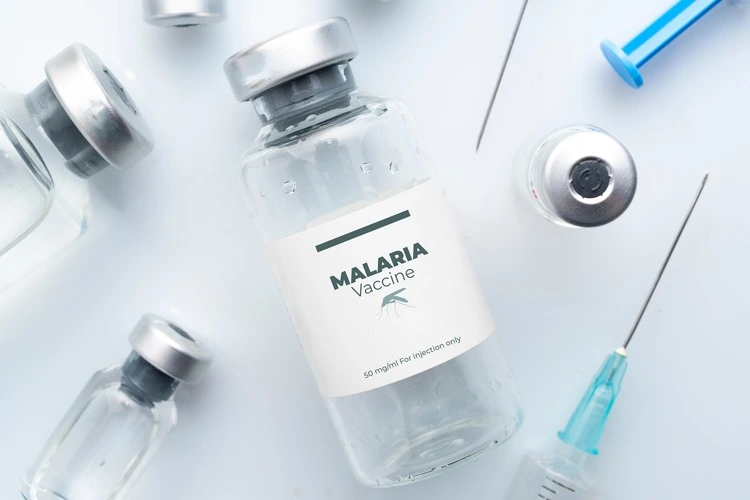
In 2002, the G7 and other stakeholders created the Global Fund to Fight AIDS, Tuberculosis and Malaria – a financing mechanism that raises and distributes billions of dollars to low- and middle-income countries to reduce the impact of these diseases.
Since its creation, more than $69billion has been disbursed, and more than 70 million lives have been saved, strengthening systems for health across more than 155 countries. As such, it makes it one of the largest funders of global health.
Supporting COVID-19 vaccine rollout
Back in 2021, global leaders pledged to deliver one billion COVID-19 vaccine doses to low-income countries worldwide, either directly or through the COVAX scheme. By the 2022 G7 summit, more than 1.17 billion vaccine doses had been administered, far exceeding the original pledge.
Such vaccines have prevented thousands of hospitalisations and deaths worldwide.
Coordinating action on Ukraine
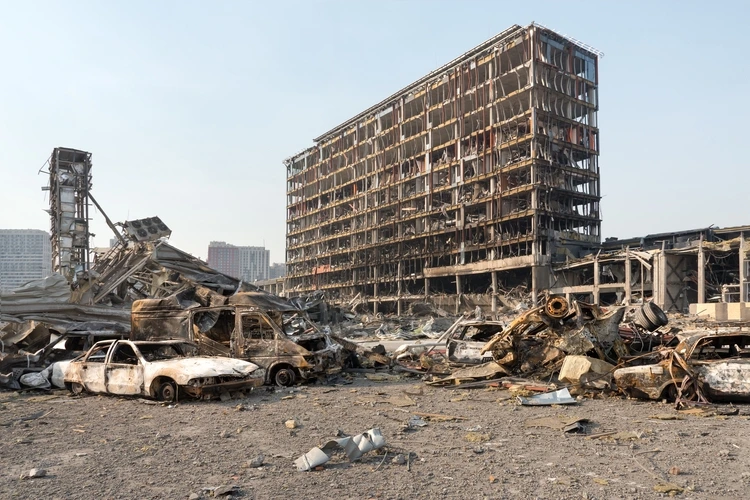
Since Russia’s invasion of Ukraine, the G7 have collectively coordinated action to support the nation. This has included a mechanism – known as the Extraordinary Revenue Acceleration (ERA) Initiative – which has provided approximately $50billion to Ukraine, repaid with profits generated from immobilised Russian sovereign assets.
Reports suggest that the latest summit in Évian will bring about more support for Ukraine, including strengthening its air defences and tightening sanctions on the Russian oil and gas sectors.
Co-ordinating response to 2008 financial crisis
In 2007, G7 countries implemented several economic policies and emergency action plans to mitigate the fiscal fallout of the financial crisis. This included a five-point action plan to stabilise the global financial system, committing members to ensuring banks had access to funding; protecting depositors; recapitalising banks where necessary; restarting lending to businesses and households, and supporting major financial institutions to prevent collapse.
According to the UK thinktank Institute for Government, the G7’s greatest achievement was creating a new lending facility after the crisis.
Supporting GAVI
The G7 has been one of the most notable financial backers of GAVI – a vaccine alliance – since its launch in 2000. Following its inception, GAVI has helped vaccinate more than one billion children in the world’s poorest countries, contributing to reductions in deaths from diseases such as measles, polio, hepatitis B and diphtheria.
The UK has historically been one of the largest donors to GAVI, alongside the US.
Backing the ‘Heavily Indebted Poor Countries’ (HIPC) Initiative
One of the G7’s most significant achievements was backing a debt-relief programme known as the Heavily Indebted Poor Countries (HIPC) Initiative, first created by the IMF and the World Bank.
It was created to ensure that poor countries are not left with an unmanageable debt. To date, 37 countries – 31 of them in Africa – have received debt relief through the initiative for which they were eligible, meaning billions of dollars could be freed up for health, education and infrastructure spending.