

From Bhopal to the draining of the Aral Sea, discover some of the worst man-made disasters that have occurred around the world
By
Around the world, some of the worst disasters have been caused not by nature, but by human decisions and error. A range of factors – from industrial accidents, poorly planned development and environmental mismanagement – have triggered crises which continue to impact people and ecosystems alike decades later.
Here, we look back at some of the most devastating man-made disasters around the world, how they were caused and what impacts they led to…
Bhopal
In December 1984, more than 500,000 people in the vicinity of the Union Carbide India pesticide plant in Bhopal, India, were exposed to the highly toxic gas methyl isocyanate after a leak at the plant.
Around 40 tons of the chemical was released, hanging low to the ground and killing residents. At least 3,000 people died on the night of the pesticide leak, while hundreds of thousands were left with cancer, disease and chronic pain for decades to come. An estimated half a million survivors suffered respiratory problems, eye irritation or complete blindness.
Such a disaster is the single worst industrial accident in history.
Chernobyl

The April 1986 disaster at the Chernobyl nuclear power plant in Ukraine was the most serious accident to have occurred in the nuclear power industry. It occurred due to a flawed reactor design and inadequate staff training.
The explosion and fires that followed released at least five per cent of the radioactive reactor core into the environment, depositing radioactive materials into many parts of Europe. Within a few weeks, 30 workers were killed, and more than one hundred more suffered radiation injuries.
In response, the authorities evacuated around 115,000 people from areas surrounding the former nuclear power plant, and 220,000 people from Belarus, Russia and Ukraine.
As of 2005, there had been more than 6,000 cases of cancer reported in children and adolescents who were exposed to radiation at the time of the accident.
Deepwater Horizon oil spill

The Deepwater Horizon oil spill is the largest marine oil spill in history, caused by an explosion back in April 2010 of the Deepwater Horizon oil rig in the Gulf of Mexico. The explosion and sinking of the oil rig killed 11 workers.
The petroleum that had leaked from the well before it was sealed formed an oil slick extending more than 149,000 square kilometres (approximately 57,500 square miles), totalling 3.19 million barrels of spilled oil. Around 20 per cent of this oil may have ended up on top of and in the seafloor, damaging deep-sea corals and other ecosystems unseen from the surface.
To begin the clean-up operation, 1.8 million gallons of dispersants – substances that emulsify oil and make it easier to remove – were released. Oil quickly began to contaminate beaches in Louisiana and was removed; harder to deal with were the state’s marshes and estuaries where the topography was covered in delicate plant life.
All in all, an estimated 1,770 kilometres (1,100 miles) of shoreline were polluted, with significant harm to wildlife. Reports emerged of pelicans turning black with oil, smothered turtles washes up on beaches and fish covered in brown sludge. In the long term, strandings of both dolphins and sea turtles were also reported, from 2010 to 2014, more than 1,000 dolphins were found along the shores of the Gulf.
Draining of the Mesopotamian Marshes

In the 1990s, the once lush and diverse wetlands of Mesopotamia became entangled in a political storm. Former Iraqi leader Saddam Hussein drained large areas in part to punish tribes living there, the Marsh Arabs, for participating in anti-government rebellions.
Several years ago, the marshes were once again thriving thanks to restoration efforts. But now, this ecosystem is collapsing again due to a combination of meteorological, hydrological and political reasons. Unless radical action is taken to ensure the region receives adequate water again, southern Iraq’s marshlands are likely to disappear for good.
Aral Sea
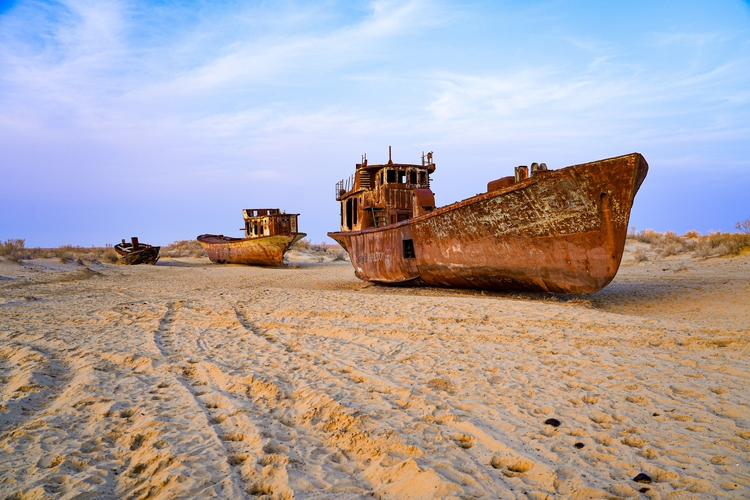
Up until the late twentieth century, the Aral Sea – located between Kazakhstan and Uzbekistan – was the world’s fourth largest saline lake.
Unsustainable, Soviet-era crop cultivation beginning around 40 years ago has meant that the lake has now already shrunk to half its former size in a reduction that the UN calls ‘the most staggering disaster of the twentieth century’.
The 3.5 million people who live in the region have seen their health, jobs and living conditions deteriorate, with the once thriving fishing and canning industry evaporating entirely as the Aral Sea’s waters turned toxic for fish and wildlife alike. In addition, blowing dust from the exposed lakebed, contaminated with agricultural chemicals, became a public health hazard.
In an effort to save some of the lake, Kazakhstan built a dam between the northern and southern parts of the Aral Sea, leading to fisheries in the North Aral to rebound. Water levels in this part of the river have begun to slowly increase.
Exxon Valdez oil spill
In 1989, the oil tanker Exxon Valdez ran aground on Bligh Reef in Prince William Sound, Alaska, after leaving the port of Valdez bound for California. The collision ruptured the ship’s hull, releasing around 11 million gallons of crude oil into the surrounding waters – creating one of the most damaging environmental disasters in US history.
The spill spread rapidly, contaminating approximately 2,100 kilometres (1,300 miles) of shoreline. Ecological impacts were severe: scientists estimate that the disaster killed around 2,800 sea otters, hundreds of harbour seals and several pods of killer whales. Fish stocks were also impacted – particularly salmon and herring – which in turn disrupted local fisheries and coastal communities dependent on them.
The clean-up operation took several years, with the remote location and harsh weather near Prince William Sound making containment difficult. In the wake of the oil spill, public outrage helped drive the Oil Pollution Act of 1990, which strengthened spill-response rules and required the introduction of double-hulled oil tankers in US waters to reduce the risk of similar accidents.
Fukushima

After a major earthquake in Japan in March 2011, a 15-metre tsunami disabled the power supply and cooling of three Fukushima Daiichi reactors. Ultimately, this led to a disaster that was the second worst in the history of nuclear power generation.
Immediately after the disaster, radiation levels increased in food, water and the ocean near the Fukushima Daiichi plant. Because of the threat of radiation exposure, around 150,000 people were forced to evacuate their homes.
At least 16 workers were injured in the explosions, while dozens more were exposed to radiation as they worked to cool reactors and stabilise the plant.
Long-term effects of radiation exposure are debated by experts and residents. The World Health Organisation (WHO) released a report in 2013 that said the disaster will not cause any observable increase in cancer rates in the region. However, some residents believe the dangers are far greater and remain wary.
Even today, several towns near Fukushima remain off limits, with authorities working to clean up the area so residents can return.
Great Pacific Garbage Patch

Every year, an estimated 1.15 to 2.41 million tonnes of plastic enter the world’s oceans. But there’s once place in particular that accumulates plastic the most: the Great Pacific Garbage Patch. Despite its name, it is actually comprised of two patches: the Western Garbage Patch and the Eastern Garbage Patch.
Located between Hawaii and California, it is the largest accumulation of ocean plastic in the world – stretching for more than 1.6 million square kilometres, an area twice the size of Texas or three times the size of France. By weight, the patch is equivalent to more than 740 Boeing 777s.
You might think that the patch is visible with large pieces of debris floating around. Instead, via satellite imagery, the water looks like a cloudy soup. Such an appearance is caused by the presence of microplastics which can’t always be seen by the naked eye.
Aberfan
In October 1966, the worst mining-related disaster in British history took place in Aberfan, a small village in South Wales.
The tragic event started when a nearby colliery ran out of tipping space in the valley floor in 1916. To combat this, a total of seven tips were constructed on the hillside overlooking Aberfan village, containing 2.1 million cubic metres of colliery spoil.
One of these tips – Tip 7 – slid down from the mountainside and into the village of Aberfan during the disaster. It entirely engulfed Pantglas Junior School and 19 houses, killing 144 people – 116 of them children.
Minamata disease
In the late 1950s in Japan, people in the fishing village of Minamata began to fall ill with a strange neurological disease mainly affecting their central nervous system. In severe cases, victims fell into comas and died within weeks.
After much research, scientists found high levels of methylmercury, a toxic form of mercury, were present in the industrial wastewater from a chemical factory – and this was the cause of the disease. The methylmercury was entering victims’ bodies through contaminated fish and shellfish, a staple of the fishing village’s diet.
As of March 2011, 2,271 patients were officially recognised as having Minamata disease, but it is estimated that the number of patients is in the several tens of thousands.


