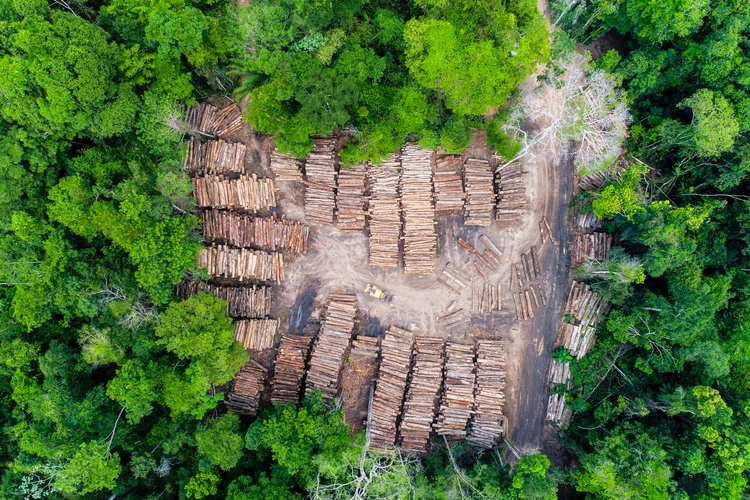
New Guinea forest – the world’s third-largest rainforest – is set to experience significant destruction to habitats, communities and families due to loggers
By
Up to 39 million trees in the world’s most biodiverse rainforest are about to be logged and shipped to China, according to rainforest charity Cool Earth.
The charity has reported that loggers are lying in wait outside eight rainforest communities in the Milne Bay Province of Papua New Guinea, trying to convince the communities to let them log for timber.
Enjoying this article? Check out our related reads…
If successful, estimates suggest up to 39 million trees, habitats that are yet to be explored and species that are yet to be discovered, eight communities, and 200 families are at risk.
The forest they are targeting – the New Guinea forest – is the world’s third largest rainforest, stretching for 73 million hectares. It stores around 6.9 billion tonnes of carbon and is home to seven per cent of all species on the planet, including endangered species such as the cuscus and birds of paradise.
In addition, more than 80 per cent of Papua New Guinea’s population depend directly on forests for food, shelter, medicine and other cultural benefits. As such, severe logging would have widespread impacts not just on rainforest communities but on the larger nation’s society.
When loggers do arrive at rainforest villages, they are not arriving alone. According to Cool Earth reports, they are hiring local people to act as messengers, setting up bases beside rainforest communities.

‘They like to target leaders and ward councillors first, knowing that if they convince one respected figure to let them log the land, others might follow,’ said a spokesperson for Cool Earth. ‘Right now they are pressuring eight communities, visiting them every two weeks to try and convince them to sell their trees.’
For the safety of both the communities and the Cool Earth team, the charity has chosen not to name the logging company. However, online records show that they intend to log and sell the timber to China.
As well as verbal pressure, loggers are also using financial incentives to encourage rainforest communities to permit logging.
‘When a logger puts a thick envelope of money on the table, it can look like a lifeline. Even if it’s just for a few weeks, life would feel easier. People in these communities don’t see thick envelopes of money every day. It is easy to understand why a logger’s offer would be tempting.’
However, to counter this, Cool Earth has an initiative giving cash to more than 58,000 people living in rainforests around the world. In return, the charity asks that recipients say no to loggers so rainforests globally remain intact.
Cool Earth has also provided technology and data to communities, helping to train them to monitor territories for activities such as illegal logging, mining and encroachment. Already, the charity supports three out of the eight communities that loggers are targeting, with the other five set to receive aid in the new year
‘It is critical that we partner with all the communities in this area, otherwise the loggers will win, and we will lose the forest forever,’ a Cool Earth spokesperson concludes.
What is illegal logging?
Simply defined, illegal logging is the unlawful felling, processing, transportation and exporting of timber.
There are high rates of illegal logging in most timber-producing countries in the tropics, as well as in Russia and some parts of Eastern Europe.
According to the most recent statistics from Interpol, illegal logging was tied to 15 to 30 per cent of global timber production, and accounted for 50 to 90 per cent of logging in many tropical countries.
The estimated annual economic value of illegal wood was $50 billion to $150 billion, making it the world’s third-largest transnational crime after counterfeiting and drugs.
Illegal logging can have a devastating impact on biodiversity as loggers often target forests in protected areas, which contain trees that are otherwise overexploited elsewhere. The practice can also impact Indigenous communities through the loss of forest resources, as well as via intimidation and violence.