France’s waymarked GR routes open up mountains, coast and countryside to all. Tristan Kennedy picks the kit that helps you go further, more comfortably
GR34. GR20. G45. To the untrained eye, these combinations of letters and numbers might look incomprehensible. But to anyone who’s spent time hiking in France, they’re like a secret code – a seemingly boring set of designations that hold the key to unlocking a whole world of adventures.
GR stands for Grande Randonnée, the name given to a series of footpaths that criss-cross the length and breadth of the country. Encompassing more than 60,000km of marked trails, this network takes in all of France’s most famous geographical features and many of its most celebrated tourist sites.
Enjoying this article? Check out our related reads…
The GR5, for example, is the name for a 2,500km-long trail that runs much of the length of western Europe: from the Hook of Holland, over the Alps and all the way down to Nice on the Mediterranean coast. GR20 is the code for the trail that runs along the spine of Corsica. It’s far from the longest, but with more than 11,000m of elevation gain over 180km, it’s often said to be the toughest of the GR34, by contrast, are quite gentle. Its trail that runs along the spine of Corsica.
It’s far from the longest, but with more than 11,000m of elevation gain over 180km, it’s often said to be the toughest of the GR34, by contrast, are quite gentle. Its trail that starts at the spectacular eighth-century island monastery of Mont Saint Michel and wraps its way around the whole coastline of Brittany. Colloquially known as the Sentier des Douaniers, or ‘the Customs Officers’ Trail’, it was once tramped by long-suffering policemen trying to stop smugglers landing on the region’s rugged coast.
It’s not just France’s natural beauty that makes the Grandes Randonnées stand out, it’s the intention behind their creation. Starting in 1947, this network was founded on explicitly egalitarian principles: designed to bring outdoor recreation – once the preserve of those who had estates, as well as enough free time to enjoy walking on them – to the masses.
The trails were the brainchild of Jean Loiseau, an archivist at the Banque de France and a passionate hiker. Born in 1896, he first fell in love with walking as a Scout in the 1910s, and after the First World War, he set up a walking group called the Compagnons Voyageurs. As the 1920s turned into the ’30s, however, Loiseau began to realise that it wasn’t just time or money that was preventing people from taking up this life-affirming activity: a lack of skills such as map-and-compass reading was limiting participation, even among those who might have had the economic wherewithal and the desire to try hiking for themselves.
Inspired by the Appalachian Trail in the US, he began talking of a network of simply marked walking trails that would require no specialist skills to follow. In the aftermath of the Second World War, with France still struggling to overcome the divisions sown during the Nazi occupation, his dream of stitching the country together with paths that would allow its battle-scarred citizens to escape into nature seemed almost utopian. But in 1946, Loiseau set about making this vision a reality. The first section of a Grande Randonnée – the GR3, near Orléans – was inaugurated the following year.
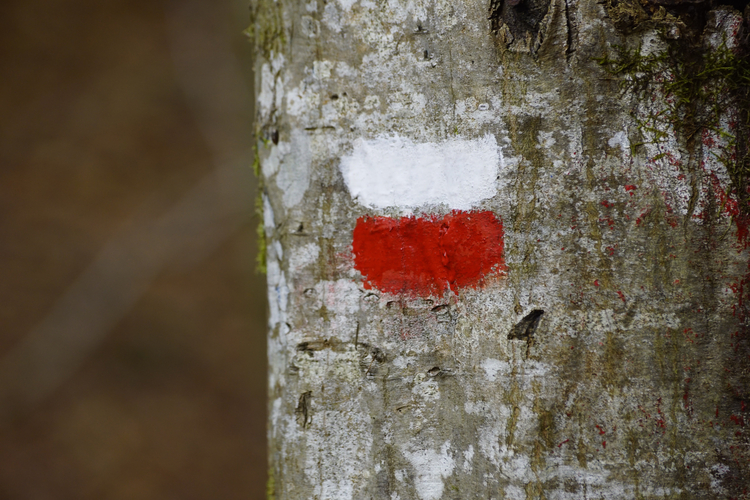
Then, as now, the genius of the GR system is simplicity. The red-and-white trail markers – two horizontal stripes painted on rocks, trees and occasional signposts for the main route, with angled variants indicating changes of direction – have created a visual language that even the most novice hiker can understand. In an era before smartphones and downloadable GPX files, these modest paint marks were both map and reassurance, and helped open up hiking to a whole new audience.
Loiseau didn’t invent this trail-marking system from scratch. Known as Czech trail markers, versions of these same symbols had been in use in the Austro-Hungarian Empire since the 1880s. Nor did he invent the idea of a national network of hiking routes.
But there was something quietly radical about the GR philosophy. Unlike the great American trails, which often run through designated wilderness, many French routes pass directly through villages and across private farmland. Long-distance hiking on the GR routes has always been less about heroic isolation and more about connecting people to their land. Rather than being decided in top-down fashion by governments or tourist boards, the trails are the work of the Fédération Française de la Randonnée Pédestre, a membership organisation, and they’re maintained by around 8,900 volunteers.
Another feature that sets French trails apart from those in North America, for example, is the fact that the infrastructure is often close at hand. Municipal campsites and mountain refuges punctuate many routes. This again opens it up to non-experts – and it means your pack can be lighter than you might imagine, provided you pack intelligently.
At the heart of any GR kit list is a good pair of boots or walking shoes – ideally not too heavy. As the saying goes, every gram on your feet feels like five on your back. A rucksack is arguably the next most important bit of kit. A pack in the 40–60 litre range will give you enough space for clothing, food and a tent if needed, but not so much that you’re tempted to carry the kitchen sink. A lightweight waterproof jacket is advisable for any long-distance hike, as are dedicated hiking socks, which help prevent sweating and blisters. Finally, we’d advise packing a pair of walking poles. While some insist on hiking without them, once you’ve tried a decent pair – especially on the kind of steep downhill you might encounter on the GR20, GR5 or the GR10 through the Pyrenees – you won’t look back.
Nearly 80 years after their creation, the GR routes continue to evolve. New sections are added and old ones are rerouted. From modest beginnings, the network has now grown to 304 numbered trails. But while lots has changed since Loiseau’s day, the fundamental appeal of the GR trails remains the same. They still offer a wonderful way to escape into France’s most beautiful landscapes. They’re still incredibly easy to follow.
Wishlist – three items that will make long-distance hiking on the GR trails in France more comfortable
The essential: Blundstone All Terrain Boots – £210

On long-distance hikes such as the Grandes Randonnées, a dependable pair of boots is one of the most important purchases you’ll make before setting off. The Blundstone All Terrain Boots take everything that made the classic Chelsea silhouette a style favourite and adapt it for serious hiking. Built with a dual-density sole and grippy tread, they deliver stable traction across mud, chalk paths, rocky pitches and wet grass alike.
The sturdy leather upper is water-resistant without being overly stiff, striking a balance between protection and all-day comfort. And because they’re Blundstones, they slip on and off easily – a small but genuinely appreciated feature after a long day’s march.
blundstone.co.uk
The surprisingly useful: Leki Makalu Walking Poles – £115

Often overlooked by first-time hikers, good trekking poles are one of the few pieces of gear you genuinely miss once you’ve tried them. The Makalu Walking Poles by the German brand fall squarely into the ‘surprisingly useful’ category because of how much they improve comfort, stability and endurance, especially on the kind of steep ups and downs you might experience in the Alps or Pyrenees.
They’re sturdy yet lightweight, with adjustable lengths that suit varied terrain, so you can keep them short on gentle paths and longer on steep ascents and descents. The grips are comfortable and the reliable locking mechanisms are secure. At 229g each, they’re not as light as some of Leki’s trail-running models, but that’s not what you need for long-distance hikes. Instead, these are a sturdy, solid classic that will go the distance.
leki.com
The luxury: Osprey Stratos 44 Backpack – £200

A comfortable, well-fitting pack can transform long treks from a grind into a glide. The newly launched Stratos 44-litre pack from Osprey sits at the premium end of the category. It’s ideal for multi-day walks with overnight stays in refuges or well-equipped campsites.
The ventilated back panel helps keep the bag off your back to reduce sweating, and the supportive, adjustable shoulder, waist and chest straps spread weight comfortably. Multiple access points let you reach your gear easily, while the integrated rain cover means it’ll stay dry even if you find more Pyrenean showers than Provençal sunshine.
osprey.com