Doug Specht considers how a millions-strong protest in the US can remain relatively unnoticed by mainstream media
On a Saturday morning in Driggs, Idaho, population under 2,000, residents left their homes and gathered in the town square to protest against the President of the United States.
There were no celebrities, no television cameras, no union organisers bussed in from a city. Just neighbours. The same scene, scaled up in different ways, played out that day in Oxford, Mississippi; in Rapid City, South Dakota; in rural Montana, and simultaneously, in over 3,000 locations across all 50 states, an estimated eight million people took part in what may be the largest single-day protest in American history.
Enjoying this article? Check out our related reads…
Marches ran in parallel in London, Rome, Paris, and across Latin America. By Monday morning, most news outlets had moved on. How does a protest this large almost disappear?
What is the ‘No Kings’ movement?
The No Kings movement has now staged three national mobilisations. Around five million people turned out in June 2025. Seven million in October. On 28 March 2026, that figure reached eight million.
The movement’s grievances are broad: the ongoing US–Iran war and the cost-of-living crisis it has deepened; ICE operations that have resulted in civilian deaths including those of Renée Good and Alex Pretti; and what organisers describe as a systematic erosion of constitutional norms. Two-thirds of RSVPs came from outside major urban centres, including reliably Republican states where public dissent carries a social cost.
In St. Paul, Minnesota, chosen as the flagship location in honour of those killed by ICE, Bruce Springsteen performed. In Los Angeles, tear gas was deployed near a federal detention centre and 75 people were arrested. The White House’s response, delivered by press secretary Abigail Jackson, was to call the protests ‘Trump Derangement Therapy Sessions’. This framing as being therapeutic, irrational, self-indulgent was not improvised. It was, as Jackson’s always carefully crafted words are, a strategy.
The coverage gap
NBC, CNN, CBS, the LA Times, and Politico all covered the protests. The BBC published a brief explainer. Euronews ran a short package. Coverage existed. But it existed as same-day news, rather than as the reckoning with a historic democratic moment that the numbers arguably demanded. By Sunday, the Iran war had reclaimed every front page.
Every major US network led its 28 March broadcast with war coverage. The US–Iran conflict has become a structural blackout: it commands broadcast minutes in a way that reduces everything else, including eight million people in the streets, to filler. This is not editorial conspiracy; it is the logic of an attention economy in which a shooting war always outranks a peaceful one.
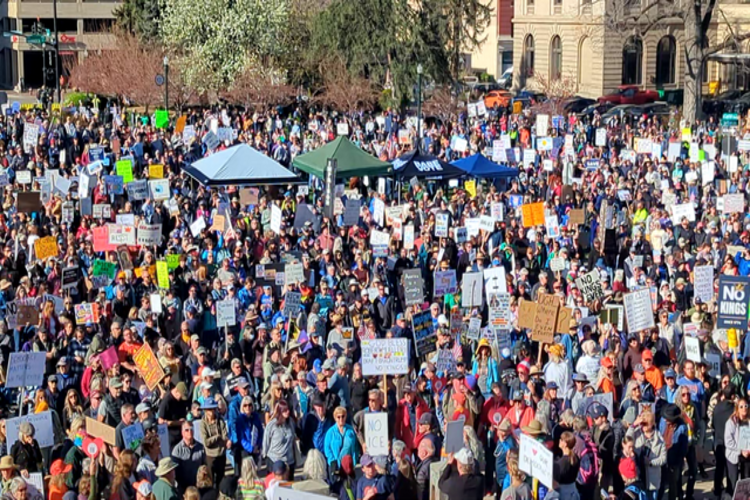
The right-wing media ecosystem operated differently but to similar effect. Fox News covered the protests, but through a consistent delegitimisation lens: ‘bad group therapy’, ‘stage-managed’, a ‘Democrat-backed protest machine’. This approach does not suppress coverage so much as pre-digest it — giving audiences a dismissive frame before they have formed their own. And then there is the international gap. A solidarity march in London drew up to half a million people and received more prominent coverage from Al Jazeera than the American protests did from US domestic outlets. When the rest of the world notices something that America’s own media is minimising, the asymmetry is itself a story.
Does size actually matter?
Harvard political scientist Erica Chenoweth’s analysis of historical resistance movements found that when approximately 3.5 per cent of a population participates in sustained non-violent action, the success rate is historically very high. In the United States, 3.5 per cent equals roughly 12 million people. No Kings is at eight million, around 2.4 per cent. Close, but not there yet. However the lack of coverage of these protests may well limit their chances of reaching Chenoweth’s tipping point.
The near-invisibility of No Kings is not simply an oversight. It is the product of an information environment shaped by a war that consumes the news agenda, platform algorithms that reward conflict over civic action, and a White House that has learned to label democratic expression as pathology before it can be evaluated on its merits. When eight million people can take to the streets and be absorbed and dismissed within 24 hours, the problem is not whether Americans are willing to protest. It is whether protest, in 2026, can still be heard.
Return, then, to Driggs, Idaho, and those few hundred people in a mountain town, turning out anyway, with no cameras and no certainty that it would matter. Whether that act represents the beginning of something consequential, or the outer limit of what dissent can now achieve, is uncertain. That uncertainty is the story. And the fact that so few outlets are telling it is, perhaps, the most important detail of all.