Part bikepacking, part packrafting, bikerafting is opening up new ways to travel through landscapes where roads and rivers meet
By
In the Douglas Adams novel The Hitchhiker’s Guide to the Galaxy, there’s a running joke that the one piece of equipment essential for anyone wanting to travel safely across time and space is a towel. Ford Prefect, one of Adams’ central characters and a co-author of the titular guidebook, is ‘a frood who really knows where his towel is’, and his humble washcloth somehow comes to symbolise his preparedness for the challenges of surviving in a chaotic universe.
Enjoying this article? Check out our related reads…
Like many of the ideas in Adams’ book – The Infinite Improbability Drive, The Restaurant at the End of the Universe, ‘the paranoid android’ – the concept of ‘bikerafting’ sounds faintly ridiculous when you first hear about it.
But on closer inspection, it makes a whole lot of sense. The premise is simple enough: strap a lightweight inflatable raft (known as a packraft) to your bike, cycle as far as the trail goes, then launch yourself – and the bike – onto the nearest river or lake. Paddle for a while, haul everything back onto dry land, and continue riding. The name is a portmanteau of ‘bike’ and ‘packrafting’, and this new discipline – essentially bikepacking with aquatic interludes, or packrafting with occasional bouts of pedalling – is catching on fast.
In truth, the idea of combining land and water travel isn’t new at all. Long before anyone strapped a packraft to their handlebars, explorers and traders were linking rivers and overland routes in remarkably similar ways. The coureurs des bois, the French-Canadian fur traders who pushed deep into the interior of North America in the 17th and 18th centuries, travelled vast distances by canoe, hauling their boats and cargo across portage trails whenever rivers became unnavigable.
For these early travellers, the landscape was not divided neatly into land and water. It was a continuous network of rivers, lakes, forests and trails, all linked together by human effort. But while the canoe – a form of transport perfected by the First Nations peoples the fur trappers encountered – was ideal for the remote waterways of the Canadian interior, the coureurs des bois would presumably have paid dearly for the boatload to avoid the slow and muddy process of portage between different river systems.
Thankfully for today’s adventurers, voyages much as made possible by modern materials are a whole lot more fun. At the heart of the idea is the packraft. First designed for emergency use, these craft have developed significantly in recent years. Today’s packrafts are impressively capable, able to glide across lakes, drift down quiet rivers or even tackle sections of whitewater.
Crucially, many of them weigh less than three kilograms and pack down to the size of a sleeping bag, meaning they can be carried on a bike. Suddenly, the possibilities expand dramatically. The map starts to look different. Portage sections that might once have taken days to drag a canoe over can be crossed in a matter of hours. Unfordable rivers that might prevent you from cycling cross-country turn into fast-moving highways.
Of course, this sort of travel requires some specialised equipment. First, you need a raft. Brands such as Anfibio, Kokopelli and MRS have spent years refining packraft designs, producing boats that strike a delicate balance between durability, stability and packability. The second thing to think about is the paddle – you don’t want to find yourself at a foul-smelling creek without one. Traditional kayak paddles are heavy and awkward to carry on a bicycle. But modern touring paddles, made from lightweight carbon fibre, often break down into sections, so you can slide them neatly into a frame bag or lash them easily to a top tube.
Then there’s the bike. While almost any bicycle will technically work, gravel bikes have emerged as the machine of choice for most bikerafting adventures. Their drop-bar efficiency makes covering long distances easier, while tyres – typically somewhere between 40 and 50 millimetres – offer enough grip for rough tracks, muddy portage paths and uneven riverbanks.
The abundance of mounting points for bags is also helpful when you’re carrying boating equipment. Fat bikes have their advocates too, particularly in places such as Alaska or Iceland, where sandy beaches and glacial outwash plains are common. But for most riders, a robust gravel bike strikes the best balance between speed, comfort and versatility.
One of the cleverest aspects of bikerafting is how the bike itself travels on the water. The usual approach is to remove the wheels and lash them, along with the frame, across the bow of the boat using a web of straps or cord. This keeps the drivetrain safely out of the water while distributing the weight evenly across the front of the raft. At first glance, the arrangement looks faintly improbable – like a floating sculpture made of aluminium tubing – but in practice it works remarkably well. Once you’re afloat, the bike simply becomes cargo.
Like many outdoor pursuits, bikerafting is evolving quickly. New raft designs are emerging with reinforced bows specifically intended to support bicycles. Ultralight paddles continue to shave off precious grams. Even bikepacking luggage is adapting, with waterproof bags designed to cope with both heavy rain and the occasional splash. But for all these innovations, the basic thing you need to get bikerafting are pretty simple: a bike, a boat, a paddle and a willingness to improvise.
Which is perhaps why the sport is so appealing; because it’s new, there aren’t many rules, and it has a refreshingly exploratory spirit. The coureurs des bois might not recognise the lightweight materials or carbon-fibre paddles involved. But the underlying idea – the freedom to move seamlessly between land and water – would surely feel familiar.
And that’s the real magic of bikerafting: it allows modern adventurers to rediscover a very old way of travelling through the world. Just remember, as The Hitchhiker’s Guide says: always pack a towel.
Three items you’ll need if you want to try bikerafting
The Essential: Anfibio Revo XL + Packraft – £975

The ideal boat for bikerafting needs to be light enough to strap to your bike for long rides, but stable and capable enough to handle rivers, lakes and the extra weight of your gear. The Revo XL+, by German brand Anfibio, strikes that balance remarkably well.
Designed for mixed-water conditions, it combines a self-bailing VenturiTube drainage system with a stiff, profiled inflatable floor that improves handling and helps the raft maintain speed even in turbulent water. The distinctive TwinTail stern improves balance and control, while the generous dimensions give it plenty of buoyancy and load capacity for multi-day trips.
Internal TubeBags allow luggage to be stored inside the raft’s tubes, distributing weight more evenly and freeing up deck space – ideal when you’re carrying a large load. Crucially for bikerafting, the whole thing weighs 2.98kg and packs down to 25 x 35cm.
The Luxury: Finna Explorer Gravel Bike – £2,650
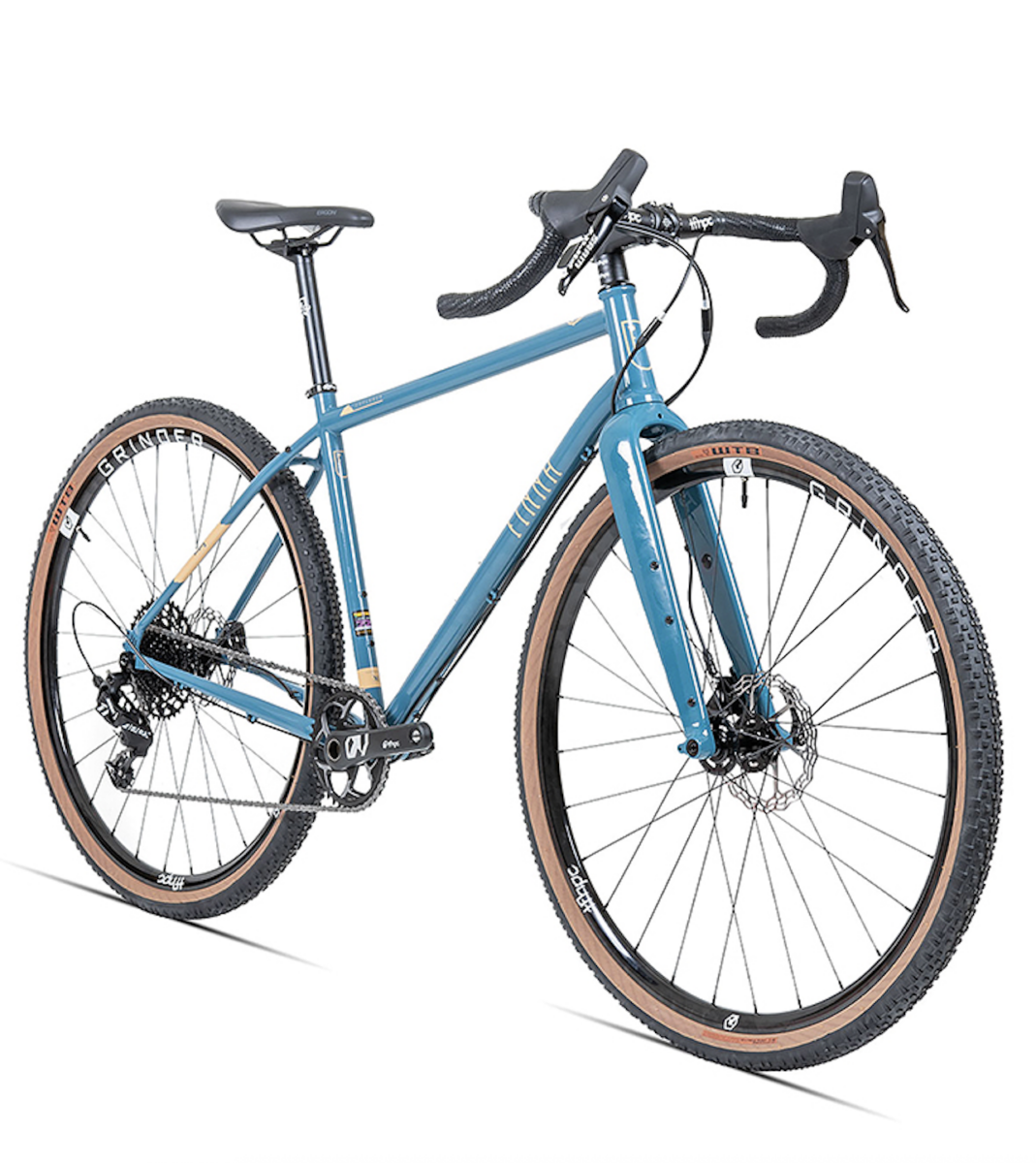
A gravel bike isn’t necessarily a luxury item, but the Explorer, made by the Spanish brand Finna, is definitely a cut above your average trail-adapted, drop-bar machine. It’s designed with bikepacking and off-road exploration in mind, and combines a stable geometry with generous tyre clearance, making it comfortable on rough forest roads, gravel tracks and long backcountry approaches.
Multiple mounting points allow you to attach frame bags, cargo cages and drybags. Perhaps most importantly, the bike handles incredibly well, even when fully loaded. A bike that can climb efficiently, descend in a controlled manner and remain comfortable after long days in the saddle really makes all the difference when it comes to proper expedition riding.
The price tag on the Finna Explorer might make it seem like an indulgence, but we reckon it’s a luxury worth investing in.
The Surprisingly Useful: Voited Pillow Blanket – £125

So it’s not a towel, but this incredibly versatile piece of kit from British brand Voited arguably goes one better. At first glance, it looks like a simple insulated camping blanket, but this ‘4 in 1’ item, as Voited describes it, can transform into a pillow, sleeping bag liner, poncho or standard blanket depending on how it’s folded and fastened.
The ripstop fabric and synthetic insulation make it warm, water-resistant and durable. After a long day of riding and paddling, it might serve as an extra layer in your sleeping system. The next morning, it could be stuffed into its pouch to become a pillow or wrapped around you while cooking breakfast beside the river.
On a bikerafting trip, versatility is everything. Space is limited, and every item ideally needs to serve more than one purpose. That makes Voited’s Pillow Blanket a surprisingly useful bit of kit.