
At the UN General Assembly, governments speak for individual nations. Who takes responsibility for the relationships that connect them?

By
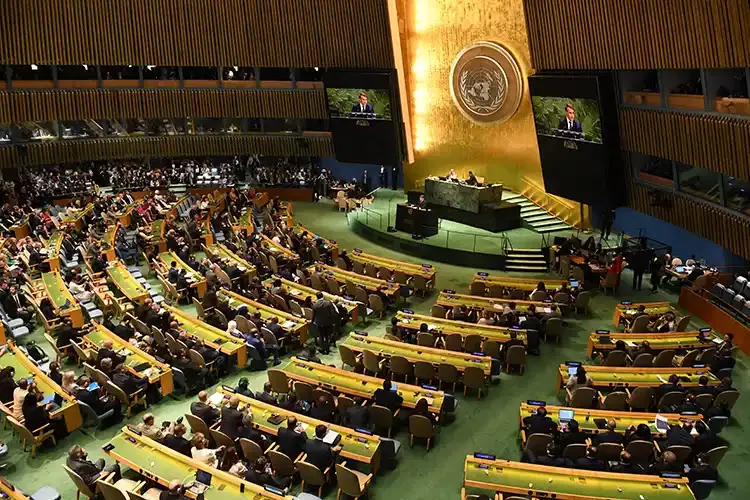
At the United Nations General Assembly, the world takes the form of a succession of national statements. Governments explain what threatens their security, what their economies require and what they expect from others. The arrangement is familiar enough to seem natural. Yet it encourages a particular understanding of international politics: that countries arrive with separate interests, and cooperation begins when those interests can be persuaded to overlap.
This year’s United Nations General Assembly discussions offer a reason to question that starting point. The UN’s climate event on 23 September brought energy transition, energy security and climate justice together within its stated agenda. These are not separate national concerns awaiting diplomatic coordination. They are different aspects of relationships that already connect countries, distributing benefits and burdens between them. The difficulty is that governments can acknowledge those connections without accepting the responsibilities that follow.
The UN’s problem, then, is not simply that states disagree; it is that the national interests presented in its chamber can conceal the international relationships through which they are produced. Energy security in one country may depend on extraction elsewhere. Affordable consumption may depend on distant labour and environmental damage. What appears in a ministerial speech as a domestic achievement can rest on costs excluded from the account.
The boundaries used to organise political responsibility do not match the global reach of economic power. A government can pursue prosperity through relationships extending across the world, then invoke the limits of its jurisdiction when asked to address their consequences. Connection is celebrated when it delivers growth. Distance appears to become more important when someone must answer for the damage.
This doesn’t mean borders have suddenly become irrelevant, nor does it mean the UN was founded in ignorance of interdependence. International cooperation is its purpose, and cross-border problems are hardly new. The more useful question is why some connections are treated as indispensable features of economic life, while responsibility for maintaining the people and environments supporting them remains negotiable.
Climate change exposes this selective understanding of interdependence most fully. A shared atmosphere makes it impossible to separate one country’s development choices neatly from another’s prospects. Yet the language of national ambition invites governments to present climate action as a contribution they choose to make, weighed against competing domestic priorities. Responsibility is narrowed to what a government considers politically affordable, rather than what its relationships with others require.
There are legitimate arguments about how that responsibility should be distributed, of course. Historical contributions to warming, present emissions and the capacity to act do not produce identical rankings of countries. But disagreement over allocation should not obscure the underlying point: a state cannot plausibly describe its economy as global when discussing its opportunities and purely national when discussing its obligations.
Enjoying this article? Check out our related reads…
This is why the connection between energy security and climate justice matters at the General Assembly. Consider a government seeking to reduce its exposure to imported fossil fuels by expanding renewable energy. That may be a necessary and valuable policy. But judging it only by domestic benefits leaves unanswered questions about the conditions under which equipment and materials are supplied, and whose interests determine those conditions.
The point is not that a transition with international supply chains is inherently unjust, or that every government must control everything beyond its territory. It is that success cannot be assessed solely from the consuming country’s perspective. If the transition is to be just, the places providing its materials and labour must enter the argument as more than suppliers whose difficulties belong to somebody else.
Otherwise, climate justice becomes a reassuring phrase attached to policies assessed primarily through national gains. The language allows governments to endorse fairness in principle without changing the terms on which they benefit from unequal relationships. The General Assembly offers an opportunity to challenge that separation, but only if the discussion moves beyond comparing national promises to examining what those promises require of other places.
That change of perspective would not settle the negotiations; it would, however, make evasion harder. Governments would have to explain not just their domestic constraints, but why those constraints should take precedence over the pressures their choices help create elsewhere. The answer is not to replace states with an abstract global public that has no means of exercising authority. Smaller countries need a forum in which they can confront powerful governments, and governments remain necessary to turn commitments into public action. But representation through states should be the beginning of the discussion, not the boundary of responsibility.
The familiar complaint about the UN is that the world gathers, speeches are delivered and national interests prevail. The deeper problem is that those interests are too often presented as though they originated and ended at the border. They do not. Until governments are required to account for the connections on which their prosperity depends, the General Assembly risks reproducing the very fragmentation it exists to overcome: a connected world discussed as a collection of separate responsibilities.