
• Skip to main content
  • Skip to secondary menu
  • Skip to primary sidebar
  • Skip to footer
Geographical

Geographical

Official magazine of the Royal Geographical Society (with IBG)

  • Geographical Home
  • News
  • Features
  • Opinion
    • Climatewatch
    • Front Lines
  • Podcast
  • Travel
    • Discovering Britain
    • Passport
  • Culture
    • Book reviews
  • Quizzes
    • Crosswords
  • Choose Geography
    • University directory
    • Masters courses
    • Course guides
      • Climate change
      • Environmental science
      • Human geography
      • Physical geography
    • University pages
      • Aberystwyth University
      • Brunel University
      • Cardiff University
      • University of Chester
      • Edge Hill University
      • The University of Edinburgh
      • Newcastle University
      • Nottingham Trent University
      • Oxford Brookes University
      • The University of Plymouth
      • Queen Mary University of London
    • Geography careers
      • Charity/non-profit
      • Education & research
      • Environment
      • Finance & consulting
      • Government and Local Government
    • Applications and advice
  • Magazine
    • Issue previews
    • Subscribe
    • Manage My Subscription
    • Special Editions
    • Geographical Archive
    • Advertise with us
  • Subscribe
    • Direct Debit Changes

Citizen science study launches on starling murmurations in the UK

28 October 2026
2 minutes

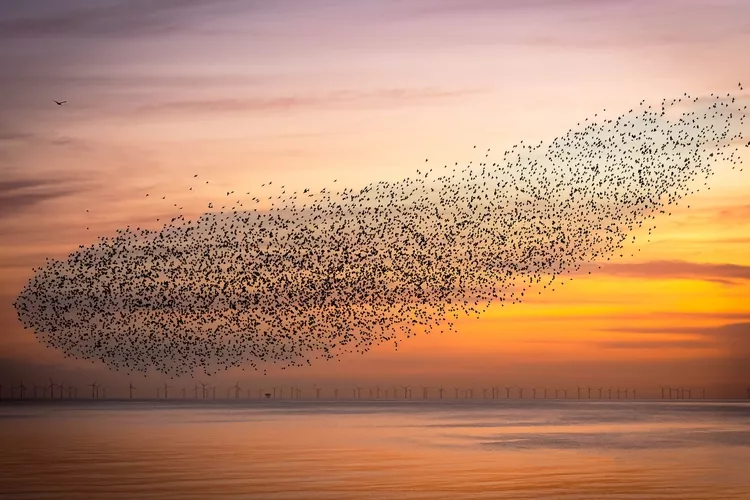
A flock of starlings swarming in a murmuration formation around Brighton Pier in the United Kingdom
A starling murmuration near Brighton Pier. Image: Shutterstock

University of Gloucestershire researchers want to know more about the mystery of starlings gathering in enormous, coordinated flocks


By Victoria Heath

Researchers from the University of Gloucestershire are inviting the public to take part in a citizen science study of starling murmurations, huge, synchronised displays in which up to hundreds of thousands of birds form cloud-like shapes in the sky.

Starlings live in the UK year-round, but their numbers increase between November and February after migrating from Scandinavia.

The new project builds on citizen science research carried out by Professor Anne Goodenough and Professor Adam Hart in the winters of 2014-2015, in collaboration with the Royal Society of Biology, and will investigate whether murmurations have changed over the last decade.


Enjoying this article? Check out our related reads…

  • British Wildlife Photography Awards 2023 winners
  • What nations are experiencing brain drain and brain gain?
  • The Ganges: river of life, religion and pollution
  • What could a cull extension mean for the British badger?
  • Review: The way of the hermit by Ken Smith

Members of the public across the UK are invited to report on these spectacles during autumn and winter through a short online survey about when the display occurred, its approximate size, and whether birds of prey were present.

‘The great thing about this project is that almost anyone can contribute. Some simple observations from thousands of people can tell us more about this remarkable behaviour,’ said Professor Adam Hart, professor of conservation ecology at the University of Gloucestershire and co-author of the original study.

Starling murmurations are thought to be an anti-predator behaviour – gathering in a large flock helps starlings avoid being picked off by a bird of prey. Video: RSPB

The original project produced more than 3,000 reports from 23 countries, mostly from the UK, finding that the average murmuration contained around 30,000 birds. The largest saw 750,000 birds gather in an enormous flock.

Researchers recorded birds of prey in almost 30 per cent of murmurations, and their presence was associated with larger, longer displays.

Research suggests murmurations may be an anti-predator behaviour, with starlings gathering in huge flocks to reduce the threat posed by peregrine falcons and sparrowhawks.

Starlings are red-listed in the UK and are a bird of high conservation concern, with UK numbers down 54 per cent since 1995. You can spot them across the country, including in hotspots such as Cambridgeshire, Devon, Nottinghamshire, Pembrokeshire and Warwickshire.

To help starling numbers, the RSPB suggests keeping a natural grass lawn so the species can forage for invertebrates in the soil; installing nest boxes in suitable positions; and providing fresh water in shallow dishes.

Themes Wildlife Birds

Protected by Copyscape

Primary Sidebar

SUBSCRIBE

GEOGRAPHICAL WEEKLY LOGO FREE - Sign up to get context, clarity and perspective in a noisy world, every Friday
GIVE A GIFT

Give a year of Geographical - order a gift subscription

Popular Now

December 2026 Geographical crossword

December 2026 Geographical crossword

Endless horizon over the shimmering sea

Severe marine heatwave hits California

Stingrays laid out on a beach with fishing boats offshore in Thailand

The hidden stingray skin trade pushing endangered rays towards extinction

The Dalton Highway stretching through Alaska's autumn landscape

Alaska: a state of extremes

risk management for cyber threats , security policy to prevent cyber attack

UK is ‘seriously underprepared’ for the growing risks it faces, report finds

Footer

  • Facebook
  • Instagram
  • LinkedIn
  • Reddit
  • TikTok
  • Twitter
  • YouTube

Geographical print magazine cover

Published in the UK since 1935, Geographical is the official magazine of the Royal Geographical Society (with IBG).

Informative, authoritative and educational, this site’s content covers a wide range of subject areas, including geography, culture, wildlife and exploration, illustrated with superb photography.

Click Here for SUBSCRIPTION details

Want to access Geographical on your tablet or smartphone? Press the Apple, Android or PC/Mac image below to download the app for your device

Footer Apple Footer Android Footer Mac-PC

More from Geographical

  • Subscriptions
  • Get our Newsletter
  • About Us
  • Contact Us
  • Advertise with us
  • Privacy policy
  • Terms & Conditions

Copyright © 2026 · Site by Syon Media