From hot sand and bubbling bays to sperm whales and rainforest trails, Bryony Cottam discovers how community-led tourism is shaping a different kind of Caribbean escape
By
I gingerly push my fingers into the cool, brown sand, not at all sure what to expect. Simon Brissett watches, waiting to see how his dare plays out. ‘See how long you can hold your hand there,’ he’d said moments before. As I lean over the side of the kayak and sink my fingers deeper, I start to notice a change. Then, with a yelp of surprise that makes Brissett laugh, I yank my hand away. The sand had suddenly become hot.
The beach had been a ten-minute, downhill drive from Jungle Bay, the forested hill-top resort where I’d spent my first night on Dominica.
Enjoying this article? Check out our related reads…
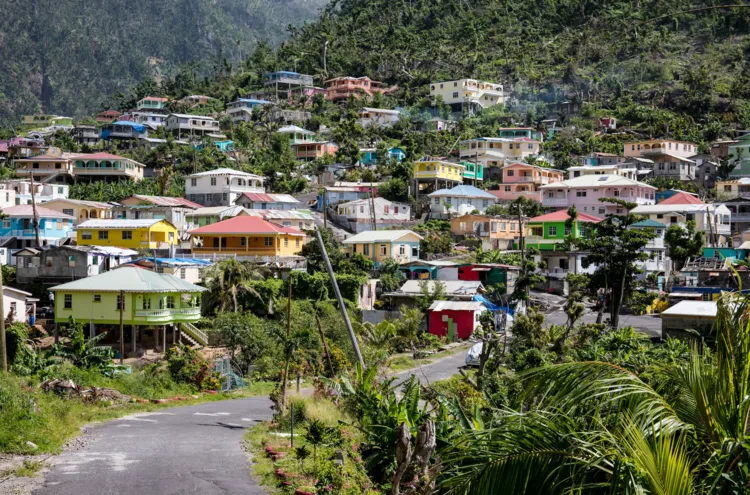
In the time it had taken Brissett, my activity guide at Soufrière Outdoor Centre, to arrive, I’d already exhausted the handful of sights to be seen along the town’s seafront road: a dive shop, a concrete jetty and a handful of fishing boats, the ruins of a stone structure and a red-roofed church, its grey stone arches freshly coated in bright, sky-blue paint. Nearby, a hand-painted sign welcomed visitors to the Bubble Beach Spa.
A two-kilometre paddle later, we’d hauled the kayak onto a secluded strip of beach and waded into the sea. Brissett pointed out butterflyfish and parrotfish as we swam between meadows of sea fans and gaping barrel sponges. A green turtle glided serenely into the distant aquamarine. For all its aquatic life, however, the sea along this stretch of Dominica’s coast had been remarkably still. Back in Soufrière, our kayak languishes in the shallow waters of the bay, scraping against the sand and startling a foraging chicken that clucks and scuttles into the bushes. I stare down at the water. It gently bubbles, like champagne.
Soufrière Bay lies in the caldera of a sunken volcano. Just beyond the beach, where natural gases are percolating up through vents in the sand and rock, the floor of the ocean abruptly falls away. A month before I arrived, Russian freediving champion Alexey Molchanov had drawn a breath, kicked his fins and slipped 127 metres into this abyss, setting a new world record in the process.
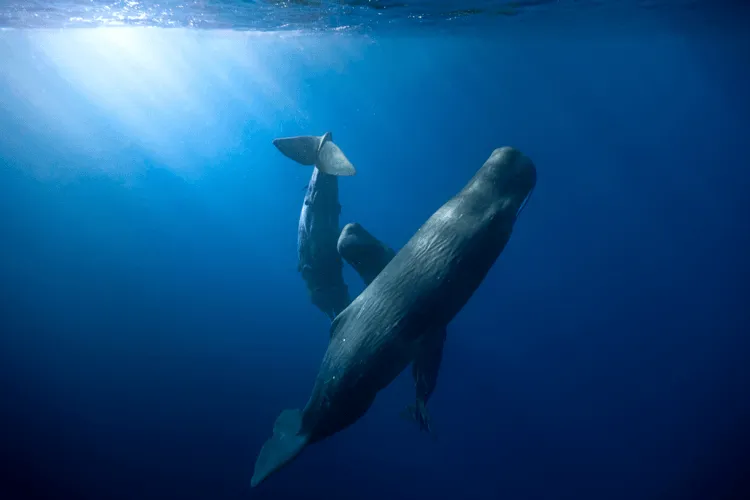
Sperm whales, full of deep-sea squid, which they hunt in the ocean’s twilight zone, often surface here to ‘log’ (rest). With such easy access to their favourite food, these typically nomadic whales have made the waters of Dominica their permanent home – and with such easy access to whales, the Dominica Sperm Whale Project has become a world-leading authority on sperm whale research. Decades spent decoding the rhythmic clicking, called codas, that the whales use to communicate has revealed that these Caribbean clans possess unique vocal dialects. ‘I think it’s likely that they use codas to coordinate as a family, organise babysitting, foraging and defence,’ Canadian whale biologist and project founder Shane Gero told Reuters. Later, aboard a dive boat with crew from the Fort Young Hotel and Dive Resort, I slip on a pair of headphones and listen to the creaks and clacks picked up by a hydrophone.
South of Soufrière, the ocean road follows the curve of the coast around to a peninsula, where the rim of the caldera rises from the sea. A drive across a narrow tombolo that divides the Caribbean and Atlantic oceans leads us to Scotts Head, a vantage point from which 18th-century British forces once guarded the seas. Standing amid the ruins of the fort – a solitary, rusting cannon still pointing east – I look north across the bay at the rugged green island shaped by an even larger, more complex volcanic history.
In geological terms, Dominica is a young island. Some 26 million years ago, as the Caribbean and Atlantic plates converged, forcing the Atlantic’s oceanic crust deep into the Earth’s hot mantle, the resulting magma began to pile up, forming the newest addition to a chain of islands. While many of the Lesser Antilles – and islands in the wider Caribbean – have long been dormant, Dominica is still being formed. I’d barely noticed its mountainous peaks and cliffs when I’d first landed; there’d been nothing to see but sea on the hour-long flight from Barbados, itself an isolated eastern outpost formed from compacted coral reefs. By the time Dominica had come into view, we were practically on the runway. Still, there were signs that I’d landed on a very different isle.

As we’d driven from north to south across the island, between Dominica’s regional airport and Jungle Bay – 35 kilometres as the crow flies but more than an hour and a half by car – I’d been quickly lulled to sleep by the winding roads and thick, warm evening air.
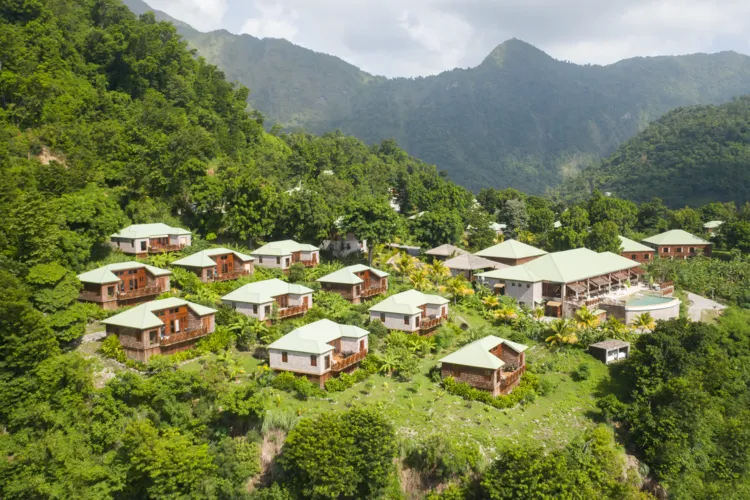
Sometimes, a particularly steep incline or sharp bend jolted me awake. Periodically, my ears popped. On arrival, my room – a self-contained villa – was filled with a warm and earthy scent; outside, the night air filled with the whistles and chirps of a rainforest orchestra. By morning, however, the vast views afforded by the resort’s hillside position had finally revealed the shape of the land.
Back from a day spent exploring the southern coast, I wander through the grounds of Jungle Bay, spotting coconuts tucked high up in the palms and ducking around low-hanging breadfruit larger than my head. ‘Everywhere you look there’s something to nibble on,’ says Stacy Moses, the head landscaper and horticulturist, drawing aside a broad leaf to reveal a cluster of small bananas. She picks a leaf from another tree and crushes it between her fingers. ‘It smells like my room,’ I venture. ‘Bay,’ she says with a nod.

Across the eight-hectare edible jungle, a gardening taskforce tends to a staggering diversity of plants that flourish in the island’s volcanic soils and frequent tropical showers. Like the bay tree, which acts as a potent natural insect repellent, many of these plants have been put to work across the resort – bottled as aromatic oils for the spa, pressed into juices for the breakfast buffet, or crafted into the light fixtures and thatched roofs that furnish the villas. ‘You’d think we’d planted it all – but not really,’ says Moses. ‘Many of the established plants you see have been here for a long, long time.’ She stops by the remnants of an old steel pulley system that once transported buckets of citrus downhill to the L Rose & Co lime oil factory – the ruins I’d seen earlier in Soufrière.
By the time Dominica – or Waitukubuli, as the island is still known today by the Indigenous Kalinago people – attained independence in 1978, it had endured 305 years of colonial tug-of-war as French and British forces fought for its natural resources. But unlike neighbouring Barbados and Antigua, where the large, flat plains were perfectly suited to expansive sugar plantations, Dominica’s vertical, volcanic landscape proved too challenging for sugar cane, despite repeated attempts. So when the Merchant Shipping Act of 1867 made it mandatory for all British ships to carry lime juice to combat scurvy – a disease estimated to kill 50 per cent of crews on long-haul voyages at the time – Scottish ship-provisioner Lauchlan Rose saw a major opportunity in Dominica’s fertile soil. The limes squeezed in the mills of Dominica earned British sailors an enduring nickname and, though its fruit is now sourced from major production hubs in Mexico and Peru, Rose’s continues to stock British supermarket shelves with its lime marmalade.
The legacy of colonialism remains visible across the Caribbean, particularly where tourism is involved. Many Caribbean communities are grappling with a modern model that prioritises exclusive, large-scale development, often at the expense of already marginalised people and fragile ecosystems. In Jamaica, activists fighting what they call ‘plantation tourism’ have taken to the courts to challenge the privatisation of public beaches. A similar conflict is playing out in Barbuda, where, as we reported in our June issue, the struggle to protect communal land from the advance of luxury resorts continues.
‘Developers have come to the Caribbean in search of prime real estate: our beaches,’ says Samuel Raphael, the founder and director of Jungle Bay. ‘Then they’ve offered local people low-end jobs, presented as a step up from back-breaking, sugar-cutting work – and that’s basically been the only choice governments have known for decades. The alternative, of course, would be: “You go hug your trees and we’ll take our money someplace else.”’

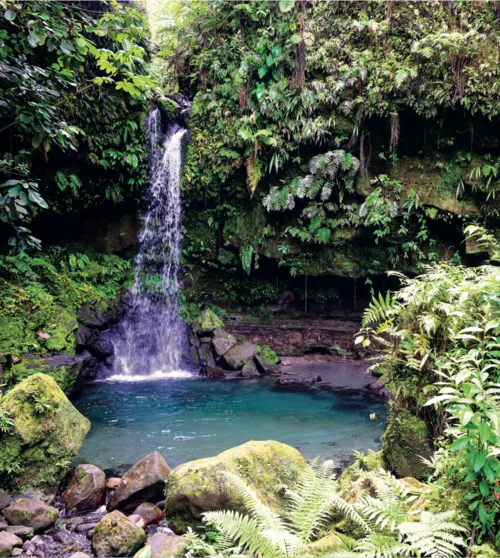
Raphael is sure that a relative absence of beautiful, white sand beaches has helped to spare Dominica the same fate. Instead, he argues the island offers something unique to the region: nature. Rather than reclining on manicured shores, visitors trek through misty rainforests, hike to the island’s volcanic lake and swim in natural waterfall pools.
Raphael describes how he first found joy in hiking as a youth, when he would explore the rugged landscapes of St Croix – the largest of the US Virgin Islands and his family’s home after emigrating from Dominica. A child of the 1970s, he was shaped by the global wave of social activism – particularly the anti-apartheid movement – and studied international relations in Washington DC, with dreams of becoming a US Foreign Service attorney. Then, in 1980, the political tide turned. As his career trajectory stalled, Raphael returned to Dominica to refocus his efforts in the home he’d left behind – starting with tourism.
‘When I looked around,’ he explains, ‘I didn’t see hotel owners who looked like me in the region – and it’s the main industry of the region. How can we progress if the people of the Caribbean remain outsiders in such a key industry?’ He felt that normalising local leadership – proving it was not just possible, but sustainable – was the only way to inspire the next generation. After deciding that actions would speak louder than any words, a vision for Jungle Bay was born.

Since then, the resort has become a model for environmentally sustainable, community-driven tourism, employing a predominantly local workforce and sourcing its produce from small-scale island farmers and craftspeople.
Dominica’s tourism is also evolving, with the construction of a new cable car that will ferry visitors into the Morne Trois Pitons National Park, and the arrival of a new international airport that will cut flight times from Europe. These developments come with the promise of much-needed economic benefits – provided the island can successfully balance growth with its current commitment to low-impact tourism.
Outside Jungle Bay’s reception and gift shop, where I’m browsing the bottles of bay tree oil, I see Moses peering up into the leafy canopy. ‘I’m looking for Bob,’ she explains. ‘He usually hangs around here, but it’s kind of cold today – hence the sweater,’ she says, gesturing to her outfit. I nod, sweating in my T-shirt and shorts. Suddenly, she points at a coconut: ‘That’s Bob’s girlfriend.’ I stare at the coconut until I eventually see a green iguana staring back. The Lesser Antillean iguana, a critically endangered species across its range – it has already disappeared from seven islands – is a regular sight at the resort, Moses tells me. In many ways, Dominica is preserving a version of the Caribbean that is rapidly vanishing elsewhere.