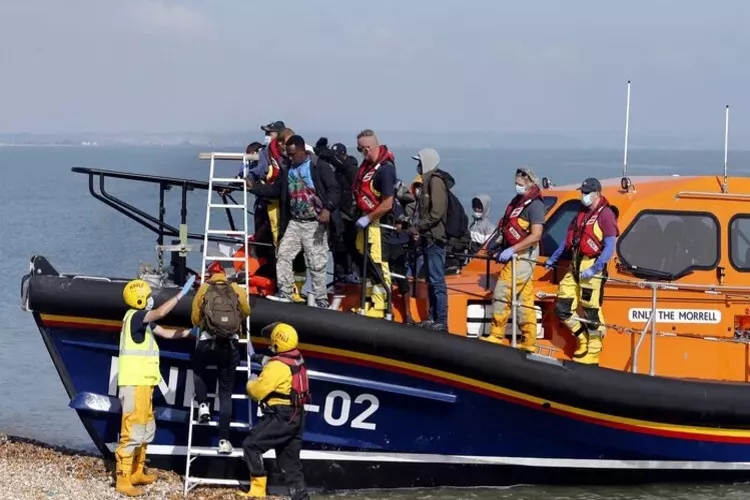
Small boat arrivals to the UK are down 43 per cent and at their lowest since 2020. Yet hundreds have blockaded two ports in protest against arrivals

By
At Eastney, on the eastern edge of Portsmouth, around 140 people had come ashore on a Sunday evening after crossing some 80 miles from the Baie de la Seine. By the time they were due to be driven to the processing centre at Manston, hundreds of protesters had blocked the road. Perhaps a third wore balaclavas.
Two police cars had their windscreens smashed, and the crowd did not disperse until three in the morning. It was the second port blockade that weekend. The previous morning, hundreds of masked men in black had shut the roads around the Port of Dover, also in protest at small-boat arrivals. Alongside this, intimidation of the RNLI’s volunteer lifesavers has grown, all against a backdrop of significantly reduced small-boat crossings.
Some 17,281 people had crossed the English Channel by small boat by early September, 43 per cent fewer than at the same point in 2025. Across the summer, the fall was steeper: 7,416 arrivals from June to August, down 48 per cent, the lowest since 2020.
Over the same period, immigration became increasingly political and grew as a source of concern for some. Ipsos recorded it as the country’s top issue in July, named by 43 per cent, up four points in a month and the highest of the year.
If the policy for reducing crossings is working, why does it feel to so many people as though it is failing?
The arithmetic of spectacle
Between June and August, 102 boats completed the crossing against 224 in the same months of 2025, a fall of more than half. The number of boats has seen a far steeper fall than the reduction in human arrivals. Each vessel therefore carries more people, now an average of about 73 this summer, up from 63. In 2018, the average dinghy carried just seven people. In August, one boat arrived having squeezed 230 desperate souls aboard.
Fewer, but more heavily laden, boats are a direct result of intensified policing of the French coast, which has pushed smuggling gangs to consolidate into fewer, larger, longer-range departures, launching from Belgium and now Normandy. Enforcement has transformed the shape of the crossings.
The public does not experience migration as an annual total. It experiences occurrences. Two hundred people disembarking at once is a single filmable, shareable spectacle. The same two hundred spread across thirty dinghies over a fortnight is background noise and unlikely even to make a headline. Fewer boats means more spectacle per arrival, not less.
Why the figures will not help
Some 49 per cent of Britons think net migration has risen; only 16 per cent know it fell, by 69 per cent, to 204,000 in the year to June 2025. The public puts asylum seekers at a third of immigration; the true figure is nearer nine per cent.
But the assumption that correcting these numbers would change anything deserves more scepticism than it gets. Ipsos finds 62 per cent believe asylum seekers are economic migrants falsely claiming refuge to reach welfare. This conviction drives hostility more powerfully than practical concerns and is bound up with identity and values in ways that make it stubbornly resistant to correction. The government’s implicit reply to the weekend – the numbers are falling, so the anger is misplaced – is not merely insufficient; it may be beside the point.
Organisation, not grievance
The tempting explanation is economic: hollowed-out coastal towns finally erupting. Portsmouth has the deprivation to support it, with 15 of its 125 neighbourhoods among England’s most deprived tenth. But those cluster in Charles Dickens, Paulsgrove, Nelson, Fratton and St Thomas, not Eastney.
And in Dover, the Conservative group leader on the district council described protesters who ‘loaded into rental vans and then descended on roads leading in and out of Dover’, while Sir Roger Gale reported them parking overnight on a village green in another constituency. This was not a neighbourhood boiling over. It was a national network arriving at a location.
That network is new. Hope Not Hate identified the Dover blockade as the work of Patriot Platform, founded this summer by Daniel Thomas (‘Danny Tommo’), a former bodyguard of Tommy Robinson, assembled from smaller local groups through his social media following and coordinated over Signal and Telegram.
While the make-up of this group might be questionable, its narrative was amplified by politicians and the police alike. Hampshire’s Conservative police and crime commissioner called Portsmouth a ‘wake-up call’ for the government and stressed that hundreds present behaved lawfully. A Reform councillor insisted they were ‘hundreds of local residents and families’, not ‘dangerous thugs’.
Built to be seen
Both blockades were composed to be looked at: the uniform black clothing and rehearsed discipline. Footage of masked ranks across the roads into the port circulated within hours. Those images were produced at almost no legal cost. Kent Police first called the Dover protest ‘spontaneous’, with no intelligence that it was coming; the force has since acknowledged it was told of possible protests the day before, but that the information ‘was not fully assessed’. Days later, the only offence under investigation there was damage to a road.
The political response has tracked the pictures rather than the figures.
Chris Philp, the shadow home secretary, said the scenes reflected genuine frustration at the government’s failure to stop arrivals, despite the government’s proven record on slowing them significantly.
The weekend leaves the government with a problem its own statistics do not address. Enforcement has cut the number of people crossing while enlarging the spectacle each crossing produces: fewer boats, more people on each, coming ashore in places with no experience of receiving them. A hundred and forty people landing makes for a striking image. The crowd that formed to meet them was composed for the same cameras. Policy has been aimed at the volume. The protests are built on the spectacle.