From a third species of manta to a ‘death ball’ sponge, discover the array of new findings made in the world’s oceans in 2025
By
The world’s oceans are full of weird and wonderful life. Since exploration has allowed humans to search more deeply into the depths of our planet’s waters, we have uncovered some fascinating creatures and ecosystems in regions new and unchartered in equal measure.
From species such as the anglerfish and blobfish – which live deep in the darkness below sunlit waters – to scorching hydrothermal vents crawling with life able to withstand such high pressures, the list goes on and on as to the plethora of life that the sea holds.
Enjoying this article? Check out our related reads…
But what exactly have scientists and researchers discovered in our oceans this year? Read on to find out seven of the most interesting findings made in 2025…
1) A third species of manta
After years of speculation, 2025 marked the year that a new manta ray species was finally confirmed.
Mobula yarae, commonly known as the Atlantic manta ray, can reach around six metres across. Their key identifying features include a ‘V’ shaped white shoulder patch, lighter colouration around the mouth and eyes and dark spots confined to the belly.
2) A species of snailfish
Lying 3,263 metres below the ocean surface is the bumpy snailfish, a new ocean species discovered in 2025. Measuring just two to three inches long, it was one of several new species found on an expedition led by the Monterey Bay Aquarium Research Institute this year.
Snailfish hold the record for the deepest-dwelling fish out of any species on Earth, with one found 8,338 metres deep.
3) Communities of extreme life in deep ocean
This year, a Chinese led-research team captured pictures of life at depths of more than 9 kilometres (5.6 miles) below the ocean surface.
At these depths, scientists spotted what appeared to be fields of marine life, including various types of tube worms and molluscs that had never been studied before. Such findings are challenging scientists’ assumptions that these communities of animals, rather than rare sightings, are actually common.
4) A carnivorous ‘death ball’ sponge
Researchers sampling the depths of the Southern Ocean discovered a spherical sponge – known as Chondrocladia sp nov – earlier this year. The sponge is dubbed the ‘death ball’, as it is covered in tiny hooks that trap prey. This is a different mechanism from how sponges usually feed, typically using filters to absorb nutrients.
During the research mission, scientists also discovered 29 other previously unknown deep-sea species, including new sea stars, black corals and novel crustaceans.
5) More than 800 new species
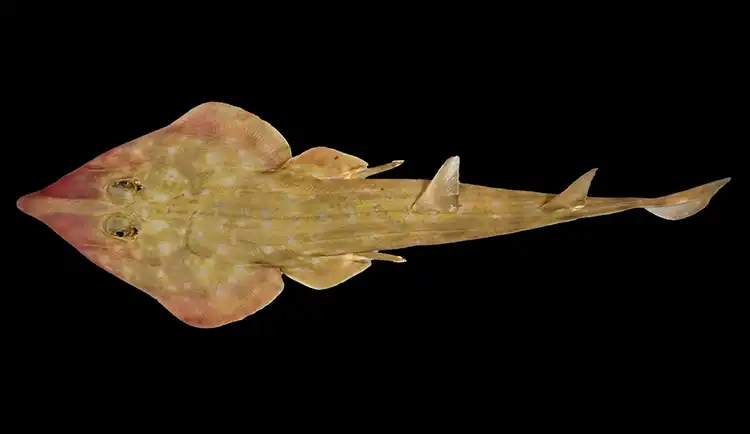
In 2023, the Nippon Foundation-Nekton Ocean Census was launched as the world’s largest effort to accelerate the discovery of new marine life. After ten ocean expeditions, the team revealed in 2025 that it had discovered more than 800 new species since its inception.
These species include a guitar shark found off Tanzania; a limpet found at depths of more than 3,000 metres in the Arctic Ocean; a pipehorse found in Africa by a local scuba dive company, as well as a squat lobster discovered in an expedition in the southeastern Pacific Ocean, making it the first species of its kind to be found there.
6) Antarctic methane ‘seeps’
In the Ross Sea, researchers discovered more than 40 new methane seep sites – locations on the seabed floor where methane gas can escape – in 2025. Using remotely operated vehicles and divers under the ice, the research team found dozens of these sites at Cape Evans on the west side of Antarctica’s Ross Island.
The first methane seep site was discovered back in 2012, but since then, the sites have been cropping up at a ‘remarkable rate’, according to scientists.
If Antarctic seep systems follow the same behaviour as other sites, there is potential for this methane to enter the atmosphere, and it currently is not a source accounted for in future climate change scenarios
7) The wreck of a Portuguese warship
This year, archaeologists located a Portuguese warship – more than 300 years old – named Nossa Senhora do Cabo near the waters of Madagascar. According to researchers, it is resting on the seafloor near Nosy Boraha, a small island off Madagascar’s east coast, after being raided by pirates back in the 1700s.
The shipwreck’s identity was confirmed by analysing historic documents, the size and shape of the hull, alongside artefacts found nearby.
More than 3,300 artefacts have been recovered from the ship, including gold coins inscribed with Arabic, pieces of porcelain and religious figurines.