
• Skip to main content
  • Skip to secondary menu
  • Skip to primary sidebar
  • Skip to footer
Geographical

Geographical

Official magazine of the Royal Geographical Society (with IBG)

  • Home
  • Briefing
  • Science & Environment
  • Climate
    • Climatewatch
  • Wildlife
  • Culture
  • Geopolitics
    • Geopolitical hotspots
  • Study Geography
    • University directory
    • Masters courses
    • Course guides
      • Climate change
      • Environmental science
      • Human geography
      • Physical geography
    • University pages
      • Aberystwyth University
      • Brunel University
      • Cardiff University
      • University of Chester
      • Edge Hill University
      • The University of Edinburgh
      • Newcastle University
      • Nottingham Trent University
      • Oxford Brookes University
      • The University of Plymouth
      • Queen Mary University of London
    • Geography careers
      • Charity/non-profit
      • Education & research
      • Environment
      • Finance & consulting
      • Government and Local Government
    • Applications and advice
  • Quizzes
  • Magazine
    • Issue previews
    • Subscribe
    • Manage My Subscription
    • Special Editions
    • Podcasts
    • Geographical Archive
    • Book reviews
    • Crosswords
    • Advertise with us
  • Subscribe
    • Direct Debit Changes

New study links air pollution to more advanced coronary artery disease

10 December 2025
3 minutes

Dense smog covering a modern city skyline
Air pollution is a growing environmental issue. Image: Shutterstock


Air pollution has been linked to more severe heart disease, and there’s a notable difference between men and women, according to a new study


By Amber Bryan

Air pollution is a constantly growing environmental issue. In 2021, it contributed to an estimated 2.46 million cardiovascular deaths. It is a huge environmental risk to health and plays a major role in causing heart attacks and strokes. 

Two common pollutants found in urban air include ambient fine particulate matter (PM2.5) and nitrogen dioxide (NO2). PM2.5 are about 30 times smaller than a human hair, allowing them to penetrate deep into the lungs and bloodstream. It originates from sources such as vehicle exhausts, industrial emissions and wildfire smoke. NO2 is a harmful gas that comes from burning fossil fuels in vehicles, power plants and industrial processes.


Enjoying this article? Check out our related reads:

  • The fight for clean air around the world
  • Only seven countries in the world had healthy air quality in 2023
  • The worst US cities for air pollution – and why they are on the West Coast
  • Two thousand children a day die from air pollution
  • Outdoor air pollution linked to differences in children’s brain development

A study of more than 11,000 adults, presented at the annual meeting of the Radiological Society of North America (RSNA) has highlighted the importance of improving air quality, to reduce the risk of cardiovascular disease. Its findings show that levels of air pollution below or near regulatory standards and typical urban exposures are associated with early signs of heart disease, sometimes before symptoms can appear. 
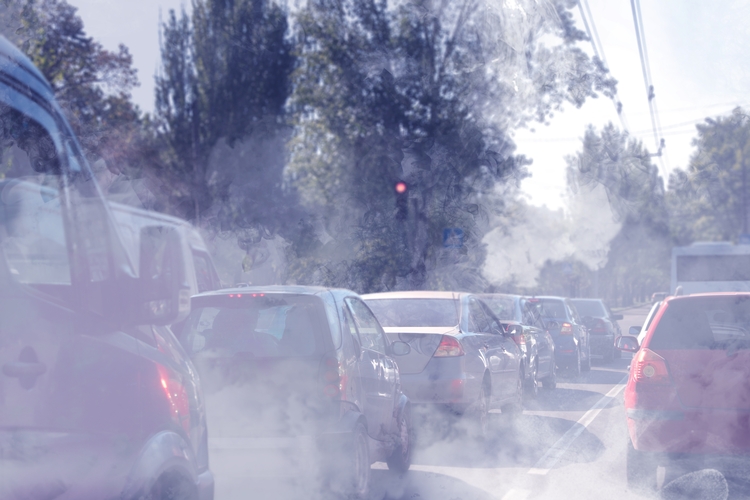
Air contaminated with fumes in city. Cars surrounded by exhaust on road
PM2.5 originates from sources such as vehicle exhausts. Image: Shutterstock

The study examined data from adults who had undergone cardiac CT scans between 2012 and 2023, across three major Toronto hospitals. Researchers matched patients’ postal codes, with air quality data, allowing them to estimate each person’s average exposure to air pollution over the 10 years before the CT. Three signs of coronary artery disease were assessed: calcium score (plaque buildup in the arteries), total plaque burden (total amount of fatty buildup in the arteries) and obstructive stenosis (artery narrowing).

Researchers found that for every increase in long-term PM2.5 of one microgram per cubic meter, calcium buildup in the coronary arteries increased by 11 per cent, the chance of having more plaque increased by 13 per cent, as well as the chance of obstructive disease increasing by 23 per cent. Exposure to NO2 followed a similar pattern, however with smaller effect sizes for every one part per billion increase.

A sick young man wears a mask to protect against PM 2.5 dust coming from the city and air pollution
Air pollution contributed to an estimated 2.46 million cardiovascular deaths in 2021. Image: Shutterstock

Long-term exposure to common air pollutants have been linked with more advanced coronary artery disease – however, there’s a difference between men and women. 

Lead author of the study and cardiothoracic imaging fellow in the Department of Medical Imaging, Temerty Faculty of Medicine, University of Toronto, and University Health Network (UHN), Felipe Castillo Aravena, said: ‘Overall, higher long-term exposure to air pollution was associated with more coronary artery disease on cardiac CT in both women and men.’ 

Dr. Castillo adds: ‘In women, long-term exposure to fine particulate matter was linked to higher calcium scores and more severe narrowing of the arteries. In men, higher long-term exposure to fine particulate matter was associated with higher calcium scores and higher plaque burden.’

How does air pollution compare in cities around the world?

99 per cent of the world’s population breathes bad air every day, and air pollution kills an estimated seven million people worldwide every year, according to the World Health Organization. 

The top five cities with the worst air quality are: Cairo (Egypt), Lahore (Pakistan), Delhi (India), Hanoi (Vietnam) and Dhaka (Bangladesh), which fall under unhealthy and very unhealthy air quality index.

On the flip side, the top five cities with the best air quality are: Oslo (Norway), Kobe and Kyoto (Japan), Birmingham (United Kingdom) and Lisbon (Portugal), which all have good air quality index. 

Themes Briefing

Protected by Copyscape

Primary Sidebar

OUR UK DIRECT DEBITS ARE CHANGING
WINTER SALE

Geographical subscriptions

GEOGRAPHICAL WEEKLY LOGOFREE - Sign up to get global stories, told well, straight to your inbox every Friday

Popular Now

The Florida Wildlife Corridor is giving species such as the black bear room to roam

What can be done to protect Florida’s wildlife?

Red squirrel

2025 in review: the most impactful conservation efforts this year

Christmas Quiz: Forests

Christmas Quiz: Forests

Five very different New Year’s traditions

Five very different New Year’s traditions

QUIZ: Christmas Quiz – Borders

QUIZ: Christmas Quiz – Borders

Footer

  • Facebook
  • Instagram
  • LinkedIn
  • Reddit
  • TikTok
  • Twitter
  • YouTube

Published in the UK since 1935, Geographical is the official magazine of the Royal Geographical Society (with IBG).

Informative, authoritative and educational, this site’s content covers a wide range of subject areas, including geography, culture, wildlife and exploration, illustrated with superb photography.

Click Here for SUBSCRIPTION details

Want to access Geographical on your tablet or smartphone? Press the Apple, Android or PC/Mac image below to download the app for your device

Footer Apple Footer Android Footer Mac-PC

More from Geographical

  • Subscriptions
  • Get our Newsletter
  • About Us
  • Contact Us
  • Advertise with us
  • Privacy policy
  • Terms & Conditions

Copyright © 2026 · Site by Syon Media