China’s new five-year plan will create short-term opportunities but long-term uncertainty for UK businesses in an increasingly competitive and interconnected world
By Andrew Ross
As a middle power with declining global influence, the UK must navigate an increasingly fractious geopolitical landscape in which it has little say, but on which its future prosperity depends.
China’s new five-year plan, recently rubberstamped at the annual ‘Two Sessions’ gathering in Beijing, is particularly symbolic of how major geopolitical players set the global agenda that others must follow. With a focus on rebalancing its economy away from basic export- and infrastructure-led growth, China’s new five-year plan seeks to create an innovation-led economy centred on advanced high-tech manufacturing and technological self-reliance, all of which have potentially profound implications for access to and control over global supply chains.
Enjoying this article? Check out our related reads…
In terms of trade, as China rebalances towards a more technologically advanced and green economy, there are both short and long-term considerations for UK businesses.
In the short term, the new five-year plan should create opportunities for UK businesses, as they already excel in several of the areas China is seeking to upgrade. For example, in the fields of advanced AI, fintech and green energy, trading opportunities are likely to increase. In the long term, as China becomes more self-reliant, the outlook will be less certain as China seeks to reduce its dependency on Western inputs and expertise.
To mitigate China’s desire for greater self-reliance, UK companies will need to respond in kind by continually innovating to ensure they remain relevant and not superseded. This should, in theory, be a good thing for the global economy.
The recent quinquennial plan seeks to position China as the global technology leader, as evidenced by the pivot towards advanced manufacturing and AI in sectors such as robotics, biotechnology, digital platforms and energy. While this rightfully allows China to pursue a path of greater self-reliance, it also seeks to reduce China’s dependence on western supply chains, which will have geopolitical implications.
While the geopolitical implications are unclear at this early stage, China will continue its rivalry with the United States. The outcome of this rivalry will largely be dependent upon who gains the in upper hand in relation to technological leadership.
Yet while China and the United States are geopolitical rivals, they are highly reliant upon each other for their own continued development. Taking one example, in the race for technological superiority China has dominance in the refining and production of global rare earths, which are critical for the manufacture of circuit boards, semiconductors, and mobile phones.
However, the United States dominates the actual production of advanced AI chips such as Nvidia’s H20, which China itself is also highly reliant upon for its own industrial development. While both China and the United States confront each other in the era of the new Great Game talk of decoupling is probably overstated, as both are highly interconnected and interdependent of each other.
As for the UK, without a seat at the top table it must position itself carefully leveraging its strengths as a reliable trading partner, while positioning itself strategically to take advantage of a new world order that is increasingly multipolar in nature.
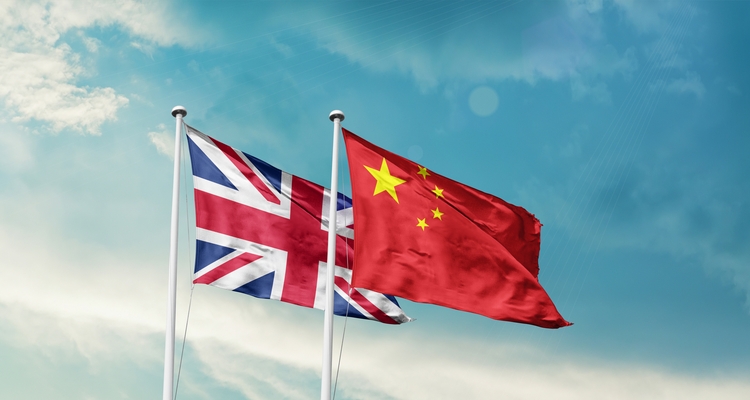
While the Chinese and UK economies are vastly different in terms of size and structure, the opportunities for economic, trade and culture cooperation are promising, in that the respective economies should be seen as complementary rather than competitive in nature.
As the major geopolitical powers seek to reduce their dependency on each other, the UK is uniquely placed – as a leading middle power – to tap China’s $18 trillion economy, as a result of global excellence in fields of artificial intelligence, data science, life sciences, the creative industries, and renewable energy development.
As governments and businesses work through the implications of China’s new five-year plan, in the short term at least, the UK has expertise that China needs.