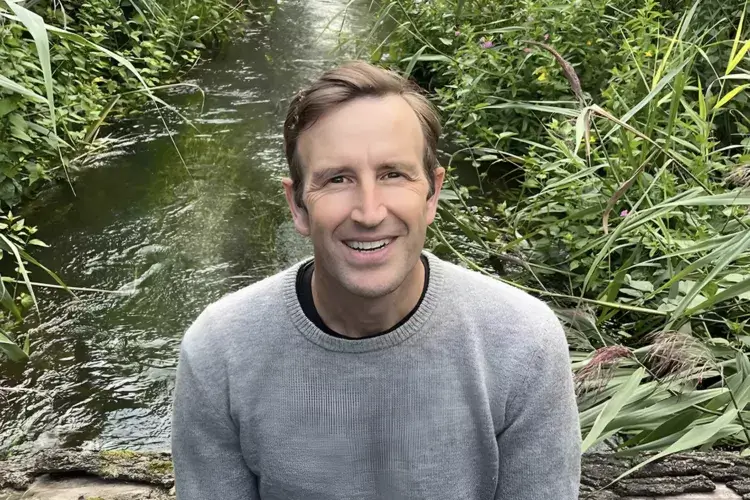
Robert Macfarlane tells Jonathan Lorie why our relationship with the natural world still leaves us with room for hope
By Jonathan Lorie
‘Are you perhaps the Indiana Jones of nature writing?’ Robert Macfarlane smiles and then winces at my question. ‘Do I grab a hat and whip from the back of my door? That’s not a question I’ve been asked in that form before. Just for the record, let me reject it.’
And yet, in a career spanning more than two decades of prize-winning books, this Cambridge academic-turned-environmental-campaigner has chronicled his perilous journeys up mountains, down wild rivers, into nuclear-waste bunkers and over remote islands. He has kayaked, swum, climbed, hiked and crawled to places few of us will ever see — and brought back luminous fragments of experience and wisdom to share.
Enjoying this article? Check out our related reads…
Back at his writing desk, he grinds these into books with the slowness of a glacier but also with its power — books that brim with adventures and insights and a growing sense of the fragility of our world. It’s no wonder that his name has even appeared among outside contenders for the Nobel Prize in Literature.
‘I’ve learned so much from putting my body in the way of places, people and ideas,’ he tells me over coffee. ‘You know, my book The Old Ways opened with the line “This book could not have been written by sitting still.” I have found, without fail, that landscapes and people will always surprise you. And the library has its limits.’
The library in question is Emmanuel College, Cambridge, where he has been a fellow since 2002. But we meet in London, in a bookshop café by St Martin-in-the-Fields, where tonight he will give a reading from his newest work, The Book of Birds. It’s a collaboration with the illustrator Jackie Morris, who will draw endangered species live on stage.
In person, Macfarlane isn’t what you might expect: a tall man with the big hands and broad shoulders of a mountain climber, but the soft speech of a thinker and the kind eyes of a father. His three children figure frequently in conversation and his books, and he talks of teaching students as a ‘vocation’.
‘Teaching is something I feel very committed to,’ he says. ‘It feels like there are urgent matters and ideas that need public discussion. I mean, here we are sitting through the third heatwave of the summer. We’re seeing birds fall dead from the skies in India, we’re seeing 10,000 fish turn belly up in the Loire. The omens are plain for all to see.’
Against this he has tried to find ‘a geography of hope’, as he calls it in his recent book Is a River Alive? The book is a vivid account of three epic journeys into the pristine jungles of Ecuador, the polluted deltas of India and the untamed rivers of Canada to meet campaigners who are risking their lives to safeguard the environment. It’s a thrilling, sobering, at times mystical ride, written as an ecstatic act of union with the forces of the wild. By its end, he’s channelling a torrential river’s ‘voices’, beyond the boundaries of logic, of language, even of human life, and realises that ‘I am rivered.’
A question asked throughout this book is whether there is hope for the future. Today he insists there is. ‘All of us are wrestling at some level with damage,’ he says with a frown, ‘with loss, with decline, and with their converse, which is hope and action and change. Loss and love are the two poles that we rattle between. In such times, despair is a luxury and hope is a discipline. Tonight we’ll touch on the catastrophic declines of bird species globally — and we’ll also watch Jackie conjure wonder on the stage.’
Wonder has been at the heart of Macfarlane’s work since he first burst on the scene in 2003, with an unlikely tome about mountaineering. Mountains of the Mind asked why we’re attracted to mountains, how they affect our ideas and, crucially, what drives climbers even to their deaths. Its most poignant passages told the tale of George Mallory, who disappeared into the clouds on Mount Everest in 1924 but may have been the first to reach its peak, 29 years before Edmund Hillary.
Mountains was a bestseller, with its dazzling mix of derring-do, personal memoir and existential enquiry. That formula still informs his books today. Reviewing it in The Irish Times, Arminta Wallace predicted: ‘This is a new kind of exploration writing, perhaps even the birth of a new genre, which doesn’t just defy classification — it demands a whole new category of its own.’ That category was to become known as ‘new nature writing’, a genre that has boomed in our bookshops for the past quarter-century.
Macfarlane himself had been a high-altitude climber and the book recounted his scarier experiences, including whiteouts and avalanches. This was a passion inspired by his grandfather, a noted climber who reached his first 3,000-metre Alpine peak at the age of nine — and at the top bumped into the battle-scarred leader of Mallory’s expedition. Childhood holidays were spent at his house in the Cairngorm mountains, learning to hike and climb and coveting his ice axe.
It was a change from the tamer countryside of Nottinghamshire, where Macfarlane grew up at the end of a country lane. His father was a doctor, not an explorer, his mother a medical secretary. But mountains claimed him. At 21, he spent a summer hiking the Canadian Rockies, where he picked up a book by the American environmental writer Barry Lopez that changed his life. As he recalled in the preface to Mountains, ‘Lopez showed me that non-fiction could be as experimental, polyphonic and deeply patterned as any novel. I was seized with the desire to adventure with language and form as a writer myself.’
Two years later, he completed that first breakout book. It won the Guardian First Book Award, the Sunday Times Young Writer of the Year Award and the Somerset Maugham Award. And it left him believing that ‘ultimately, mountains quicken our sense of wonder. They make us ready to credit marvels.’
Seeking further marvels, his next work, The Wild Places (2007), took him around the British Isles in search of ‘the wild places that remained’. And he found them, spectacularly, in scattered, secret places. He bivouacked on beaches, hiked through holloways, crested extinct volcanoes, saw wild hares and swam in phosphorescent seas. He brought back new ways of understanding landscape, meanings deeper than maps, a sense of identity based on geology, wildlife, time and memory. ‘Long before they were political, cultural and economic entities,’ he found, ‘these lands were places of stone, wood and water.’
The book’s format was inspired by his friend and mentor Roger Deakin, whose bestselling book Waterlog (1999) described swimming the waterways of Britain, looking for a ‘frog’s-eye view’ of the nation. It helped launch the modern wild-swimming movement — and arguably new nature writing itself. Deakin was a guiding presence in The Wild Places, a flamboyant figure in a Tudor farmhouse in Suffolk where he swam the moat and left doors and windows open for wildlife. His death was also recounted, in a tender tribute that ended with Macfarlane weeping.
Those first books put him in the vanguard of new nature writing — a label he disliked — and also in the crosshairs of the Scottish poet and essayist Kathleen Jamie. In 2008, she wrote a famous critique in the London Review of Books: ‘When a bright, healthy and highly educated young man jumps on the sleeper train and heads this way, with the declared intention of seeking “wild places”, my first reaction is to groan. It brings out in me a horrible mix of class, gender and ethnic tension. What’s that coming over the hill? A white, middle-class Englishman! A Lone Enraptured Male! From Cambridge! Here to boldly go, “discovering”, then quelling our harsh and lovely and sometimes difficult land with his civilised lyrical words.’
I ask Macfarlane how that feels today and he replies slowly. ‘I guess, you know, sometimes I feel I should apologise for being young or for writing as I did 20 to 25 years ago. And then I think, well, a bad writer would dogmatically stick in one mode — and I have no interest in that. There’s a growing tendency away from the lone walker of The Wild Places. I’m always in company, always with people. No landscape speaks with a single voice. The turn to collaboration is about ten to 12 years old and it has been a joy.’
That collaborative turn encompasses the many travelling companions in his books — a horde of colourful characters whose passions and obsessions illuminate his quests — as well as partnerships with artists. He has co-created songs with the singer-songwriter Johnny Flynn, radio scripts with the actor-director Simon McBurney and children’s books with Jackie Morris.
The best-loved of the picture books is The Lost Words, which elevated him in 2017 from bestselling author to national treasure. It was a treasury of puzzle-poems for children with gorgeous watercolours of flora and fauna. He wrote it in protest when the Oxford Junior Dictionary dropped 50 everyday words for nature — such as acorn, kingfisher and wren. The poems revive such words and the book became a worldwide hit, used in schools and hospitals, community groups and music groups. The Boston Symphony Orchestra commissioned a choral piece, the Forestry Commission staged a play, museums around Britain toured an exhibition.
‘It was a once-in-a-lifetime experience,’ he says with a smile, ‘that is still happening ten years on. Why is it resonating? I think it was that fracture between childhood and nature, and the idea that if we cannot name these things we can barely see them, let alone love them or care for them. So how do we stop that slipping away?’
Stopping the slipping away of things that once were treasured, in nature and in culture, may one day be seen as Macfarlane’s most important mission. His profound belief in the power of words to move and mobilise people, to convey and conserve the wonders of nature, is a thread that runs throughout his career. Fittingly, these days he’s more than an English don at Cambridge: he is professor of literature and the environmental humanities, a field he describes as the meeting place of nature and culture, landscape and politics, environmentalism and the Anthropocene.
It’s a perfect platform to face the challenge he set in Is a River Alive?: ‘Somehow we need to find new ways of imagining, new ways of being that will leave us less alone in this world, less the desolate lords. Our aliveness, as well as all life that lies beyond the human, is at stake in this.’
Or as he suggests when we say our goodbyes: ‘We need to imagine another world and other futures that feel exciting and inspiring.’
Other books by Robert Macfarlane:
The Old Ways (2012) A gentle ramble through the history and meaning of walking, told by tracing ancient pathways and famous walkers in England, Scotland and overseas. A central figure is the nature poet Edward Thomas, who died in the First World War and whose reputation Macfarlane has helped to revive.
Landmarks (2015) A ‘field guide to literature I love’, this is Macfarlane’s homage to his heroes in nature and landscape writing. It tells their stories and explains their works, forming an indirect manifesto for his practice as a writer. Each chapter ends with a ‘word-hoard’ or glossary of endangered words for types of landscape.
Underland (2019) A prize-winning exploration of the underground places that humans have used, from prehistoric caves to nuclear-waste bunkers. This deep-time dive through human stewardship of the Earth leaves him wondering whether we are being ‘good ancestors’ for future generations.