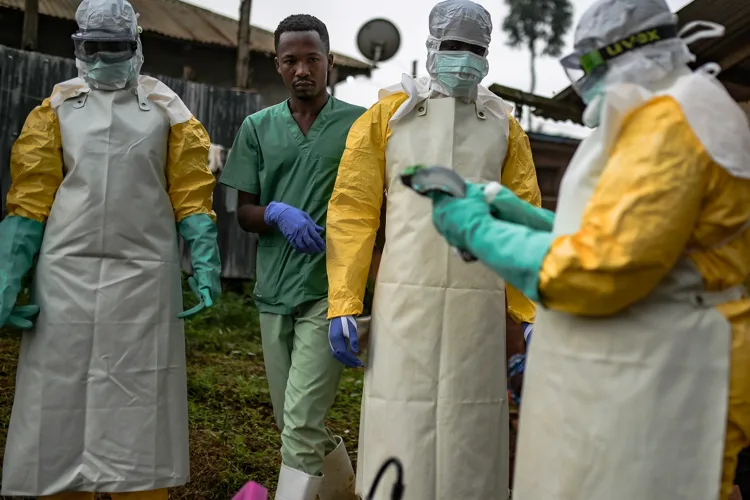
As Ebola spreads through eastern DRC, rebel violence, mass displacement and deep mistrust are making a deadly outbreak more difficult to contain
Words and photographs by Olivia Acland
Our car, sandwiched between two army trucks, rattles past a cluster of roofless, charred houses recently torched in rebel attacks. Moments later, the tarmac melts into mud and the road starts to twist through ever-thickening jungle.
I’m embedded with the Congolese army, hurtling into the forests in which rebels from the Allied Democratic Forces (ADF) hide. The group, Congo’s deadliest, has slaughtered more than 5,000 people in the past decade and claims an affiliation with Islamic State.
Its fighters storm villages at night, hacking people to death with machetes, or attack them early in the morning as they work in their fields.
Violence in the region has intensified just as international aid budgets have contracted. Conditions in camps – where a quarter of a million displaced people are crowded into tarpaulin shelters – are worse than ever. Food and clean water are scarce; medicine is almost non-existent.
But things are about to get worse. Unbeknown to us, another killer is already creeping through the region, infecting people in camps and conflict-battered villages: Ebola. While an official outbreak would not be declared until 15 May 2026, experts believe the virus has been spreading since January.
As Ebola starts to tighten its grip on the region, so too do the rebels. Our convoy stops at the edge of the mud track and soldiers spring out of the trucks. Some carry rocket launchers; others have ammunition magazines draped around their necks.
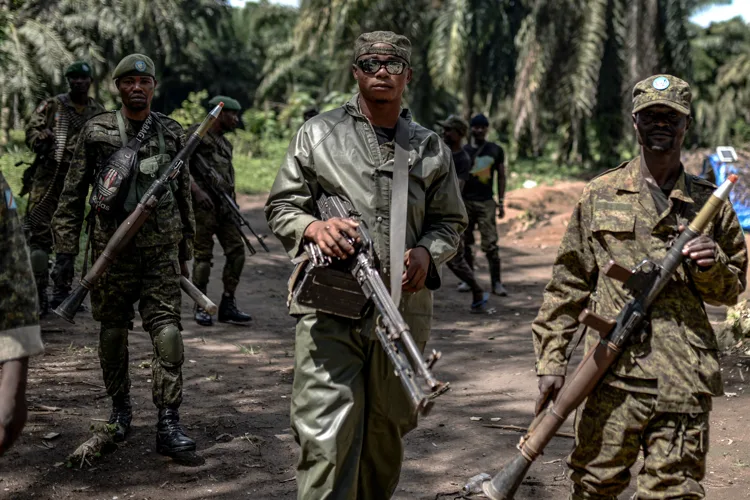
The rebels are nearby, they tell me, but the army is pushing them north.
The soldiers are proud to have ‘secured’ this stretch of road, making it safe for traders to pass. When a motorbike laden with bananas appears on the mud track, they urge me to take a photo – proof, they say, that civilians are returning to the area.
But just a week later, I learn that ADF fighters have stormed villages along this same road in the middle of the night, killing 26 civilians in their homes and as they tried to flee. The soldiers’ claim that the route was safe feels tragically premature.
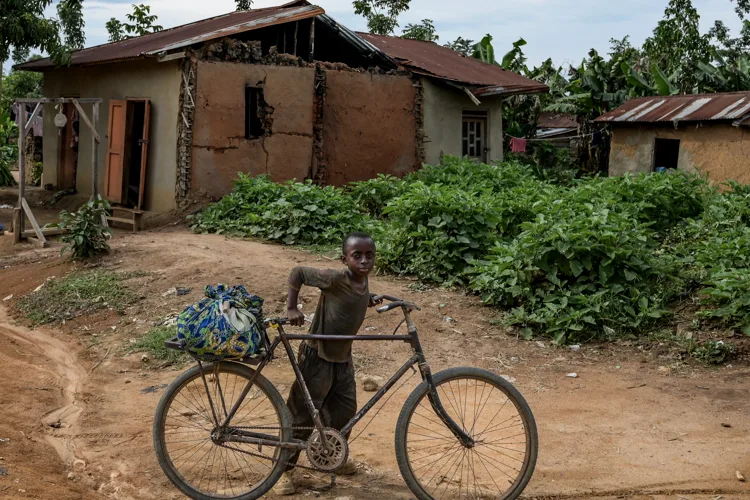
The spread of Ebola is inextricably linked to the insecurity, Seros Muyisa, a Congolese colleague, tells me. ‘People do not cultivate their fields because of the ADF attacks,’ he says. Forced to find work elsewhere, many travel from North Kivu province to the gold mines of neighbouring Ituri, where the outbreak began.
Some have returned, carrying the virus with them. ‘People are traumatised by the relentless ADF attacks. It’s not easy for them to adhere to the Ebola response,’ Muyisa says.
This region has been ravaged by conflict, on and off, for 30 years. The population feels abandoned by a government that has repeatedly failed to stop the massacres. Police routinely extract bribes, while government soldiers have even been known to loot alongside rebels.
So when the health ministry announced that Ebola had reached eastern Congo, the news was greeted with scepticism. Rumours spread. Some claimed the outbreak had been invented so that officials could make money from foreign donors.
Others said doctors were killing patients in treatment centres by injecting them with poison.
‘People think Ebola is another way of exterminating the people of Beni and Butembo,’ Muyisa says, referring to two of the largest cities in the province. Such rumours can prove deadly. To control an outbreak, sick people need to report to treatment centres and their contacts must be identified and monitored.
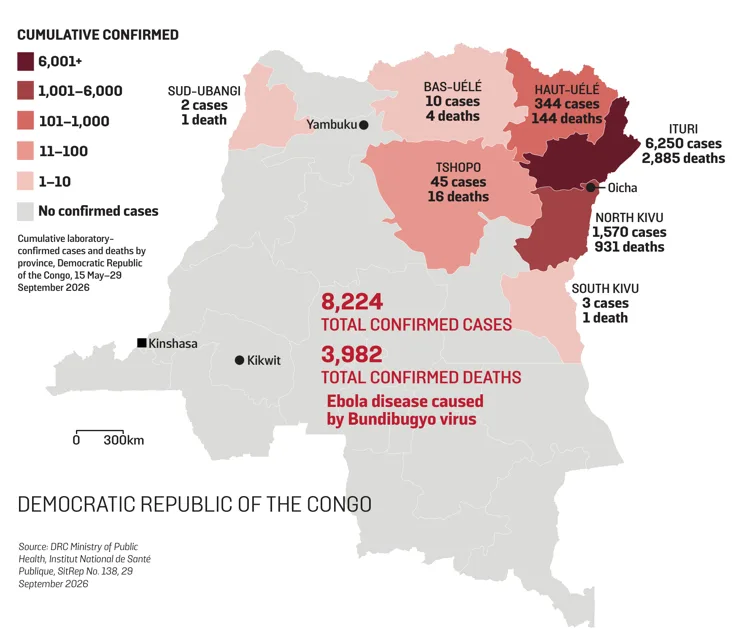
Without that cooperation, it becomes extraordinarily difficult to contain Ebola. By the time I returned to eastern Congo this summer to report on the Ebola outbreak it had become the fast-est-growing outbreak on record, killing thousands of people, infecting many more and spreading to seven provinces.
The true figures are probably even higher. Experts whisper that weak contact tracing means health authorities may not have a real handle on how bad things are. ‘Take the official number of cases and times it by three or four,’ a doctor staying at my hotel tells me quietly one morning.
Ebola, which can cause internal bleeding and organ failure, spreads through direct contact with the bodily fluids of an infected person, usually when they enter the body through broken skin or the eyes, nose or mouth.
The great-est risks fall on health workers who come into close contact with patients at their sickest – and with their vomit, diarrhoea and blood. Their best defence is personal protective equipment (PPE): gowns, gloves, masks and goggles.
On my trip, the threat feels immediate. I obsessively coat my hands in sanitiser and recoil whenever anyone stands too close. I douse my hotel bathroom in chlorine.
‘We do not have enough PPE,’ Dr Mukuko Kambale, head of the Katwa health zone, tells me one evening. The area has registered more than 100 cases in the past three weeks. Because foreign aid budgets – especially in the USA – have been slashed, there isn’t enough money for the response.
Health workers are dangerously exposed. ‘Partners are not coming with enough finances,’ Dr Kambale says.
With a hint of desperation, he explains that there are also not enough beds in Katwa’s treatment centres for all of the sick. He doesn’t know where to put them. Even when people cooperate with the response, it seems, the response can’t keep up.
Amid all the struggles, there are, as ever in Congo, glimmers of joy. At Mongbwalu General Hospital in Ituri, in the disease’s former epicentre, I watch three nurses in turquoise scrubs dance down a corridor. They shake their hips and stomp from side to side, clapping and singing as they go.
One jingles a small silver bell. They are celebrating an Ebola patient who has recovered and is about to be discharged. Recovery, it seems, is a relative term. The survivor sits slumped in a chair, sweat beading on his skin, his eyes fixed on the floor.
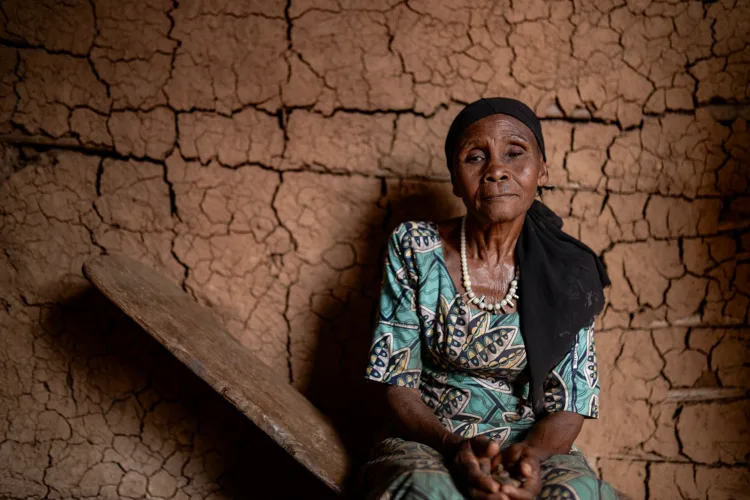
For many people who’ve endured years of violence in this part of Congo, Ebola ranks low among their daily fears. Eighteen-year-old Claudine Kaseraka (not her real name, pictured above) is more worried about finding enough money to feed her two-year-old daughter and about the stigma that still haunts her.
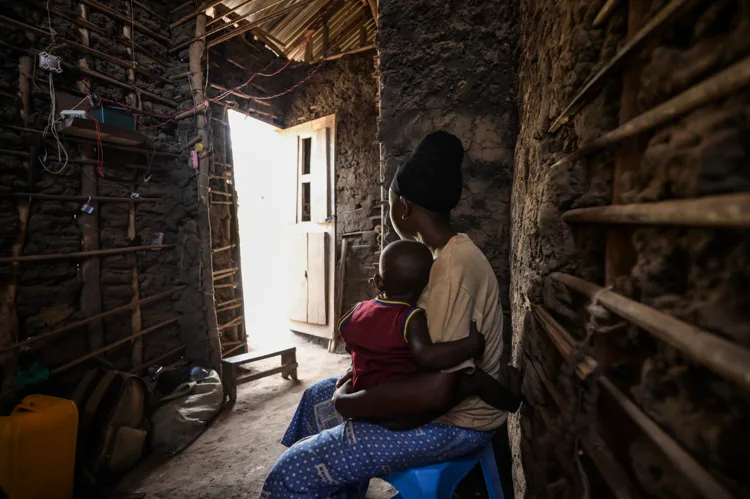
‘The community here are always pointing their fingers at me,’ she says quietly, sitting on a stool outside her tin-roofed home in Beni. ‘They say that since I was in the bush with those people, my spirit has changed and that I could kill now too.’
Kaseraka was just 12 when ADF rebels abducted her and dragged her into the forest. She spent three years in a camp there, forced to have sex with a fighter in his 30s. When she escaped, she was six months pregnant. Her daughter, a wide-eyed toddler with small gold hoops in her ears, now totters around outside the house, playing with a neighbour’s child. Kaseraka is frightened that the rebels will return. Ebola, by contrast, feels remote. ‘I hear Ebola kills,’ she says with a shrug.
‘I’m not interested.’ Her response is common. In communities already battered by conflict and displacement, Ebola feels like a new, sometimes distant problem.
Foreign NGO workers have begun to arrive in Beni to help contain the disease, even though the response is still underfunded. But their presence has fuelled more rumours – some say they are bringing Ebola with them. After all, if they care about the people of Beni, why weren’t they around when the massacres happened?
As Muyisa puts it: ‘People don’t understand why they are mobilising for Ebola but not to eradicate the ADF.’
Ebola: five decades of outbreaks
Ebola is a severe, often fatal disease caused by a group of related viruses. Outbreaks have principally affected sub-Saharan Africa, with fatality rates ranging from 25 per cent to as high as 90 per cent.
1976: A new disease emerges
The first recognised outbreaks occurred almost simultaneously in what are now South Sudan and the Democratic Republic of the Congo (DRC). The latter centred on Yambuku, where infections spread partly through the reuse of contaminated needles. The virus was named after the nearby Ebola River.
1995: Ebola returns to the DRC
An outbreak in and around Kikwit infected 315 people and killed 254. More outbreaks followed, making the DRC the country most frequently affected by the disease. Scientists believe that fruit bats are its likely natural hosts, although this has never been conclusively established.
2014–16: West Africa’s epidemic
Beginning in Guinea before spreading through Liberia and Sierra Leone, the largest recorded Ebola epidemic infected more than 28,600 people and killed 11,325. Its unprecedented scale accelerated work on vaccines, treatments and rapid diagnostic tests.
2018–20: Conflict complicates containment
The DRC’s tenth outbreak – centred on North Kivu and Ituri – was then the second largest recorded. It caused 3,481 cases and 2,299 deaths. Armed conflict, attacks on health workers, population movements and distrust of the authorities repeatedly disrupted efforts to contain it.
A medical turning point
Vaccines and antibody treatments developed against Zaire ebolavirus have substantially improved the chances of controlling outbreaks and surviving infection. But success still depends on finding cases quickly, tracing contacts, providing safe treatment and gaining communities’ trust.
2026: A different challenge
The present DRC outbreak is caused by Bundibugyo virus. Existing vaccines and approved antibody treatments were designed for Zaire ebolavirus, making the response more uncertain. By 29 September, the outbreak had infected 8,224 people and killed 3,982across 7 provinces.
Who are the ADF?
The Allied Democratic Forces (ADF) began as a Ugandan rebel movement in the mid-1990s. Formed from several factions opposed to President Yoweri Museveni, it initially aimed to overthrow Uganda’s government. After military setbacks, its fighters established bases across the border in the densely forested mountains of eastern Democratic Republic of the Congo.
Under its current leader, Musa Baluku, the ADF has adopted a more explicitly Islamist identity. It pledged allegiance to Islamic State, which publicly recognised it as an affiliate in 2019 and presents its attacks as the work of its Islamic State Central Africa Province.
UN investigators have documented financial and operational links between the ADF and Islamic State, although the group also remains rooted in local networks and grievances.
Rather than seeking to administer large areas, the ADF generally operates from remote forest camps and relies on raids, ambushes and bombings. Its fighters have massacred civilians, abducted children and adults, looted settlements and burned homes across North Kivu and Ituri, while also carrying out attacks inside Uganda.
Congolese and Ugandan forces have conducted joint operations against the group since 2021. These have destroyed camps and placed its fighters under pressure but have not ended the violence.
Instead, ADF units have dispersed into more remote areas, where insecurity, weak state authority and difficult terrain allow them to regroup – and severely complicate efforts to deliver healthcare and contain Ebola.